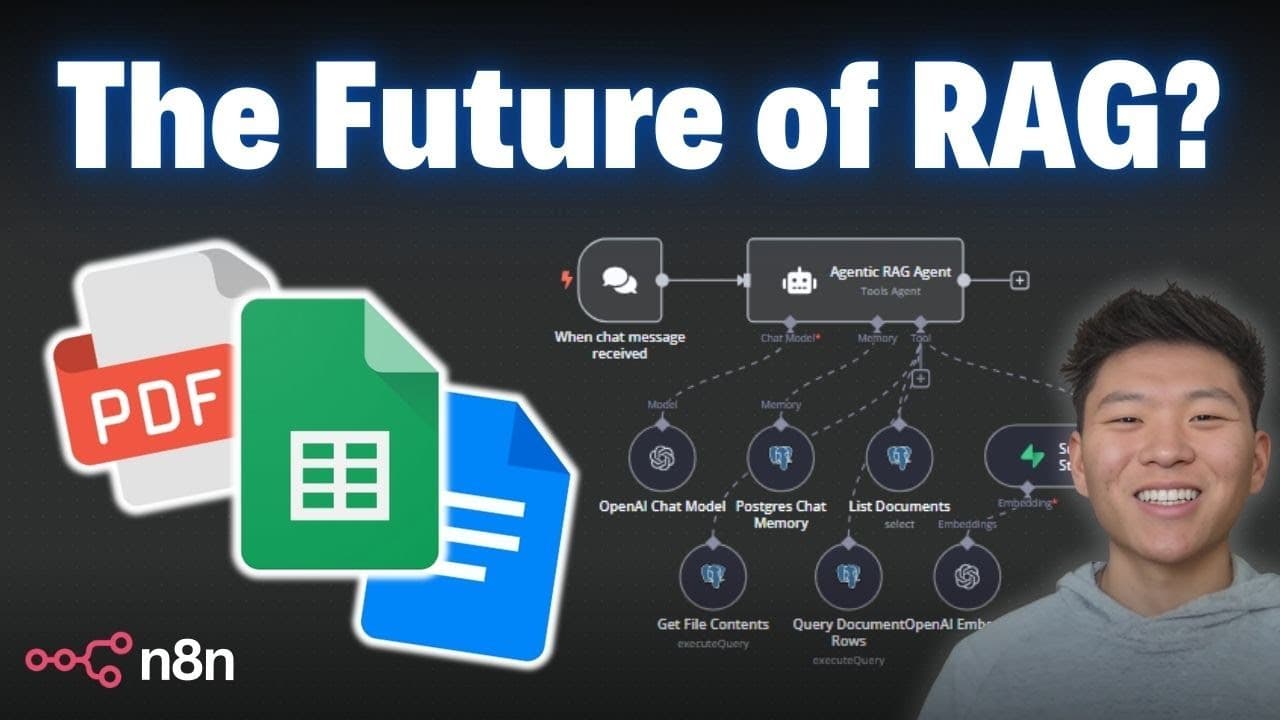
How does Agentic RAG improve data querying?
TL;DR
Agentic RAG adds reasoning before querying to select the right data sources and queries, yielding more relevant results. It can consider multiple data schemas, including vector databases, relational data, and file contents, to craft smarter queries that pull in context and improve accuracy of the final answer.
Transcript
today I want to talk about a gentic rag the conversation around rag seems to be shifting so fast with you know different models releasing larger context Windows where does the future of rag really lie we've heard KAG we've heard graph rag we've also heard atic rag so just wanted to come in here and break it down and make sure you stick around to th... Read More
Key Insights
- Agentic RAG adds a reasoning step before querying to determine the most effective data sources and query types.
- The method expands beyond vector databases by incorporating relational data, file contents, and document schemas into the query process.
- Reasoning helps avoid missing context that would occur when only pulling back chunks of a document from a vector store.
- Traditional RAG relies on nearest chunks which can miss wide document context and lead to incomplete answers.
- Agentic RAG can perform SQL queries on tabular data when appropriate, enabling more accurate numerical analysis.
- The approach can choose to query different data sources depending on the question, not just text chunks.
- Embedding the query with the same model ensures compatibility with the vector space and improves retrieval coherence.
- Visualization and templates, like Cole Medins, reduce the friction of implementing an agentic RAG pipeline.
- More videos from this channel:
- More from this channel: Nate Herk | AI Automation
Install to Summarize YouTube Videos and Get Transcripts
Explore YouTube Video Summarizer or Get YouTube Transcript Extractor
Questions & Answers
Q: What is RAG and why is it used in AI systems?
RAG stands for retrieval augmented generation and it is used to improve long form answers by retrieving contextual information from external sources before generating a response. It allows an AI to leverage external data rather than relying solely on its internal parameters, which increases accuracy and relevance. The core idea is to augment generated text with retrieved context.
Q: How does a traditional vector DB RAG work in simple terms?
In a vector DB RAG system, a user query is embedded into a vector and the system searches for the nearest vectors in the database. Those nearest chunks are retrieved and fed into a language model along with the query to produce an answer. It emphasizes local context but may miss broader document context.
Q: What makes Agentic RAG different from traditional RAG?
Agentic RAG introduces reasoning before querying, allowing the agent to consider multiple data sources, schemas, and data types before forming a query. It can decide to issue SQL queries for tabular data or use different embeddings strategies, ensuring that the retrieved information is both relevant and comprehensive.
Q: Why is reasoning before querying important in Agentic RAG?
Reasoning before querying prevents the system from blindly pulling chunks and risking partial or incorrect conclusions. By evaluating data sources and schemas first, the agent selects the most suitable query type and data source, which yields more accurate answers especially for complex questions that span multiple data formats.
Q: How can tabular data be handled in Agentic RAG?
Tabular data can be addressed with SQL queries or other structured data queries rather than relying solely on vector embeddings. The agent can inspect the spreadsheet schema, decide the relevant table and columns, and perform calculations or aggregations to produce precise results like total sales or average order value.
Q: What role do data schemas play in Agentic RAG?
Data schemas guide the agent to choose the right data source and query method. By understanding the structure, such as whether information exists in documents, spreadsheets, or relational databases, the agent can craft appropriate queries, leverage correct joins, and retrieve context that aligns with the user question.
Q: How does the Cole Medin template help implement Agentic RAG?
The Cole Medin template provides three nodes that simplify setting up an Agentic RAG pipeline. It helps route queries to the correct data sources, coordinate between embeddings and data retrieval, and structure the flow so the agent can reason about which data to query before generating an answer.
Q: What is the practical benefit of Agentic RAG for business data?
Agentic RAG improves accuracy when analyzing business data by allowing the system to query both text and structured data sources. It enables more reliable summaries of meetings, more correct calculations on weekly sales, and better integration of diverse data types into coherent insights, reducing the risk of misses from chunk level reasoning.
Summary & Key Takeaways
-
Agentic RAG reframes retrieval by enabling the agent to reason about where to query next and which data sources to consult, instead of directly issuing a single vector search. This leads to more informed, context-rich outputs. The approach emphasizes source awareness and multi-database querying.
-
The video contrasts traditional vector based RAG with agentic RAG by highlighting how the latter uses schemas, file content, and tabular data to decide the best querying strategy before fetching results.
-
A practical example is provided using a template for Cole Medins RAG, showing three nodes that simplify building an agentic workflow and demonstrate how to route queries to the appropriate data sources for richer summaries and insights.
Read in Other Languages (beta)
Share This Summary 📚
Summarize YouTube Videos and Get Video Transcripts with 1-Click
Try YouTube Summary with ChatGPT & Claude or YouTube Transcript Generator
Explore More Summaries from Nate Herk | AI Automation 📚

Summarize YouTube Videos and Get Video Transcripts with 1-Click
Try YouTube Summary with ChatGPT & Claude or YouTube Transcript Generator