How to Fix AI Agent Prompts for Better Performance
TL;DR
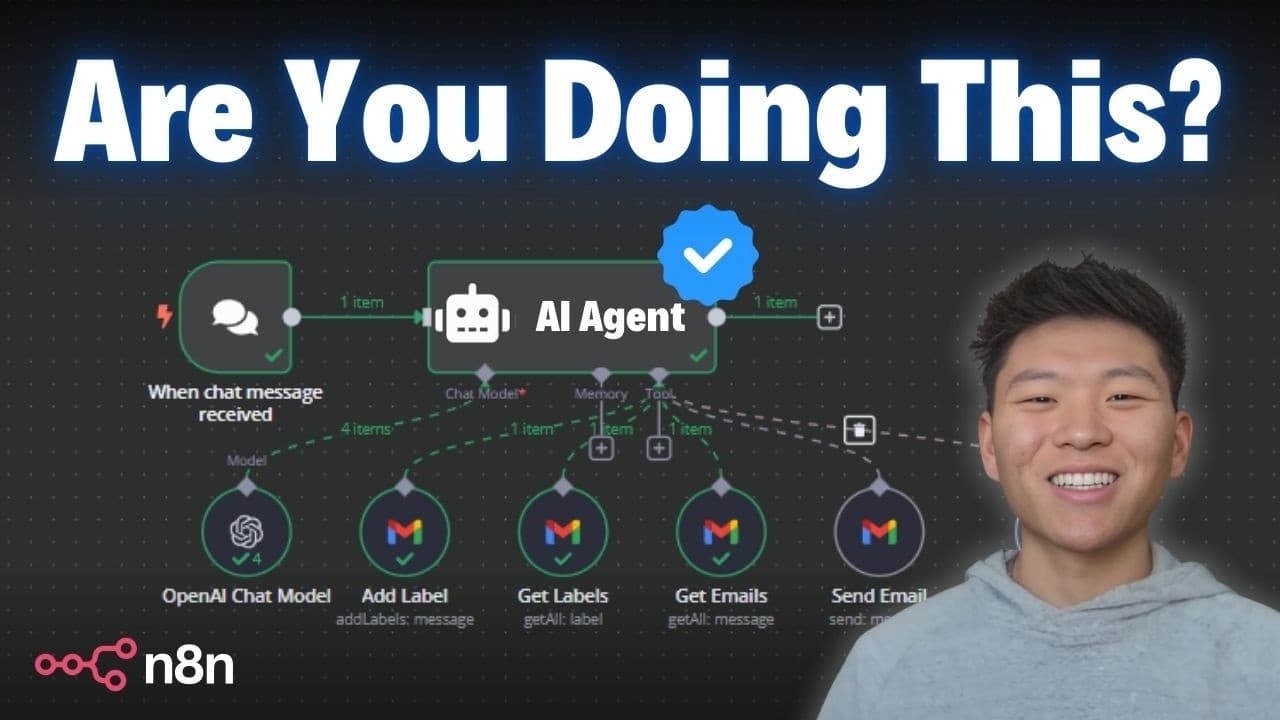
To improve AI agent performance, focus on crafting effective system prompts. Start with minimal instructions, test iteratively, and add complexity only as needed. This reactive prompting method helps in debugging and enhances agent reliability. Clear, concise prompts prevent misinterpretation and ensure agents consistently perform desired tasks.
Transcript
building AI agents and hooking up different tools is fun and all but the quality and consistency of the performance of your agents directly ties back to the quality of the system prompt that you put in there if you guys don't know me my name is Nate I've been building agents for a while now and I also run a school Community that's all about buildin... Read More
Key Insights
- AI agent performance is tied to the quality of system prompts.
- Reactive prompting involves starting with minimal instructions and iteratively adding complexity.
- Proactive prompting can lead to errors due to unforeseen edge cases.
- Clear, concise prompts prevent misinterpretation and reduce costs.
- Debugging is easier with reactive prompting as changes are made step-by-step.
- Examples in prompts should address common failure scenarios.
- Use markdown for prompt clarity and organization.
- Structured prompts include background, tools, instructions, examples, and final notes.
Install to Summarize YouTube Videos and Get Transcripts
Explore YouTube Video Summarizer or Get YouTube Transcript Extractor
Questions & Answers
Q: How to improve AI agent performance?
Improving AI agent performance involves crafting effective system prompts. Start with minimal instructions and iteratively add complexity through reactive prompting. This approach helps in identifying and fixing errors step-by-step, ensuring agents perform tasks consistently and accurately. Clear, concise prompts prevent misinterpretation and enhance reliability.
Q: What is reactive prompting?
Reactive prompting is the process of starting with minimal instructions for AI agents and iteratively adding complexity based on testing outcomes. This method allows for easier debugging and ensures that prompts are clear and concise, reducing the likelihood of misinterpretation and improving agent performance.
Q: Why is proactive prompting problematic?
Proactive prompting can be problematic because it involves creating detailed prompts upfront without knowing all possible edge cases. This can lead to errors and difficulties in debugging, as it becomes challenging to identify which part of the prompt is causing issues. Reactive prompting addresses these challenges by allowing iterative adjustments.
Q: What are the components of an effective AI prompt?
An effective AI prompt includes a structured approach with components such as background, tools, instructions, examples, and final notes. Each section provides clarity and guidance, ensuring that the AI agent understands its role, available tools, and expected actions, leading to consistent and accurate task performance.
Q: How does markdown help in AI prompting?
Markdown helps in AI prompting by providing clarity and organization to the prompt structure. It allows for the use of headers, lists, and formatting that make the prompt more readable and understandable for both developers and AI agents, ensuring that instructions are clear and easy to follow.
Q: What is the role of examples in AI prompts?
Examples in AI prompts play a crucial role in demonstrating expected inputs, actions, and outputs. They help the AI agent understand how to handle specific scenarios, particularly those where it previously failed. Including examples improves the accuracy and consistency of the agent's performance by providing clear guidance.
Q: How to handle errors in AI agent prompting?
Handling errors in AI agent prompting involves identifying issues through testing and making iterative adjustments to the prompt. Reactive prompting allows developers to address errors step-by-step, adding specific instructions or examples to guide the agent's behavior and improve performance without overwhelming complexity.
Q: Why is clear and concise prompting important?
Clear and concise prompting is important because it prevents misinterpretation and reduces the likelihood of errors. By providing straightforward instructions, developers ensure that AI agents understand their tasks and execute them consistently, improving reliability and reducing the costs associated with complex or verbose prompts.
Summary & Key Takeaways
-
Effective AI agent prompting starts with minimal instructions and iteratively adds complexity. This reactive approach aids in debugging and ensures consistent performance by addressing errors as they arise. Clear, concise prompts prevent misinterpretation, improving reliability and reducing costs.
-
Reactive prompting contrasts with proactive prompting, which can lead to errors due to unforeseen edge cases. By starting with minimal instructions and testing iteratively, developers can identify and fix issues step-by-step, improving agent reliability.
-
Structured prompts include background, tools, instructions, examples, and final notes. Using markdown for clarity and organization helps in crafting effective prompts that guide AI agents to perform desired tasks consistently and accurately.
Read in Other Languages (beta)
Share This Summary 📚
Summarize YouTube Videos and Get Video Transcripts with 1-Click
Try YouTube Summary with ChatGPT & Claude or YouTube Transcript Generator
Explore More Summaries from Nate Herk | AI Automation 📚




Summarize YouTube Videos and Get Video Transcripts with 1-Click
Try YouTube Summary with ChatGPT & Claude or YouTube Transcript Generator