How do brains build cognitive maps for flexible behavior
TL;DR
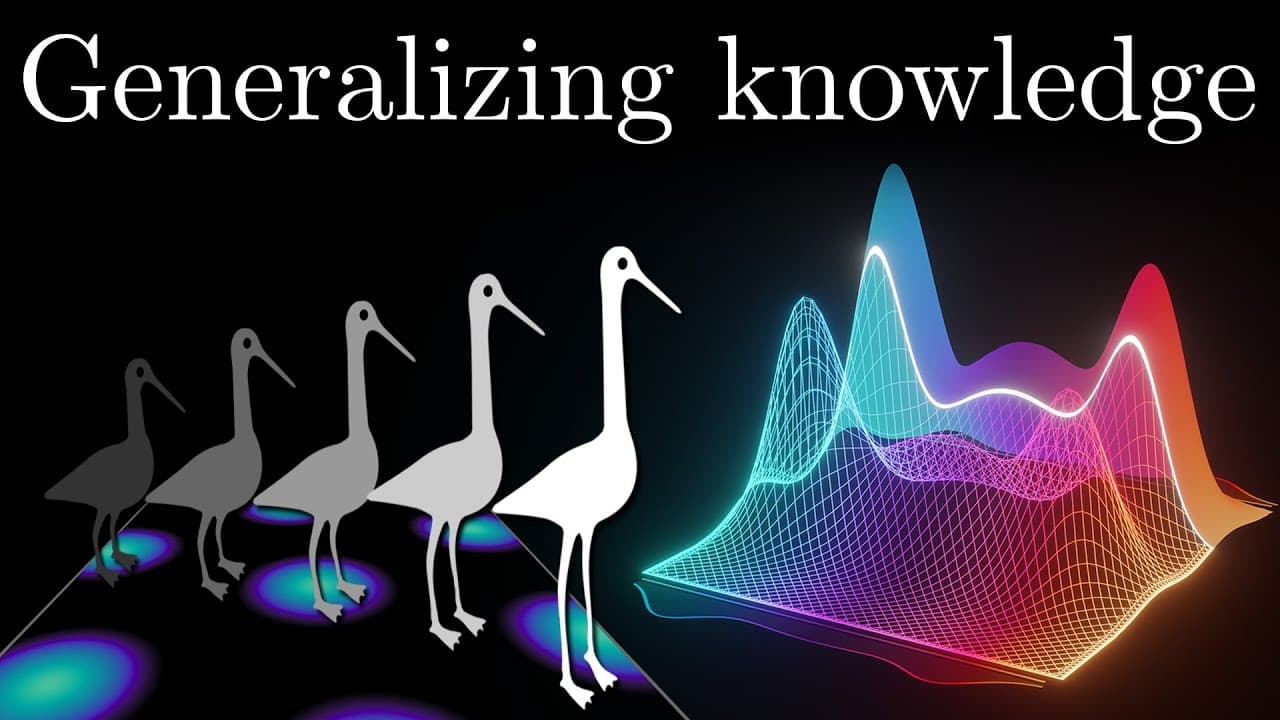
The brain creates flexible behavior by building cognitive maps that generalize across contexts. The hippocampal formation and entorhinal cortex form a relational graph with place cells, grid cells and other specialized neurons that encode location, boundaries, objects and directions. This framework supports both spatial and non spatial tasks and underlies generalization and learning.
Transcript
Perhaps one of the most fascinating abilities of the mammalian brain is that it can generate flexible behavior that is generalized across contexts. For example, let's imagine you spent a few weeks learning how to cook just the perfect lasagna. You learn that skill in your own kitchen, where you are familiar with the location of all the utensils, in... Read More
Key Insights
- Cognitive maps are internal models that enable flexible behavior across contexts.
- The hippocampus and entorhinal cortex form a neural system with place cells and grid cells that encode location and spatial relationships.
- Grid cells provide a general coordinate system for vector computations and distance estimation.
- Place cells encode location in a context dependent way, varying with surroundings.
- Object vector cells in entorhinal cortex respond to distance and direction from objects.
- Boundary cells and head direction cells contribute to spatial orientation and framing.
- Graph theory provides a unifying framework to model physical and abstract spaces as connected relations.
- Latent spaces describe underlying, unobservable representations that guide decisions in tasks like alternation in a T maze.
Install to Summarize YouTube Videos and Get Transcripts
Explore YouTube Video Summarizer or Get YouTube Transcript Extractor
Questions & Answers
Q: A real search query question about the video (e.g. 'How to...', 'What is...', 'Why does...', 'When should...'). Question 1
How do cognitive maps enable flexible behavior across different environments and tasks? The brain builds an internal relational map by combining hippocampal place cells and entorhinal grid cells, which code for specific locations and general coordinates respectively. This allows path planning and generalization from one context to another, such as cooking in a new kitchen or navigating abstract spaces.
Q: What is the role of place cells in cognitive mapping?
Place cells fire when an animal occupies a specific location, providing a location specific code that is context dependent. They contribute to forming a map of the current environment by anchoring the animal’s position to learned environmental features, and they can vary with different surroundings to support context aware navigation.
Q: How do grid cells differ from place cells in supporting navigation?
Grid cells fire in a hexagonal, regular pattern across an environment, creating a stable coordinate system. They provide vector like information about position within a space, which supports distance estimation and path integration, helping to generalize from one environment to another by supplying a consistent metric framework.
Q: What is a latent space and how does it relate to navigation and decision making?
A latent space is an internal, unobservable representation that organizes knowledge beyond direct sensory input. In navigation tasks, latent space guides choices by encoding relationships and proximities that influence decisions, even when sensory cues change, enabling generalization across tasks like a T shaped maze or abstract spaces.
Q: How does graph theory help unify spatial and non spatial cognition?
Graph theory models cognition as a set of vertices connected by edges representing relationships. This abstraction allows the same computational tools to apply to physical mazes, social trees, or abstract spaces, enabling the brain to perform path finding, root finding, and generalization on any connected structure.
Q: What is the Tolman contribution to cognitive maps and why is it important?
Edward Tolman proposed that animals form a cognitive map of the environment, going beyond simple stimulus response. This insight introduced the idea that internal representations can guide flexible behavior in new situations, which stimulated later neuroscientific investigation into hippocampal and entorhinal mechanisms.
Q: What role do boundary and head direction cells play in spatial cognition?
Boundary cells encode the presence of environmental boundaries, providing frame references for location. Head direction cells code for the animal’s facing direction. Together they stabilize spatial orientation and help update the internal map as the animal moves, supporting consistent navigation and context aware behavior.
Q: How might the brain reuse the same machinery for non spatial domains?
Because the hippocampal entorhinal system builds relational graphs and supports path integration, the same coding principles extend to non spatial spaces such as sounds or conceptual spaces. By relabeling relationships, the brain can generalize learned structures to new modalities and tasks without starting from scratch.
Summary & Key Takeaways
-
The lecture explains that cognitive maps are multi dimensional and multi modal representations built from neuronal activity in the hippocampus and entorhinal cortex. It emphasizes the shift from spatial to abstract domains and introduces graph theory as the unifying formalism.
-
It discusses path integration and the idea that the brain uses a coordinate system to track location and relationships, enabling generalization across rooms, mazes and even non spatial spaces like sounds or abstract spaces.
-
It outlines the Tolman experiments and notes how grid and place cells create a map like structure, paving the way for understanding how cognitive maps support flexible behavior and potential artificial hippocampus research.
Read in Other Languages (beta)
Share This Summary 📚
Summarize YouTube Videos and Get Video Transcripts with 1-Click
Try YouTube Summary with ChatGPT & Claude or YouTube Transcript Generator
Explore More Summaries from Artem Kirsanov 📚
Summarize YouTube Videos and Get Video Transcripts with 1-Click
Try YouTube Summary with ChatGPT & Claude or YouTube Transcript Generator