What Are Neural Manifolds and How Do They Decode the Brain?
TL;DR
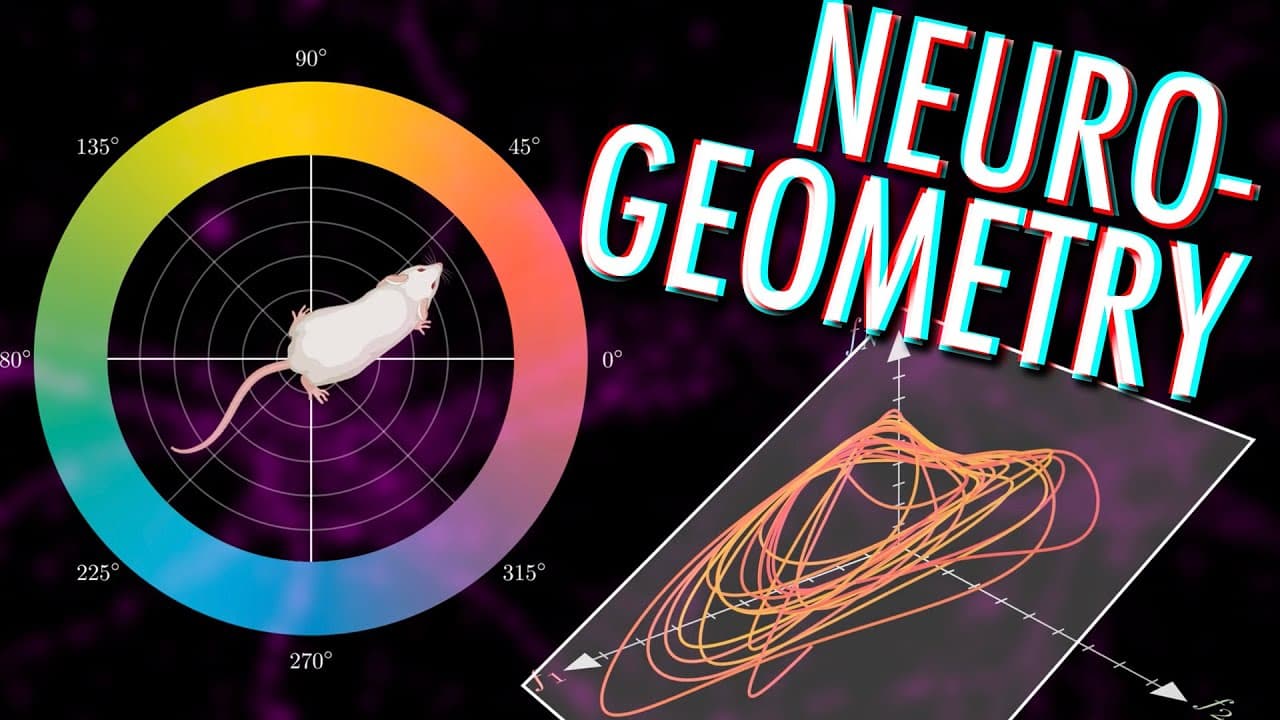
Neural manifolds are low-dimensional shapes that the collective activity of a neural population traces out inside a much higher-dimensional space, one axis per recorded neuron. Because neurons are interconnected and cannot fire independently, their joint activity stays confined to this subspace, and studying its topological properties (dimension and genus) reveals what variables a circuit encodes.
Transcript
It is the Holy Grail of neuroscience to understand how the information is being represented inside the brain encoded in patterns of activity of nerve cells. On this quest, we make use of tools offered by biology, physics, chemistry, computer science and of course, math. Today, I'm super excited to tell you about the concept that I think is just unb... Read More
Key Insights
- Neurons are electrically excitable cells that fire an action potential, or spike, in response to a stimulus, and these spikes are considered the fundamental units of communication in the brain, carrying all encoded information through collective population dynamics.
- Information in the brain is encoded in which neurons fire, their temporal relationships, and their firing rate (spikes per unit time), rather than in any single cell acting alone.
- Multi-electrode arrays record up to a few hundred neurons simultaneously, producing a spike train, a major advance over older single-electrode methods that could only eavesdrop on a handful of neurons at a time.
- The instantaneous activity of n recorded neurons forms an n-dimensional vector, so the population's state at each moment is a single point in n-dimensional neural activity space that moves as the animal performs a task.
- Neural trajectories are constrained: no neuron can fire faster than about 500 spikes per second due to cell membrane properties, and because neurons influence each other, their firing rates cannot be independent, confining activity to a low-dimensional subspace.
- Algebraic topology, described as geometry on a rubber sheet, treats shapes as equivalent (homeomorphic) if one can be continuously deformed into another without punching holes or gluing, so a circle and a square are the same but a sphere and a torus are not.
- A manifold is a shape in Euclidean space that locally resembles a lower-dimensional Euclidean space, the way Earth's curved surface feels flat to tiny inhabitants; a pinched torus stops being a manifold because the pinch point no longer looks locally flat.
- Two properties stay invariant under continuous deformation and matter for analyzing neural data: the manifold's dimension and its genus (number of holes), and a neural state is described by both intrinsic and embedding dimensions.
Install to Summarize YouTube Videos and Get Transcripts
Explore YouTube Video Summarizer or Get YouTube Transcript Extractor
Questions & Answers
Q: What is a neural manifold?
A neural manifold is the low-dimensional shape that the collective activity of a population of neurons traces out inside a high-dimensional space. Each recorded neuron contributes one axis, so the network's instantaneous activity is a point in n-dimensional space. Because neurons are interconnected and cannot fire independently, and because of physiological limits, this point's trajectory stays confined to a much lower-dimensional structure, or manifold, rather than filling the entire space. The properties of this shape can reveal how the circuit represents information.
Q: How do scientists turn neural activity into points in high-dimensional space?
Scientists record spikes from many neurons at once, producing a spike train where each bar marks a neuron firing. They partition time into short fixed-length bins and count how many times each neuron spikes in each bin to compute firing rate, usually smoothing the data for continuous variation. With n neurons, the activity at each moment is described by n numbers, forming an n-dimensional vector that corresponds to a single point in n-dimensional neural activity space.
Q: Why is neural activity confined to a low-dimensional subspace?
Although the ambient neural activity space is very high-dimensional, several constraints limit where the trajectory can go. Biological physiology caps firing at around 500 spikes per second because of cell membrane properties. More importantly, the recorded neurons belong to the same network, are intertwined, and directly influence each other, so their firing rates cannot be independent. As a result, the activity trajectory is confined to a subspace whose shape depends on the network's connectivity, connection strengths, and the task being performed.
Q: What is a spike and why does it matter in neuroscience?
A spike, also called an action potential, is an electrical impulse a neuron generates in response to an incoming stimulus, which then spreads along the neuron and is transmitted to other neurons. Spikes are described as the fundamental units of communication in the brain. All information the brain receives, from a sunset to a smell to a mathematical idea, is thought to be encoded in the collective spiking dynamics of neuron populations: which neurons fire, their timing relationships, and their firing frequency.
Q: What does topology have to do with the brain?
Topology, described as geometry on a rubber sheet, studies shapes that can be twisted, bent, and stretched but not torn or glued. It provides tools to describe the clouds of points obtained from active neurons. Because neural activity forms a manifold in high-dimensional space, topological concepts let scientists characterize that shape's invariant properties, such as dimension and genus. Studying these properties is assumed to give insight into the mechanisms behind a particular circuit and the nature of the variables it encodes.
Q: What makes a shape a manifold?
A manifold is a shape in Euclidean space that locally resembles a Euclidean space of a lower dimension. For intuition, Earth's surface is a shape in three dimensions, but because we are tiny compared to it, our surroundings feel like a flat plane; zooming in far enough makes it indistinguishable from a plane. A torus qualifies because everywhere it locally looks like a flat plane. A pinched torus does not, because around the pinch point it no longer looks locally flat no matter how close you zoom in.
Q: What is the difference between homeomorphic shapes and non-homeomorphic ones?
Two shapes are homeomorphic if one can be continuously or smoothly deformed into another without punching holes, tearing, or gluing parts together. Under this rule a circle and a square are practically the same to a topologist because one bends into the other. However, a sphere is not homeomorphic to a torus, because turning one into the other requires poking a hole or stitching parts together, which topological deformation forbids. This distinction underlies invariant properties used to classify neural manifolds.
Q: What invariant properties of a manifold matter for analyzing neural data?
Two invariant properties that stay constant under continuous deformation are emphasized as important: the manifold's dimension and its genus, which is the number of holes. A single neural state is characterized by both intrinsic and embedding dimensions, since a convoluted line can sit inside three-dimensional space while itself being one-dimensional. Analyzing these invariants of the neural manifold lets researchers infer the mechanisms behind a circuit and understand what variables the neural population is encoding.
Summary & Key Takeaways
-
The video sets out to explain how information is represented inside the brain by extracting data from active neurons and mapping it into high-dimensional space. Neurons communicate through spikes, and recording many at once with multi-electrode arrays lets scientists parameterize a circuit's collective activity as points in space.
-
With n recorded neurons, each moment of network activity becomes an n-dimensional vector, one point in neural activity space. Physiological limits and interdependence between neurons mean the moving trajectory stays confined to a low-dimensional structure whose shape reflects the network's connectivity and the encoded variables.
-
To study these shapes, the video turns to algebraic topology and manifolds, objects that locally resemble flat Euclidean space. Invariant properties like dimension and genus, illustrated through spheres and tori, provide the tools to characterize neural manifolds and gain insight into how brain circuits represent information.
Read in Other Languages (beta)
Share This Summary 📚
Summarize YouTube Videos and Get Video Transcripts with 1-Click
Try YouTube Summary with ChatGPT & Claude or YouTube Transcript Generator
Explore More Summaries from Artem Kirsanov 📚





Summarize YouTube Videos and Get Video Transcripts with 1-Click
Try YouTube Summary with ChatGPT & Claude or YouTube Transcript Generator