How Does the Hodgkin-Huxley Model Explain Neurons?
TL;DR
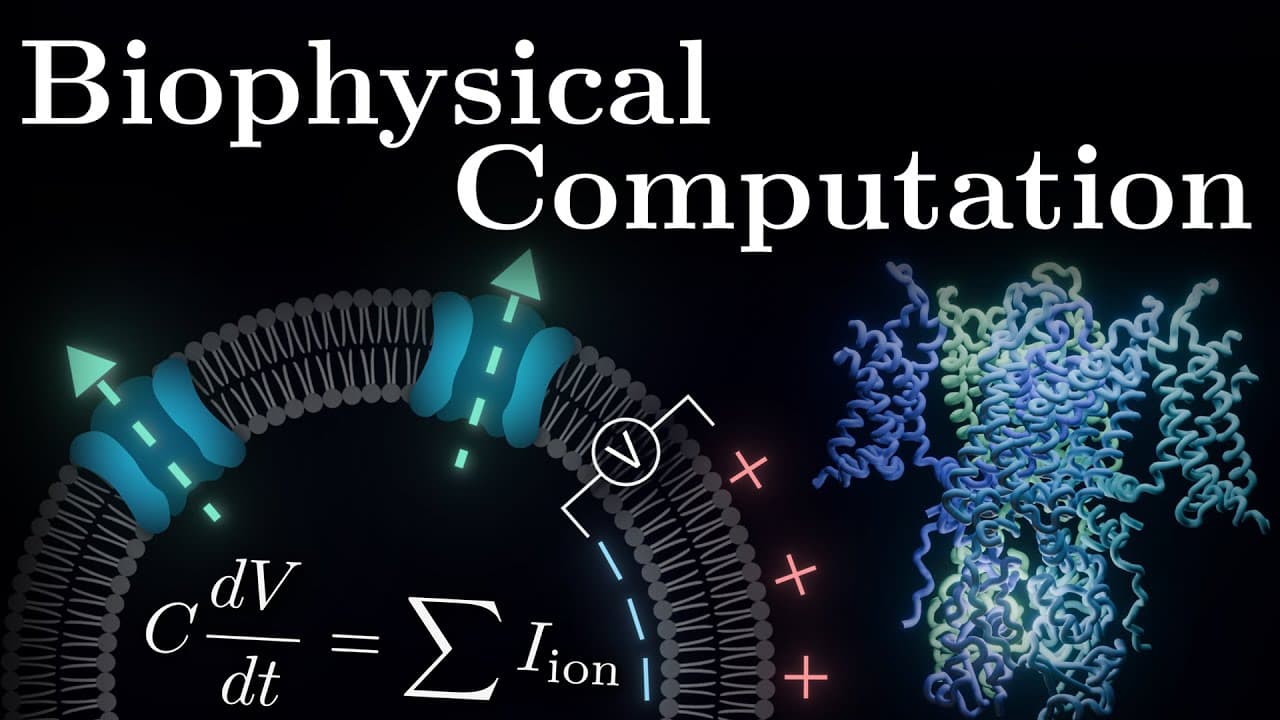
Neuronal voltage changes because ionic currents redistribute charge across a membrane that stores charge like a capacitor. The Hodgkin-Huxley model describes this process with differential equations linking membrane voltage, ion-specific equilibrium potentials, conductance, and voltage-dependent channel gates, explaining how coordinated sodium influx and potassium efflux generate an action potential within a few milliseconds.
Transcript
the human brain remains one of science's greatest Mysteries while we have mastered the art of creating computers by arranging transistors into logical circuits understanding how neurons compute is a lot more challenging after all we did not engineer them ourselves in an attempt to unravel this scientists have created mathematical models sim... Read More
Key Insights
- Membrane voltage is potential energy created by an imbalance of electric charge across the cell membrane. The neuron's interior contains more negative charge than its exterior, and the membrane prevents that imbalance from immediately dissipating through unrestricted ion movement.
- Membrane capacitance is the ability of the cell membrane to store electric charge. Its value depends on physical properties such as membrane thickness and area, while the time derivative of the capacitor relationship connects changing membrane voltage to changing charge.
- Ionic current is the rate at which electric charge crosses the membrane through specialized protein channels. The sum of these currents determines how quickly membrane voltage changes, making current balance a crucial foundation for modeling neuronal dynamics.
- An action potential is a brief electrical pulse produced by coordinated sodium and potassium flows. Sodium enters after depolarization opens sodium channels, increasing depolarization, while potassium later leaves through opened potassium channels and drives the membrane voltage back toward its resting level.
- An ion's equilibrium potential is the membrane voltage where electrical and diffusive forces exactly balance. Individual ions may continue moving in both directions through open channels, but their opposing movements create no net ionic flow at that voltage.
- The ionic driving force is the difference between membrane voltage and an ion's equilibrium potential. When the two voltages differ, net ionic flow tends to move the membrane potential toward equilibrium, with the current proportional to this voltage difference.
- Potassium's equilibrium potential is about -90 mV in the example, based on roughly 30 times more potassium inside the cell than outside. At -50 mV potassium flows outward, while at -120 mV electrical attraction produces net inward flow.
- Voltage-dependent conductance is determined by maximum conductance and the fraction of channels currently open. Maximum conductance reflects channel number and individual channel conductance, while opening probability depends on charged protein gates that change position in response to the membrane's electrical field.
Install to Summarize YouTube Videos and Get Transcripts
Explore YouTube Video Summarizer or Get YouTube Transcript Extractor
Questions & Answers
Q: How does the Hodgkin-Huxley model describe neuronal voltage?
The model treats membrane voltage as a state variable that changes over time according to the ionic currents crossing the cell membrane. The membrane stores charge like a capacitor, while ion channels provide conductive pathways. Differential equations connect the rate of voltage change to the combined currents, allowing neuronal electrical activity to be described as a dynamical system.
Q: What creates the voltage across a neuron's membrane?
Membrane voltage arises because the fluids inside and outside a neuron contain different mixtures of electrically charged ions. The inside contains more negative charge than the outside, creating stored electrical potential energy. Because the membrane is not freely permeable, the excess charge cannot immediately flow away, so the separation persists and produces a measurable voltage across the membrane.
Q: Why is a neuronal membrane modeled as a capacitor?
A neuronal membrane acts like a capacitor because it separates positive and negative charges and stores the resulting electrical potential energy. The amount of stored energy depends on the charge difference and physical membrane properties such as area and thickness. Differentiating the relationship between charge and voltage over time shows how ionic currents change the membrane's voltage as charge is redistributed.
Q: How do sodium and potassium generate an action potential?
A small rise above resting voltage opens voltage-dependent sodium channels, allowing positively charged sodium ions to enter the neuron. This inward current causes further depolarization. After a brief period, sodium channels close while potassium channels open. Positively charged potassium then leaves the cell, lowering membrane voltage and driving it back toward its resting level within a sequence lasting a few milliseconds.
Q: What is an ion's equilibrium potential?
An equilibrium potential is the membrane voltage at which two opposing influences on an ion, diffusion and electrical force, exactly balance. Ions still move through open channels in both directions, but there is no net flow because each movement in one direction is balanced by movement in the other. Departures from this voltage produce current that tends to restore equilibrium.
Q: What determines the direction of potassium flow?
Potassium flow depends on the relationship between membrane voltage and potassium's equilibrium potential. With roughly 30 times more potassium inside than outside, diffusion pushes potassium outward, while the negative cell interior attracts it inward. At about -90 mV these forces balance. Potassium flows outward at -50 mV but inward at -120 mV, moving voltage toward equilibrium.
Q: What is ionic driving force in a neuron?
Ionic driving force is the difference between the membrane's current voltage and the equilibrium potential for a particular ion. Its sign determines the direction of net ionic flow, while its magnitude helps determine current strength. Current through open channels is proportional to this difference and to conductance, following the same basic relationship as Ohm's law with conductance replacing inverse resistance.
Q: How do voltage-dependent ion channels coordinate neuronal firing?
Voltage-dependent channels coordinate firing because their protein structures contain charged gates that respond to the electrical field across the membrane. Each gate can occupy permissive or non-permissive positions, changing whether ions can pass. Membrane voltage therefore changes channel-opening probability, while the resulting ionic currents alter voltage again. This feedback produces the ordered sodium and potassium conductance changes underlying an action potential.
Summary & Key Takeaways
-
A neuron's membrane separates fluids with different ionic compositions, leaving the cell interior more negatively charged than the exterior. This charge separation creates membrane voltage, while the membrane's thickness and area give it capacitance. Tracking voltage over time establishes the core dynamical variable needed for a mathematical description of neuronal signaling.
-
The membrane is not a perfect capacitor because protein channels allow selected ions to cross it. Ionic currents change stored charge and therefore membrane voltage. Each current depends on conductance and the difference between the current membrane voltage and an ion's equilibrium potential, a voltage where electrical and diffusive forces balance.
-
Action potentials emerge from voltage-dependent changes in sodium and potassium conductance. Initial depolarization opens sodium channels, producing inward positive current and further depolarization. Sodium channels then close while potassium channels open, allowing positive charge to leave and returning voltage toward rest. Channel gates provide the biophysical mechanism coordinating this sequence.
Read in Other Languages (beta)
Share This Summary 📚
Summarize YouTube Videos and Get Video Transcripts with 1-Click
Try YouTube Summary with ChatGPT & Claude or YouTube Transcript Generator
Explore More Summaries from Artem Kirsanov 📚



Summarize YouTube Videos and Get Video Transcripts with 1-Click
Try YouTube Summary with ChatGPT & Claude or YouTube Transcript Generator