How Hopfield networks store memories like the brain
TL;DR
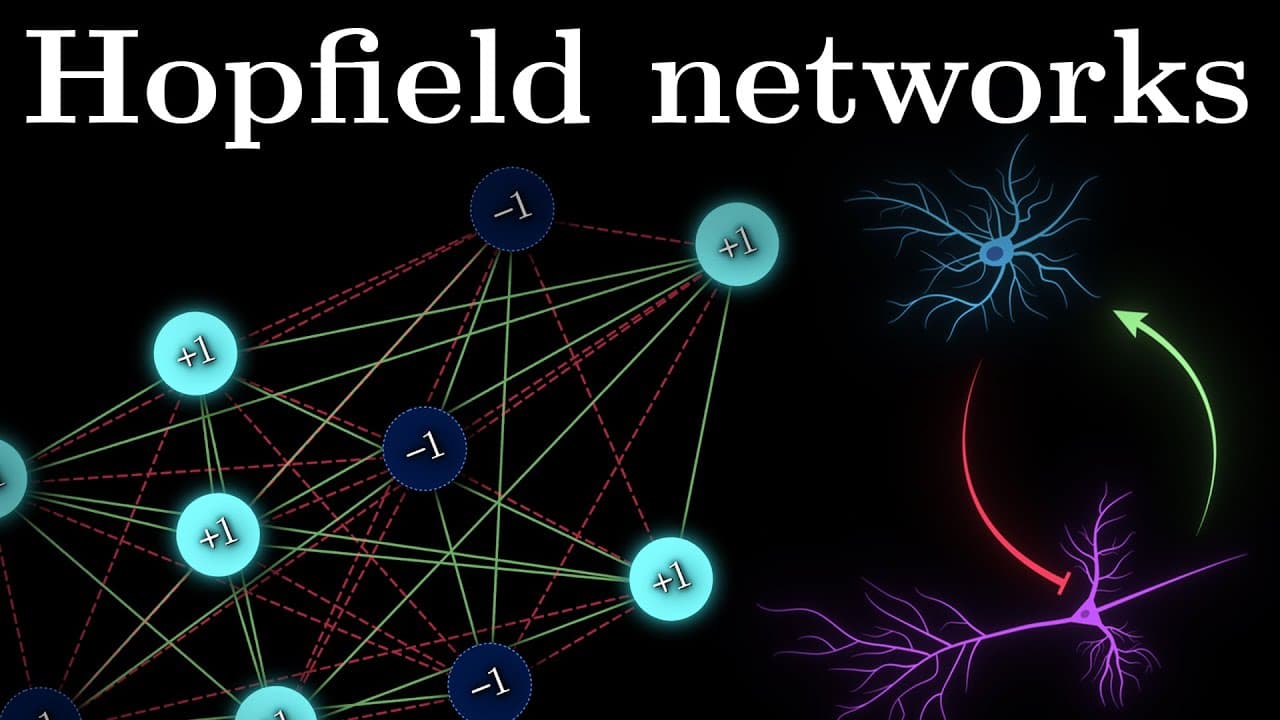
A Hopfield network learns to store memories as local energy minima and retrieves the most similar memory by letting the system descend to the nearest valley. The model uses symmetric weights and an energy function to guide updates, drawing an analogy to protein folding energy landscapes. It shows how association and retrieval can be implemented without exhaustive search.
Transcript
Consider the following scenario. You are at a party, when you hear a short snippet of your favorite song. (song plays) Almost instantly, your brain recalls the lyrics of that song and many related memories, such as attending a recent concert featuring that artist. It seems very natural and unimpressive. After all, people can recall information all ... Read More
Key Insights
- Energy landscape maps configurations to potential energy, guiding memory storage as local minima.
- Memory retrieval in Hopfield networks is driven by evolving toward the lowest energy state compatible with the input.
- Symmetric weights ensure consistent bidirectional influence between neurons, stabilizing memory patterns.
- The model borrows ideas from protein folding, using energy minimization rather than exhaustive search.
- Stored memories correspond to attractor basins where the system naturally converges.
- The approach emphasizes two modes: learning to sculpt the landscape and inference to descend to a memory.
- Happiness of a connection is the alignment of neuron states with connection signs, contributing to total energy.
- Limitations and perspective discuss practical constraints and scope of Hopfield networks.
Install to Summarize YouTube Videos and Get Transcripts
Explore YouTube Video Summarizer or Get YouTube Transcript Extractor
Questions & Answers
Q: How does a Hopfield network define memory in terms of energy?
A Hopfield network defines memory as a local minimum in its energy landscape where the configuration of neuron states is most compatible with the stored weights. Each stored pattern shapes an attractor basin so that when the network is perturbed, the dynamics tend to descend into the nearest minimum. This gives a stable recall point for retrieval.
Q: Why are symmetric weights important in Hopfield networks?
Symmetric weights ensure that the influence between any two neurons is bidirectional and equal, which stabilizes the energy function and the convergence dynamics. This symmetry prevents oscillations and ensures that the network's updates monotonically decrease energy, guiding the system toward a stable memory representation without conflicting directions of influence.
Q: What is the connection between energy minimization and memory retrieval?
Memory retrieval in this framework relies on guiding the network to descend along the energy landscape toward a local minimum that corresponds to a stored memory. By initializing the network near the input pattern and allowing the dynamics to evolve, the system settles into the closest attractor, effectively recalling the associated memory.
Q: How is the energy landscape analogous to protein folding?
Both processes involve moving toward lower energy states rather than exhaustively exploring all configurations. In proteins, folding follows the path of minimal energy on a rugged landscape, while in Hopfield networks, memories are embedded as minima and retrieval is the descent to the nearest minimum, driven by energy minimization.
Q: What role do weights play in shaping the energy landscape?
Weights determine how strongly pairs of neurons influence each other, effectively sculpting the energy surface. Positive weights favor aligned states while negative weights discourage certain configurations. Through learning, the weights mold the landscape so that desired memories become stable minima.
Q: What are the two modes of updating in the Hopfield network described?
The two modes are learning and inference. Learning adjusts the weights to shape the energy landscape, establishing which configurations are stable. Inference initializes the network with an input pattern and updates neuron states to descend toward the nearest energy minimum, retrieving the most similar memory.
Q: What limitations are associated with Hopfield networks according to the video?
Limitations include restricted capacity for storing patterns relative to network size and potential spurious minima that do not correspond to any real memory. The video notes perspectives and constraints, suggesting that the model is a foundational paradigm with scope for refinement and extension to more complex memory systems.
Q: How does Levinthal’s paradox relate to the presented memory model?
Levinthal’s paradox highlights that exhaustive search is impractical in protein folding, yet proteins fold quickly due to energy-guided pathways. The memory model adopts a similar principle: rather than scanning all configurations, the system uses an energy landscape and descent dynamics to reach a stored memory efficiently.
Summary & Key Takeaways
-
A memory storage mechanism is built by sculpting an energy landscape where stored patterns become local minima, enabling retrieval by descent to the nearest valley. The approach relies on symmetric connections and a defined energy function to measure conflict between states and weights.
-
Retrieval is achieved by initializing the network to a pattern close to the input and letting dynamics converge to the closest stored memory, mirroring natural processes that minimize energy in physical systems.
-
The video connects brain-like memory with Hopfield networks, explaining the role of energy minimization, symmetry in weights, and the idea that memory retrieval is a downhill process on the energy landscape.
Read in Other Languages (beta)
Share This Summary 📚
Summarize YouTube Videos and Get Video Transcripts with 1-Click
Try YouTube Summary with ChatGPT & Claude or YouTube Transcript Generator
Explore More Summaries from Artem Kirsanov 📚



Summarize YouTube Videos and Get Video Transcripts with 1-Click
Try YouTube Summary with ChatGPT & Claude or YouTube Transcript Generator