How Does the Thousand Brains Theory Explain Intelligence?
TL;DR
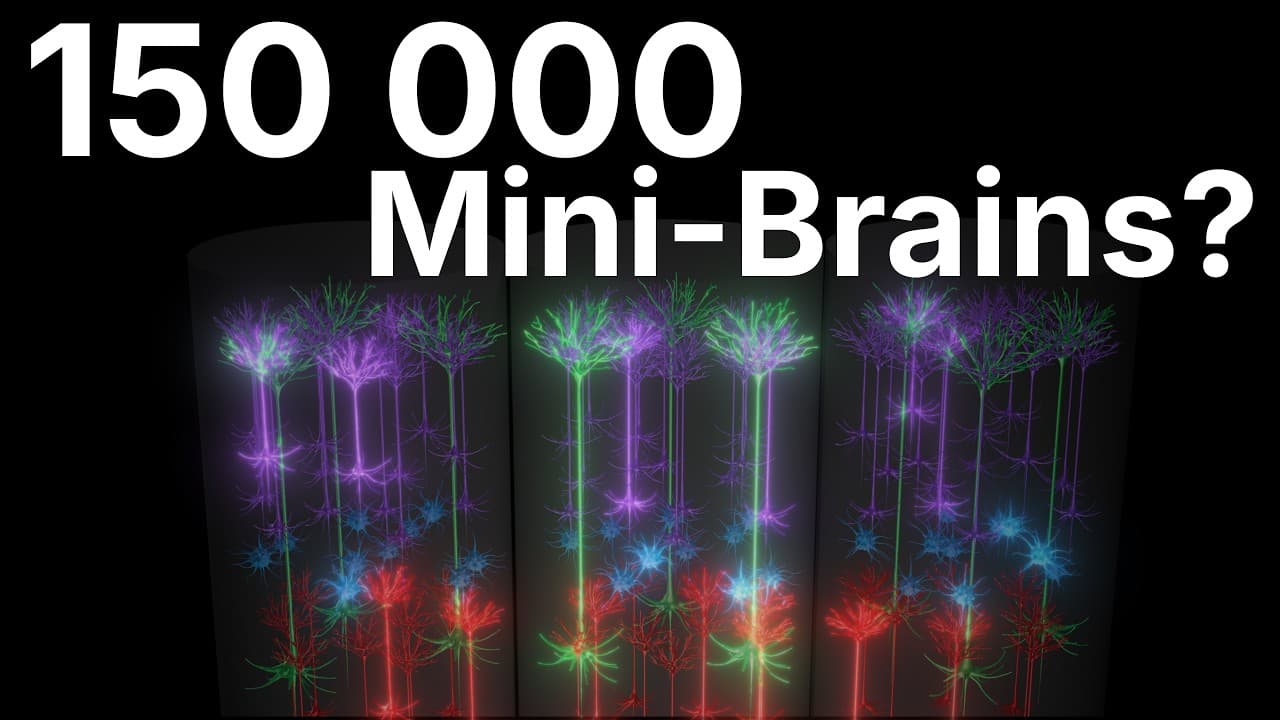
The Thousand Brains Theory suggests that instead of a single model, the brain uses thousands of cortical columns to create individual models of the world. Each column acts as a mini-brain, processing sensory input and generating predictions through a sensory-motor loop. This distributed processing allows the brain to efficiently handle complex tasks and form a unified perception through consensus voting among columns.
Transcript
This is neocortex, a sheet of cells just a few millimeters thick covering the surface of the brain. It is the most recent addition in our evolutionary history. And it's the structure responsible for nearly everything we consider uniquely human from language to abstract reasoning. For decades, scientists have tried to reverse engineer this remarkabl... Read More
Key Insights
- The neocortex is a thin sheet of cells responsible for human cognitive abilities.
- The Thousand Brains Theory proposes that each cortical column is a self-contained modeling system.
- Cortical columns build predictive models using sensory-motor loops and path integration.
- Layer 4 of the cortex receives sensory input, forming the 'what' signal.
- Layer 6 contains grid cell-like neurons responsible for the 'where' signal.
- Columns communicate and reach consensus through a voting process involving layers 2/3.
- The theory suggests intelligence arises from the cooperation of 150,000 mini-brains.
- Higher cognitive functions use the same algorithm as basic sensory processing.
Install to Summarize YouTube Videos and Get Transcripts
Explore YouTube Video Summarizer or Get YouTube Transcript Extractor
Questions & Answers
Q: How does the Thousand Brains Theory explain brain function?
The Thousand Brains Theory suggests that the brain is composed of many cortical columns, each acting as an independent processing unit or mini-brain. These columns build predictive models using sensory inputs and motor outputs, allowing for a distributed processing system. This approach enables the brain to form a unified perception through consensus voting among columns, efficiently handling complex tasks.
Q: What role do cortical columns play in the brain?
Cortical columns are fundamental units of the neocortex, each acting as a self-contained modeling system. They process sensory inputs and generate motor outputs, building predictive models of the world. This distributed approach allows for efficient handling of complex cognitive tasks, with columns reaching a consensus to form a unified perception of sensory information.
Q: How do cortical columns build predictive models?
Cortical columns build predictive models through a sensory-motor loop, integrating sensory inputs with motor outputs. Layer 4 receives sensory data, forming the 'what' signal, while layer 6 contains grid cell-like neurons for location tracking, the 'where' signal. These inputs are combined in layers 2/3 to create stable predictive models, enabling the brain to anticipate and respond to stimuli.
Q: What is the significance of the sensory-motor loop in the brain?
The sensory-motor loop is crucial for building predictive models in cortical columns. It involves integrating sensory inputs with motor outputs, allowing the brain to bind sensory features to specific locations. This process enables columns to predict future sensory experiences based on current and past inputs, forming the basis for perception, learning, and decision-making.
Q: How does consensus voting work among cortical columns?
Consensus voting among cortical columns involves lateral communication between columns to reach a unified perception. Each column sends motor commands and communicates predictions to other columns. Through this process, columns refine their predictions and resolve ambiguities, allowing the brain to converge on a single, consistent interpretation of sensory inputs.
Q: What is the role of grid cell-like neurons in the cortex?
Grid cell-like neurons in the cortex, primarily located in layer 6, are responsible for location tracking. They generate the 'where' signal, forming a coordinate system that tracks the position of sensory inputs. This spatial information is crucial for binding sensory features to specific locations, enabling the formation of predictive models and supporting navigation and spatial awareness.
Q: How does the Thousand Brains Theory relate to higher cognitive functions?
The Thousand Brains Theory posits that higher cognitive functions use the same underlying algorithm as basic sensory processing. Cortical columns process abstract inputs, such as attention shifts or memory recall, in the same way they handle physical sensations. This approach allows the brain to apply the same predictive modeling framework to both concrete and abstract cognitive tasks.
Q: How does the Thousand Brains Theory explain human intelligence?
The Thousand Brains Theory explains human intelligence as arising from the cooperation of thousands of cortical columns, each acting as a mini-brain. These columns build predictive models through sensory-motor loops, allowing for distributed processing and efficient handling of complex tasks. By reaching consensus through voting, the brain forms a unified perception, enabling advanced cognitive functions and adaptive behavior.
Summary & Key Takeaways
-
The Thousand Brains Theory explains that the neocortex is composed of thousands of cortical columns, each acting as an independent mini-brain. These columns create predictive models of the world by integrating sensory inputs and motor outputs. This distributed processing allows the brain to generate a unified perception through consensus voting among columns.
-
Cortical columns consist of six layers, each playing a distinct role in processing sensory and motor information. Layer 4 receives sensory input, while layer 6 houses grid cell-like neurons for location tracking. The columns use a sensory-motor loop to bind sensory features to locations, forming predictive models and contributing to higher cognitive functions.
-
Consensus voting among cortical columns enables the brain to form a unified perception. Each column sends motor commands and communicates laterally to reach a consensus. This process allows the brain to efficiently handle complex tasks, from physical sensation to abstract thinking, using the same underlying algorithm.
Read in Other Languages (beta)
Share This Summary 📚
Summarize YouTube Videos and Get Video Transcripts with 1-Click
Try YouTube Summary with ChatGPT & Claude or YouTube Transcript Generator
Explore More Summaries from Artem Kirsanov 📚

Summarize YouTube Videos and Get Video Transcripts with 1-Click
Try YouTube Summary with ChatGPT & Claude or YouTube Transcript Generator