How does backpropagation enable learning in neural nets
TL;DR
Backpropagation is the core algorithm that trains neural networks by propagating errors backward to adjust weights. The method relies on differentiability and the chain rule to compute how small changes in each parameter affect the overall loss. This understanding leads to gradient descent updates that improve model performance across architectures.
Transcript
What do nearly all machine learning systems have in common? From GPT and Mourney to AlphaFold and various models of the brain. Despite being designed to solve different problems, having completely different architectures and being trained on different data, there is something that unites all of them. A single algorithm that runs under the hood of t... Read More
Key Insights
- Backpropagation is the shared engine behind training for many ML systems and brain-inspired models.
- The approach relies on differentiability to compute how to adjust parameters to reduce loss.
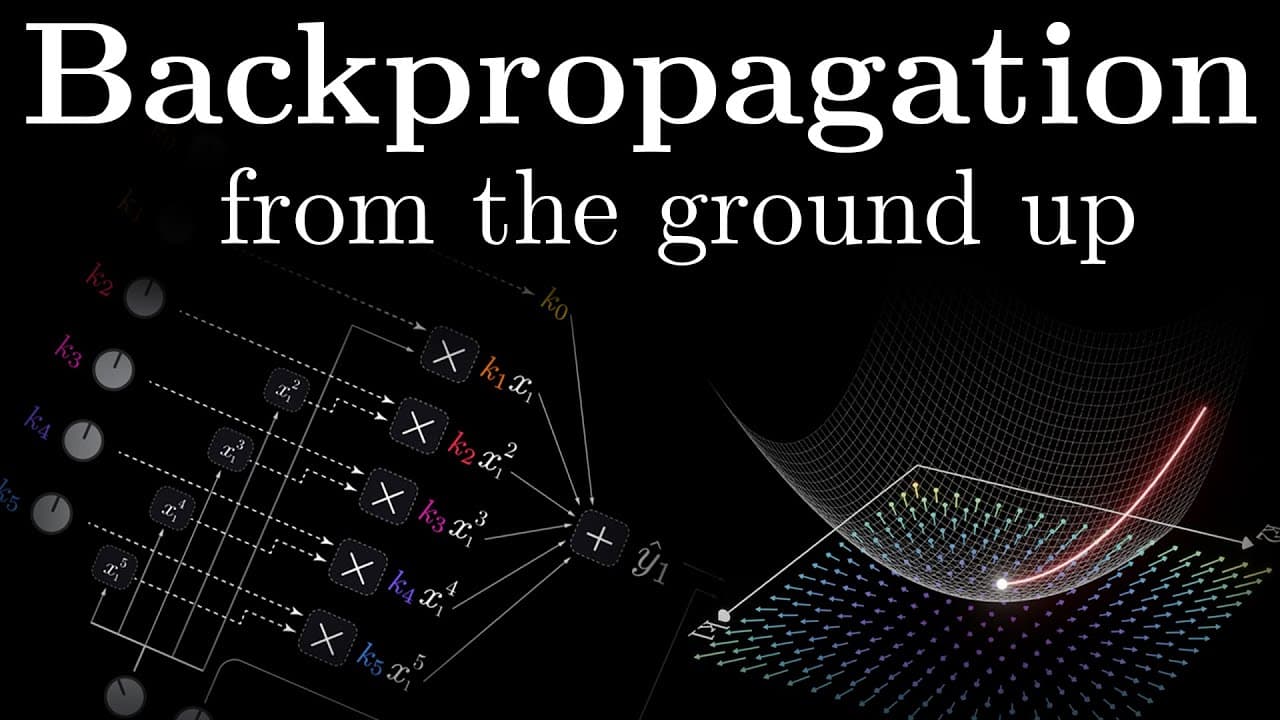
- A simple curve fitting example is used to illustrate how a loss depends on polynomial coefficients K0 through K5.
- Gradient descent updates are guided by the derivative of the loss with respect to each parameter.
- The chain rule is central to propagating error signals through composed functions in a network.
- A differentiable loss function enables efficient parameter tuning rather than random search.
- The idea of a computational graph helps organize complex models and supports autodiff for scalable learning.
- Backpropagation connects theory to practice by showing how local parameter changes influence global outcomes through gradients
Install to Summarize YouTube Videos and Get Transcripts
Explore YouTube Video Summarizer or Get YouTube Transcript Extractor
Questions & Answers
Q: How does backpropagation unify learning across different neural network architectures?
Backpropagation provides a principled way to compute how changes in each parameter affect the overall loss, regardless of the network’s exact structure. By applying the chain rule through a computational graph, the algorithm distributes the error signal backward from output to each weight, enabling gradient-based updates across diverse architectures such as simple feedforward nets or complex models. This unifying mechanism underpins learning in a wide range of systems and tasks.
Q: What is the role of differentiability in training neural networks?
Differentiability ensures that small changes in parameters lead to predictable changes in the loss, allowing the gradient to exist and be computed. This enables the use of gradient-based optimization methods like gradient descent, where we adjust each parameter in the direction that most quickly reduces the loss. Without differentiability, we could not reliably estimate how to improve the model in response to errors.
Q: Why is the polynomial fitting toy example used in the video relevant to backpropagation?
The polynomial fitting example provides a concrete, low-dimensional setting where the loss is a function of a finite set of coefficients K0 through K5. It demonstrates how a loss changes as parameters are tweaked and motivates the idea of computing derivatives to guide those tweaks. This mirrors how a neural network learns by adjusting numerous weights to minimize a data-fitting loss.
Q: How is the gradient of the loss with respect to parameters obtained in backpropagation?
The gradient is obtained by applying the chain rule through the layers of the network, effectively composing the derivatives of each layer’s operations. By backpropagating the error from the output backward through the network, we accumulate partial derivatives for every weight. This gives the direction and magnitude of adjustments needed to reduce the loss.
Q: What is gradient descent and how does it relate to backpropagation?
Gradient descent is the optimization method that uses the computed gradients to update parameters in the direction that reduces the loss most rapidly. Backpropagation provides the gradients, and gradient descent performs the actual parameter updates. Together, they form the core loop that enables neural networks to learn from data.
Q: What is a computational graph and why is it important for autodiff?
A computational graph represents the flow of data and operations in a model as nodes and edges. It makes explicit how outputs depend on inputs and parameters, which is crucial for automatic differentiation. Autodiff traverses this graph to compute exact derivatives efficiently, enabling scalable training for complex architectures without manual derivative calculations.
Q: What historical milestones are highlighted in the video regarding backpropagation?
The video references early ideas and highlights the 1986 paper by Rumelhart, Hinton, and Williams as a milestone where backpropagation was applied to multi-layer perceptrons to demonstrate successful training and meaningful hidden representations. This work solidified backpropagation as a practical and foundational method in modern ML.
Q: How does the video plan to connect backpropagation to biology in the next part?
The video frames backpropagation as a powerful algorithm in artificial systems and signals that the next part will explore synaptic plasticity in biological brains. It will discuss whether backpropagation is biologically relevant and consider alternative learning mechanisms that brains might use, bridging the gap between artificial and biological learning paradigms.
Summary & Key Takeaways
-
Backpropagation is introduced as the unifying algorithm behind diverse ML systems and brain-inspired models, tying together training methods across GPT, AlphaFold, and Mourney. The video builds intuition from a simple polynomial fitting problem to show how a loss function guides parameter updates. It emphasizes the role of differentiability and the chain rule in computing gradients.
-
The explanation traces the historical origins from early ideas to the 1986 landmark paper by Rumelhart, Hinton, and Williams, establishing backpropagation as the practical method for training multi-layer neural networks and generating meaningful hidden representations.
-
The video then derives backpropagation from first principles using a curve fitting toy problem, introduces gradient descent as the optimization strategy, and culminates with a discussion of computational graphs and automatic differentiation for scalable learning
Read in Other Languages (beta)
Share This Summary 📚
Summarize YouTube Videos and Get Video Transcripts with 1-Click
Try YouTube Summary with ChatGPT & Claude or YouTube Transcript Generator
Explore More Summaries from Artem Kirsanov 📚

Summarize YouTube Videos and Get Video Transcripts with 1-Click
Try YouTube Summary with ChatGPT & Claude or YouTube Transcript Generator