How Does the Brain Use Criticality for Information?
TL;DR
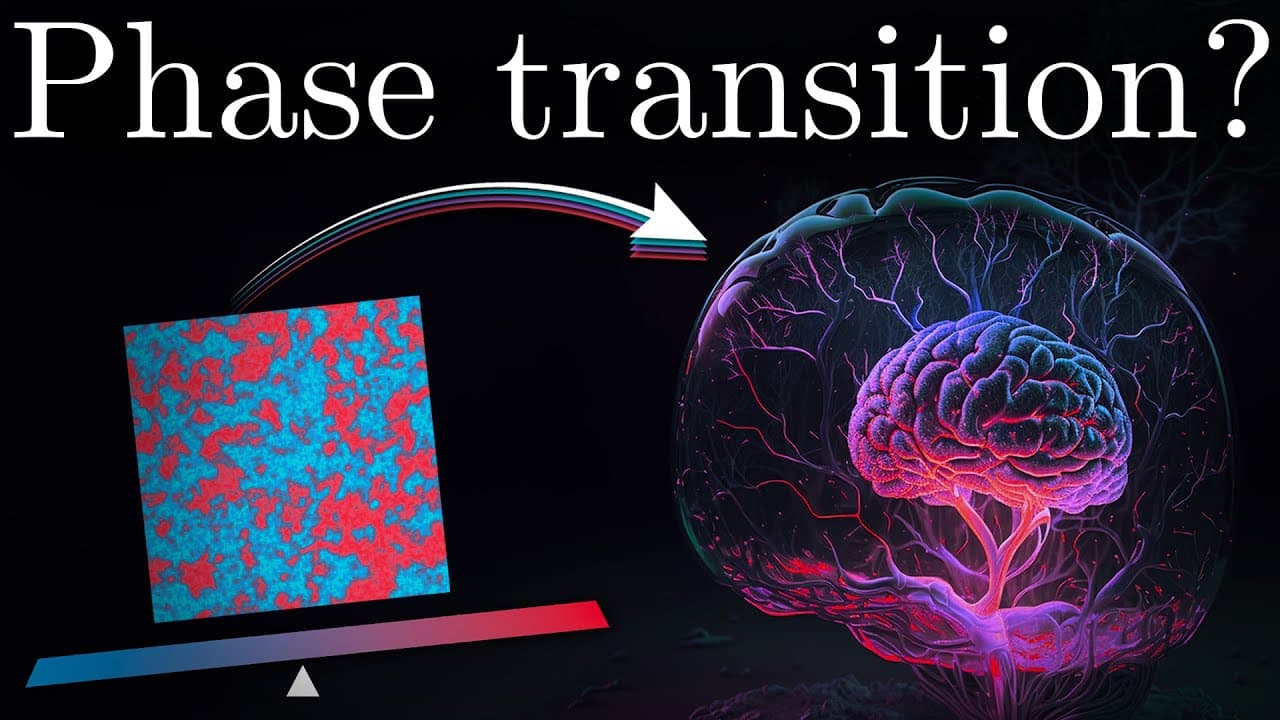
The brain may optimize information processing by operating near a critical point where order and fluctuations balance. The Ising model illustrates how local interactions can produce long range coordination at a critical temperature. Dynamic correlation length peaks at criticality, suggesting maximal information transfer and adaptable computation in neural networks.
Transcript
Understanding the brain in all of its complexity is a difficult challenge. One of the holy grails of neuroscience is to build an elegant yet comprehensive theory describing the general roles of the nervous system, something similar to what a set of Maxwell equations was to electromagnetism. In this video, we are going to talk about the Critical Bra... Read More
Key Insights
- Criticality is a special state where a system sits at the boundary between order and disorder, enabling new properties to emerge.
- Phase transitions can be continuous, allowing a system to move smoothly between states, which is crucial for understanding brain dynamics.
- The Ising model demonstrates how local interactions can yield global coordination through collective behavior.
- Temperature acts as a control parameter that modulates fluctuations and drives phase transitions.
- Correlation length measures how far information can propagate, and it peaks at criticality, indicating long range communication.
- At the critical point, systems show a mix of coordination and fluctuation, which enhances dynamic correlations.
- Neural networks may leverage criticality to optimize information transmission and processing efficiency.
- Long range communication can arise from simple local rules, offering a plausible mechanism for brain-wide coordination.
Install to Summarize YouTube Videos and Get Transcripts
Explore YouTube Video Summarizer or Get YouTube Transcript Extractor
Questions & Answers
Q: What is criticality in neural systems and why is it important?
Criticality in neural systems refers to a state near a phase transition where the brain balances order and randomness, enabling flexible coordination and information processing. This state allows large networks to respond to inputs with diverse, scalable dynamics, potentially increasing computational efficiency and adaptability. Understanding this concept helps explain how neurons could optimize transmission and processing at multiple scales.
Q: How does the Ising model relate to brain activity?
The Ising model uses spins on a lattice to illustrate how local interactions lead to global properties like magnetization. In brain terms, similar local neuron interactions can produce widespread coordinated activity patterns. At a certain temperature, the system reaches a critical point where small changes can propagate through the network, yielding large-scale effects from local rules.
Q: What happens to correlation length at the critical point?
At the critical point, the correlation length becomes long enough to span many sites in the system, meaning that fluctuations in one part of the network can influence distant regions. This extended coordination supports the idea that information can be transmitted efficiently across large neural assemblies, which is a hallmark of critical dynamics.
Q: Why is a continuous phase transition relevant to brain function?
A continuous phase transition allows a system to move smoothly between ordered and disordered states without abrupt jumps. In the brain, this means networks can gradually shift between different activity regimes, maintaining stability while enabling rapid adaptation. Such gradual changes support flexible information processing and learning across varying conditions.
Q: What role does temperature play in phase transitions?
Temperature acts as a control parameter that injects stochastic fluctuations into the system. Higher temperature increases randomness, opposing order, while lower temperature favors alignment. The balance between these forces at intermediate temperatures creates a critical regime where interesting collective behavior emerges and information flow can be optimized.
Q: How do long-range communications emerge from local interactions?
Long-range communication emerges when local interactions propagate through the network, allowing a disturbance at one site to influence distant sites via cascades. This phenomenon occurs naturally in near-critical systems where coordination can spread efficiently, producing coherent activity patterns across large-scale networks without requiring direct long-range connections.
Q: What is the practical significance of brain criticality for computation?
If the brain operates near criticality, it may optimize information transmission, sensitivity to inputs, and adaptability to changing environments. Critical dynamics could support scalable computation, balanced responsiveness, and robust information processing across variable cognitive tasks, offering a framework to understand how neural circuits achieve efficient, flexible function.
Q: What sources are recommended for further reading on brain criticality?
The video cites several references including Beggs and colleagues about cortical networks and the critical point, the cortex and the critical point by Beggs, and the scoping review Why Brain Criticality Is Clinically Relevant. These works discuss theoretical models, empirical evidence, and implications for neural computation and clinical relevance, providing a foundation for deeper study.
Summary & Key Takeaways
-
The video explains phase transitions and critical points using everyday analogies and the Ising model to show how local interactions can generate global coordination.
-
It discusses correlation length, dynamic correlations, and how criticality may optimize information transmission in neural networks.
-
The talk outlines practical implications and references for further reading on brain criticality and its computational benefits.
Read in Other Languages (beta)
Share This Summary 📚
Summarize YouTube Videos and Get Video Transcripts with 1-Click
Try YouTube Summary with ChatGPT & Claude or YouTube Transcript Generator
Explore More Summaries from Artem Kirsanov 📚




Summarize YouTube Videos and Get Video Transcripts with 1-Click
Try YouTube Summary with ChatGPT & Claude or YouTube Transcript Generator