How to Scale Shopify With Meta Ads and CRO
TL;DR
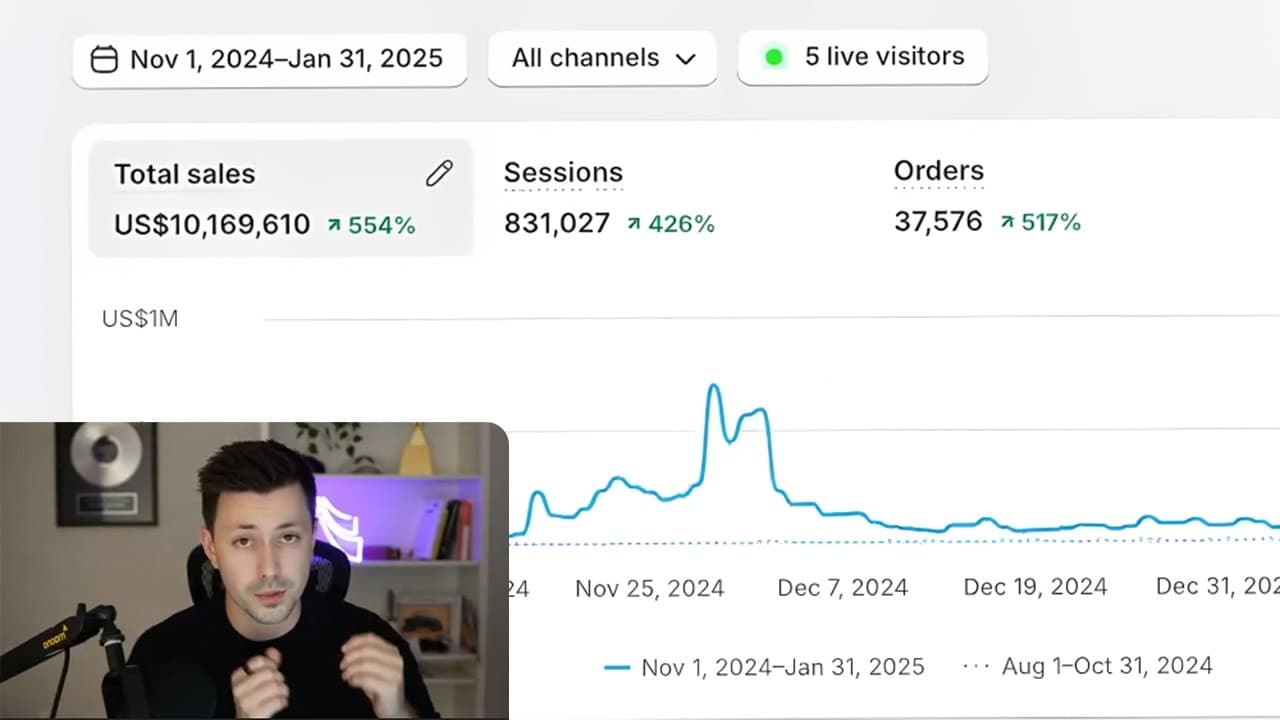
Scale a Shopify brand by consolidating Meta testing and scaling in a CBO campaign, using broad targeting for acquisition, and separating warm and hot audiences during limited sales. The featured store generated more than $10 million in 90 days, supported by $1.2 million in Facebook ad spend, a reported 4.1x return on ad spend, focused offers, landing-page tests, and conversion optimization.
Transcript
As you can see on screen, we did over $10 million in a 90-day period during November 1st, 2024 to January 31st, 2025. All as a result of everything that I am about to show you in this week's video. In this video, I'm literally going to show you the exact ad account structure that we used, explain our entire creative process, show you real examples ... Read More
Key Insights
- The store generated more than $10 million between November 1, 2024, and January 31, 2025. It recorded more than 800,000 sessions, a 4.15% conversion rate, and 550% growth compared with the previous period.
- Facebook advertising produced a reported 4.1x return on ad spend during the three-month period. The account spent $1.2 million and attributed $5.22 million in revenue to that spending.
- The promotion campaign was designed specifically for limited sales periods. It spent $618,000 and reused one campaign across Black Friday and Cyber Monday, holiday, and New Year promotions, with distinct ad sets created for each sales period.
- The promotion audience structure contained broad, warm, and hot groups within a CBO campaign. Broad targeting was left open except for excluding purchasers from the previous 30 days, allowing Meta to handle prospecting and budget allocation.
- The warm audience used 60-day engagement signals, including Instagram engagement, Facebook engagement, and 95% video views. Website visitors and lower-funnel actions were excluded because those users were assigned to the separate hot audience.
- The hot audience contained 90-day website visitors, content viewers, cart additions, and checkout initiations. Its frequency was higher because the limited promotion required repeated exposure, and the audience continued delivering strong performance despite competitive advertising costs.
- The seven-day-click acquisition campaign combined creative testing and scaling. It spent $342,000, stored winning post IDs in a champions ad set, and allowed new dynamic creative tests to compete against proven advertisements within one consolidated campaign.
- Landing-page testing was moved from a separate campaign into the main campaign structure. Top or new advertisements were paired with landing pages and launched as ad sets, while an additional ASC promotion campaign reused leading sale ads and spent another $52,000.
Install to Summarize YouTube Videos and Get Transcripts
Explore YouTube Video Summarizer or Get YouTube Transcript Extractor
Questions & Answers
Q: How did the Shopify store generate more than $10 million in 90 days?
The store combined substantial Facebook advertising with a structured approach to promotions, creative testing, landing pages, and conversion rate optimization. From November 1, 2024, through January 31, 2025, it generated more than $10 million, grew 550% compared with the previous period, attracted more than 800,000 sessions, and converted 4.15% of those sessions. Facebook spending totaled $1.2 million and produced $5.22 million in attributed revenue.
Q: What Meta ad account structure was used to scale the Shopify brand?
The account used several campaigns with distinct purposes. A $618,000 promotion campaign handled limited sales through broad, warm, and hot audiences. A $342,000 seven-day-click acquisition campaign consolidated ongoing creative testing and scaling. The account also used a landing-page testing campaign before moving those tests into the main campaign, plus an ASC promotion campaign that spent $52,000 by reusing top-performing sale advertisements.
Q: How should broad, warm, and hot audiences be structured for a sale?
The broad audience should remain wide open for prospecting, with the presented setup excluding only purchasers from the previous 30 days. The warm audience includes 60-day Instagram engagers, Facebook engagers, and people who watched 95% of a video, while excluding recent website activity. The hot audience separately contains 90-day website visitors, content viewers, cart additions, and checkout initiations, preventing overlap between warm and lower-funnel groups.
Q: Why was ad frequency high for the hot promotion audience?
High frequency was intentional because the promotion lasted for a limited period and competed for attention during an expensive advertising season. The brand wanted recent website visitors, content viewers, cart additions, and checkout initiators to see the offer repeatedly before it expired. Although frequencies around 11 and 13 could appear inflated, the hot audiences continued producing strong performance, supporting repeated exposure during the temporary sale.
Q: How did the brand test and scale Meta ad creatives?
Creative testing and scaling were consolidated inside one CBO acquisition campaign using a seven-day-click attribution setting. Winning advertisement post IDs were added to a champions ad set, which generally contained the highest-spending creative. New dynamic creative tests competed against those champions within the same campaign. This structure directed spending toward advertisements that Meta assessed as capable of producing returns and scaling, while limiting spending on weaker creative.
Q: Why did the account use seven-day-click attribution?
The brand used seven-day-click attribution because its results indicated better incremental growth under that optimization model. The setting instructed Facebook to give purchase credit when a conversion followed a click within the seven-day window. It was applied to the consolidated acquisition campaign, which spent $342,000 and served as the account's combined environment for testing new creative and scaling the advertisements that demonstrated stronger performance.
Q: How were landing pages tested in the updated campaign structure?
Landing pages were initially evaluated through a separate testing campaign, but that campaign was later turned off after the strategy changed. The updated method placed landing-page tests inside the main consolidated campaign. The team paired either leading advertisements or new advertisements with the pages, then launched those combinations as ad sets. This allowed landing pages to compete within the primary campaign instead of waiting for a separate structure to accumulate spending.
Q: How was the ASC campaign used during the Black Friday sale?
The ASC campaign acted as an additional scaling channel during the public Black Friday and Cyber Monday sale. It contained a promotion ad set populated with top-performing advertisements from the main CBO campaign. The main campaign effectively tested sales-specific creative, and successful advertisements were then added to ASC. This approach enabled the brand to spend an additional $52,000 during the promotion while relying on creative that had already performed well elsewhere.
Summary & Key Takeaways
-
The store generated more than $10 million from November 1, 2024, through January 31, 2025, representing 550% growth over the previous period. More than 800,000 sessions converted at 4.15%. Facebook accounted for $1.2 million in advertising spend and $5.22 million in attributed revenue, producing a reported 4.1x return on ad spend.
-
The advertising structure combined a promotion campaign for limited sales with a consolidated seven-day-click acquisition campaign. Promotion audiences were divided into broad, warm, and hot segments. Broad targeting excluded purchasers from the previous 30 days, while warm and hot groups used engagement and website activity windows to manage intent and message frequency.
-
Creative testing and scaling occurred together in a CBO campaign. Winning post IDs were added to a champions ad set, while new dynamic creative tests competed for budget. Landing-page experiments were moved into the main campaign as separate ad sets, and an ASC promotion campaign reused top-performing sale ads to unlock additional spending during Black Friday and Cyber Monday.
Read in Other Languages (beta)
Share This Summary 📚
Summarize YouTube Videos and Get Video Transcripts with 1-Click
Try YouTube Summary with ChatGPT & Claude or YouTube Transcript Generator
Explore More Summaries from Spencer Pawliw 📚
Summarize YouTube Videos and Get Video Transcripts with 1-Click
Try YouTube Summary with ChatGPT & Claude or YouTube Transcript Generator