How to Stabilize Volatile Meta Ads Performance
TL;DR
To stabilize volatile Meta Ads performance, judge results beyond isolated days and strengthen the factors you control: strategy, creative education, storytelling, offer value, and messaging across the five awareness stages. Brands spending less than $1,000 per day may see larger swings because Meta receives less conversion data, while buyer emotions, competitors, and market uncertainty remain uncontrollable. Read on to identify the causes of volatility and the practical levers available to advertisers.
Transcript
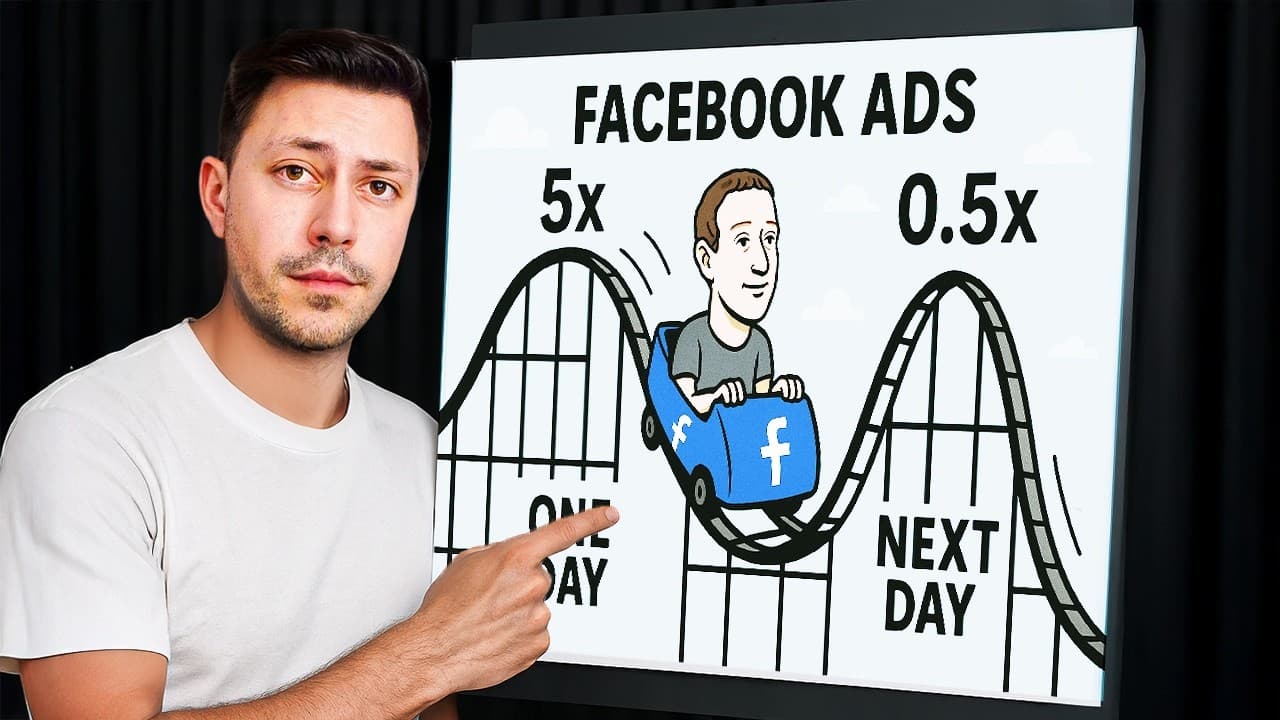
Well, if you're watching this video, your Facebook ad performance might look a little bit like this, where some days performance is phenomenal and you feel like you are absolutely balling and then the next day you are instead of balling, you're balling your eyes out because performance is so bad. And we like to call that the Zuck roller coaster whe... Read More
Key Insights
- Daily Meta Ads volatility is a normal pattern in which similar spending can produce dramatically different revenue, return on ad spend, and acquisition costs from one day to the next, even when the advertiser has not changed campaigns, creatives, products, or offers.
- Limited data is a major source of volatility for brands spending less than $1,000 per day. Higher average order value products may experience similar instability because fewer purchases give Meta less conversion information to use when optimizing delivery.
- Customers are real people whose willingness to buy changes with emotions and circumstances. Tax bills, gifts, anniversaries, unexpected incidents, and other expenses can move buyers into or out of a purchasing mood, creating performance changes that campaign analytics alone cannot explain.
- Market instability can suppress consumer spending when people feel uncertain or scared. Falling stocks, falling cryptocurrency, tariffs, policy changes, interest rates, natural disasters, and influential public statements can affect emotions and cause customers to delay purchases.
- Competitors can reduce ad performance by introducing a better product mechanism or customer experience. Meta may favor ads receiving stronger engagement, likes, shares, and positive customer responses because the platform aims to provide users with the best possible experience.
- Offer value can determine which competitor wins product-aware customers. A rival with a cheaper or more attractive offer may capture demand even without a new product mechanism, particularly when customers believe they can receive something nearly as good for a fraction of the price.
- Strategy is the most controllable cause of roller coaster performance. External conditions and human behavior cannot be fully managed, but advertisers can improve their positioning, creative approach, market awareness, offer, and ability to communicate value.
- The five stages of awareness are unaware, problem aware, solution aware, product aware, and most aware. Brands concentrated in the final two stages compete for a small audience, so education and storytelling can help them reach potential buyers earlier in the journey.
Install to Summarize YouTube Videos and Get Transcripts
Explore YouTube Video Summarizer or Get YouTube Transcript Extractor
Questions & Answers
Q: How can advertisers stabilize volatile Meta Ads performance?
Focus on controllable factors such as strategy, creative quality, offer strength, positioning, and clear value communication. Use education and storytelling to reach people across all five awareness stages instead of competing only for product-aware and most-aware buyers. External conditions and human behavior cannot be fully controlled, so isolated daily results should not be treated as proof that a campaign is broken.
Q: Why does Meta Ads performance change from day to day?
Similar spending can produce different results because ads reach real people whose emotions, expenses, and willingness to buy change. Market uncertainty, competitors, policy changes, natural disasters, and differences in offer value can also influence purchases. Performance may therefore swing even when the advertiser has not changed the campaign, creative, product, or offer.
Q: What is roller coaster performance in Meta Ads?
Roller coaster performance means an ad account performs exceptionally well one day and much worse the next despite comparable spending and no meaningful campaign changes. In the example, about $3,000 in spend generated $11,000 at a 3.7x return, but the following day produced roughly half the revenue at 2.27x while cost per acquisition rose sharply.
Q: How does a small budget affect Meta Ads stability?
Brands spending less than $1,000 per day may experience more volatile results because Meta receives less data. Higher-average-order-value products can face a similar issue because fewer purchases provide less conversion information for optimization.
Q: How do customer emotions affect Facebook ad results?
Customers are real people who are not always ready to buy. A tax bill, gifts, an anniversary expense, or an unexpected incident can change their mood and willingness to spend. Those personal shifts can appear as campaign volatility even when nothing in the account has changed.
Q: How can market conditions and competitors hurt Meta Ads performance?
Uncertainty involving stocks, cryptocurrency, tariffs, policy changes, interest rates, natural disasters, or public statements can make people delay spending. A competitor may also introduce a better product mechanism, customer experience, or offer. Stronger engagement and positive customer responses can lead Meta to favor that competitor's ads.
Q: What are the five stages of customer awareness?
The five stages are unaware, problem aware, solution aware, product aware, and most aware. Many advertisers concentrate on the final two stages, where a relatively small audience faces heavy competition. Education and storytelling can help a brand reach customers earlier in the buying journey.
Q: Why are product-aware Meta Ads highly competitive?
Product-aware customers already want the product category, so many brands compete for the same limited group. Offer value can determine the winner: a competitor may capture demand by presenting a comparable product at a lower or more compelling price. Expanding into earlier awareness stages reduces dependence on this crowded audience.
Summary & Key Takeaways
-
Roller coaster performance occurs when an ad account produces excellent returns one day and sharply weaker results the next, despite similar spending and no obvious campaign changes. The example shows revenue falling by roughly half, return on ad spend dropping from 3.7x to 2.27x, and cost per acquisition rising substantially.
-
Smaller budgets and higher average order values can produce greater volatility because Meta receives less data. Performance also changes because advertisers sell to real people whose emotions, obligations, and willingness to spend fluctuate. Economic uncertainty, market events, policy changes, natural disasters, and public statements can further affect buying behavior.
-
Strategy is the most controllable source of instability. Brands often compete within the small product-aware and most-aware segments, where value and offers strongly influence purchasing decisions. More durable scaling requires understanding all five awareness stages and using education, storytelling, stronger offers, and better ads to reach customers earlier in their buying journey.
Read in Other Languages (beta)
Share This Summary 📚
Summarize YouTube Videos and Get Video Transcripts with 1-Click
Try YouTube Summary with ChatGPT & Claude or YouTube Transcript Generator
Explore More Summaries from Spencer Pawliw 📚




Summarize YouTube Videos and Get Video Transcripts with 1-Click
Try YouTube Summary with ChatGPT & Claude or YouTube Transcript Generator