How to Make Facebook Ads Spend and Scale in CBO Campaigns

TL;DR
If an ad gets no spend inside a CBO campaign, the ad is simply not good enough, and Meta's algorithm is telling you so by withholding budget. Across hundreds of tested creatives, none that failed to earn spend in CBO later became a scaling winner. Give each new ad about a week in CBO, then judge it on whether Meta chose to fund it.
Transcript
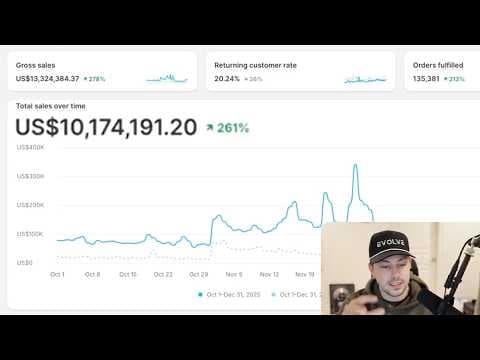
As you see on screen, so far year to date in 2025, I have spent over $5.2 million on Facebook ads alone and returned just shy of 14 million. Today's video, I'm going to answer questions that have come from our consulting community as well as some people in our free community over at Evolve with the goal of helping you better understand what to actu... Read More
Key Insights
- An ad that receives no spend in a CBO campaign is being rejected by Meta's algorithm, which predicts whether a creative will deliver the conversions you asked for. Across a large-scale creative test at the agency, no starved ad ever became a breakout winner later.
- Campaign budget optimization was introduced to raise overall account performance by shifting budget toward ads the algorithm expects to convert cheapest. With a lowest-cost bid strategy, which is recommended for nearly everyone, Meta effectively protects you from wasting money on weak creative.
- Seven days is the minimum window to give a new ad inside a CBO campaign before judging it. That gives Meta time to assess the creative. After that period, continued zero spend means the ad is simply not good enough to scale.
- The 3222 method extends the well-known 322 creative testing structure by adding a second landing page to every test. Three variations of one concept run with two headlines and two body copies, then the same ads are duplicated to a second landing page.
- Testing landing pages inside Meta removes the wait for statistical significance that third-party split testing tools require. The winning page reveals itself through spend and return on ad spend, or the variant simply fails to attract budget, which is its own answer.
- Formal split testing on the website only makes sense at real order volume, which the speaker frames as several thousand orders a month or a monthly revenue figure well into six digits. Below that, in-platform landing page tests are the practical route.
- The in-house versus agency decision hinges on self-assessment: marketing-driven brand owners can build internally, often more cheaply, while product-driven owners should hire an agency. The largest brands frequently run both, using several agencies for different specialist areas.
- Avatar-specific landing pages build trust because the customer journey matches who the ad targeted. A page claiming a product works for everyone weakens the claim, whereas a page full of results from people like the viewer makes the promise credible.
Install to Summarize YouTube Videos and Get Transcripts
Explore YouTube Video Summarizer or Get YouTube Transcript Extractor
Questions & Answers
Q: Why doesn't Facebook spend on my ads in a CBO campaign?
Because Meta's algorithm has judged those ads as unlikely to perform. Campaign budget optimization distributes budget toward the creatives it predicts will produce the most conversions for the lowest cost, so withholding spend is the platform telling you the ad is weak. This has been tested at scale across a large batch of creatives at the speaker's agency, and none of the ads that failed to attract spend in CBO ever went on to become a breakthrough winner. Rather than forcing budget onto the ad, treat the lack of delivery as free feedback and replace the creative.
Q: How long should you let an ad run in a CBO campaign before killing it?
Give it at least seven days so Facebook has time to see what the ad is about and assess it against the rest of the campaign. During that window the algorithm is gathering signal on the creative and deciding whether it can deliver conversions at a competitive cost. If the ad still has not received meaningful spend after that period, the conclusion is straightforward: it is not a good ad. Waiting longer rarely changes the outcome, and the budget is better redirected into fresh creative concepts.
Q: What is the 3222 method for testing creatives and landing pages?
It is an extension of Charlie Tishonor's 322 testing structure. The original means taking one ad concept, producing three variations of it, and running those variations with two headlines and two body copies. The added final digit means you also test two landing pages with every creative test. In practice you send the three creatives with their headline and body copy combinations to a control landing page, then duplicate the same ads with identical copy and point the duplicates at a second landing page carrying whatever you want to test.
Q: How do you test landing pages inside Meta instead of using a split testing tool?
You duplicate an identical set of ads and point one set at your control page and the other at the challenger page, then let campaign budget optimization decide. Because Meta already knows which landing page pairs best with a given ad, it will push budget toward the combination that performs and starve the one that does not. The advantage is speed: you do not have to wait for a third-party tool to reach statistical significance. Either the variant earns spend and hits a strong return on ad spend, or it gets nothing and you have your answer.
Q: When should an e-commerce brand start running formal split tests on its website?
Formal website split testing is worth doing once traffic and order volume are high enough to reach conclusions quickly. The speaker frames the threshold in terms of monthly revenue well into six figures, or alternatively a few thousand orders per month as a cleaner benchmark. Below that level, results take too long to stabilize and the effort is not justified. Even brands running very large daily ad budgets continue to test landing pages inside Meta with the same creative testing structure, reserving dedicated split testing software for more involved on-site experiments.
Q: Should I build an in-house ads team or hire an agency for my e-commerce brand?
Both work, and the biggest brands often run an in-house team alongside multiple agencies covering different specialties. The deciding factor is what kind of founder you are. If you are a marketing-driven owner who understands paid social, build in-house: it is usually cheaper, and early on a strong video editor plus your own creative strategy can carry you a long way. If you are a product-driven founder without marketing instincts, hire an agency, but be careful, because judging ad talent is hard when you lack the skill set yourself.
Q: Why is hiring an agency hard when you don't understand ads yourself?
You are effectively hiring blind. Without the underlying skill set, it is difficult to tell competent operators from poor ones, since both can present confidently and show selective results. Common sense filters out the obvious bad actors, but the finer judgment calls require knowing what good account structure and creative testing actually look like. The counterpoint is that rebuilding an agency's full team internally is slow and expensive, and at smaller revenue levels a single brand would not generate enough work to keep that team occupied.
Q: Should you build a separate product page for each customer avatar?
Yes, particularly once you have winning ads for that avatar, because a matched landing page makes your claims more believable and builds trust. If a woman clicks a skincare ad featuring women and lands on a page claiming the product works for everyone, the promise weakens. A page showing results from people like her converts better. The same applies to distinct niches such as different sports. Test new avatars against a generic page first, then build dedicated pages once an avatar proves itself, using a fast page builder so resources are not drained on custom code.
Summary & Key Takeaways
-
CBO campaigns exist to improve overall performance by letting Meta's algorithm decide where budget goes. When you optimize for purchase conversions on a lowest-cost bid strategy, Meta spends to get the most conversions at the lowest cost, which means it deliberately starves ads it predicts will underperform. Non-spending ads are a verdict, not a bug.
-
Landing pages are tested directly inside Meta using an extended version of Charlie Tishonor's creative testing structure: variations of one concept, paired with a small set of headlines and body copies, then duplicated to point at a second landing page. Meta's spend decisions replace waiting for statistical significance from a third-party split testing tool.
-
Choosing between an in-house team and an agency depends on whether you are a product-driven owner or a marketing-driven owner. Marketing-minded owners can scale a long way with a strong video editor handling creative strategy. Product-focused owners are better served hiring an agency, since judging ad talent blind is hard without the skill set yourself.
-
Separate product detail pages per avatar convert better because they make claims more believable. Skincare marketed to men should land on a page showing men's results, not a page claiming the product works for everyone. New avatars are tested against a generic page first, and dedicated pages get built only once an avatar shows traction.
Read in Other Languages (beta)
Share This Summary 📚
Summarize YouTube Videos and Get Video Transcripts with 1-Click
Try YouTube Summary with ChatGPT & Claude or YouTube Transcript Generator
Explore More Summaries from Spencer Pawliw 📚
Summarize YouTube Videos and Get Video Transcripts with 1-Click
Try YouTube Summary with ChatGPT & Claude or YouTube Transcript Generator