How to Fix Five Shopify Conversion Rate Killers
TL;DR
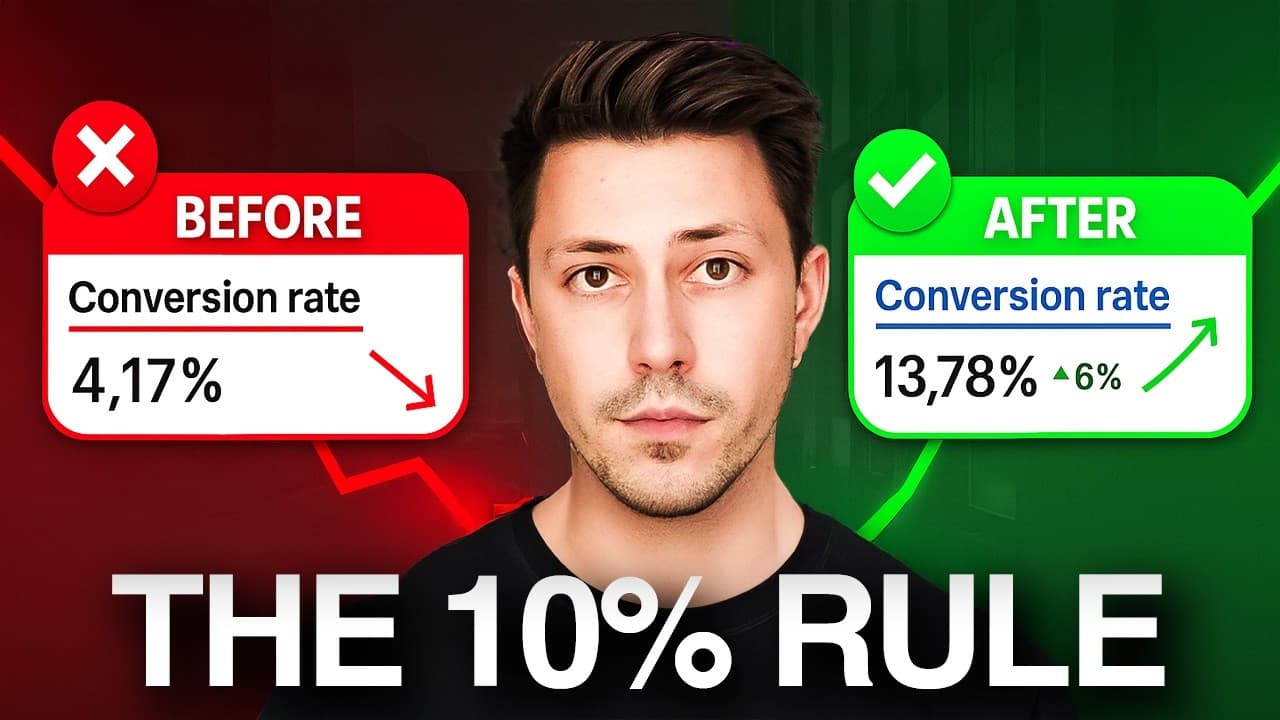
Improve an online store’s conversion rate by split testing changes until they reach statistical significance, clearly presenting essential purchase logistics, giving bundles a reason, controlling shipping charges, and matching landing pages to ads and offers. These fixes reduce uncertainty and prevent short-term fluctuations from being mistaken for reliable evidence that a store change improved performance.
Transcript
Your online store conversion rate is one of the most important metrics for your entire business. And if you take a look at on screen here, we actually have a brand that is converting over 3% with a $261 average order value. If you multiply those two things, you will get a Shopify score, which is basically how healthy your store is of $82. Now, our ... Read More
Key Insights
- A store health score is calculated by multiplying average order value by conversion rate. The agency featured in the transcript targets 250 for every brand it works with and treats a result below that level as an opportunity to improve conversion performance.
- Statistical significance is necessary before treating a test result as dependable. A short experiment can appear successful because buyers with stronger intent happened to reach one version, while visitors with little intent happened to reach the other version.
- An A/A test can reveal the danger of random variation because it compares two identical pages. In the example, identical pages appeared to differ by 55% in revenue per visitor after three or four days, despite neither page containing a substantive change.
- Small order counts are insufficient evidence for publishing a winning variation. The example produced only 13 control orders and 16 variant orders from roughly 600 store visitors, while average order value differed by more than approximately $60 even though the same product was sold.
- Proper purchase logistics reduce customer uncertainty about whether a product will work for them. For apparel, useful information includes an accurate size guide, sizing assistance, reviewer height and weight, purchased size, fit feedback, and dedicated options such as tall sizes.
- Shipping, return, exchange, fit, and guarantee details should be easy for shoppers to find. The True Classic example places free returns and exchanges, perfect-fit messaging, and a 100-day made-to-last guarantee near the product information to support purchase confidence.
- Bundles need a clear reason for customers to choose them. The recommended presentation includes an explanatory label and a default selection for the bundle most likely to be purchased, rather than offering a bundle without context or guidance.
- Congruent landing pages connect the promise in an advertisement with the offer shoppers encounter after clicking. Testing these pages and their offers is presented as a way to unlock greater scale, while the suggested shipping guideline is to keep the charge near 10% or test it.
Install to Summarize YouTube Videos and Get Transcripts
Explore YouTube Video Summarizer or Get YouTube Transcript Extractor
Questions & Answers
Q: How can I identify conversion rate problems in a Shopify store?
Calculate the store health score described in the transcript by multiplying average order value by conversion rate. The agency uses 250 as its target for brands it works with, so a score below that target indicates an opportunity for improvement. Then inspect five areas: testing quality, purchase logistics, bundle reasoning, shipping charges, and congruence between advertisements, offers, and landing pages.
Q: Why should Shopify changes be tested for statistical significance?
Statistical significance helps determine whether an observed difference is likely to persist instead of reflecting ordinary good and bad days. Without it, a merchant might publish a change because performance improved for three to five days, even though higher-intent buyers simply reached one page by chance. That mistaken conclusion can leave a harmful change active while sales later decline.
Q: What does an A/A test reveal about conversion data?
An A/A test compares two versions of the same page, so a large apparent difference demonstrates how random visitor behavior can distort early results. In the example, identical pages showed a 55% increase in revenue per visitor after three or four days. Because the pages were unchanged and the sample was small, the apparent winner was not reliable evidence of improvement.
Q: How long should an ecommerce split test run?
A split test should continue until its visitor and conversion data produce a statistically significant result, rather than stopping after an arbitrary three to five days. The transcript recommends entering visitors and conversions for both variants into the calculator at abestguide.com/calc. A test should not be treated as conclusive while that calculator reports that the result is not significant.
Q: Why are small ecommerce test samples misleading?
Small samples allow a few purchases or unusually large orders to create dramatic percentage differences. One example had roughly 600 visitors, 13 control orders, and 16 variant orders, while average order value differed by more than approximately $60 despite both pages selling the same product. The coin-flip analogy shows why a short streak does not establish dependable future odds.
Q: What logistics information should a product page include?
A product page should provide every practical detail customers need to decide confidently, including sizing, shipping, returns, exchanges, fit, and guarantees. For clothing, the transcript highlights accurate size guides, sizing tools, reviewer height and weight, purchased sizes, and fit reports. True Classic also displays tall-size options, free returns and exchanges, perfect-fit messaging, and a 100-day guarantee.
Q: How should product bundles be presented to improve conversion?
A product bundle should include a clear reason that explains why the customer should choose it. The transcript also recommends applying a label and selecting by default the bundle most likely to be purchased. This presentation gives shoppers context and direction, addressing the conversion problem created when a store groups products together without explaining the value or purpose of that choice.
Q: How do shipping charges and landing pages affect conversion?
Shipping charges can discourage purchases when they feel too high, so the transcript recommends following a 10% rule or split testing shipping charges to see whether additional margin is possible. Landing pages should also be congruent with their advertisements and offers. Testing aligned landing pages and ad offers is presented as a way to improve conversion performance and scale the brand further.
Summary & Key Takeaways
-
The store health metric presented is calculated by multiplying average order value by conversion rate. The agency targets a score of 250 for its brands, while examples include a store with a $261 average order value and conversion above 3%, plus another with a $73 average order value and 4.5% conversion.
-
Store changes should be evaluated through controlled split tests that continue until statistical significance is reached. An A/A test of identical pages appeared to show a 55% revenue-per-visitor increase after several days, but only 13 and 16 orders were recorded, demonstrating how small samples can produce misleading differences.
-
Other conversion problems include missing sizing, shipping, return, exchange, fit, and guarantee information; bundles presented without a clear reason; shipping charges exceeding the suggested 10% guideline; and landing pages that do not match their ads. The recommended remedies focus on removing uncertainty and keeping the buying experience congruent.
Read in Other Languages (beta)
Share This Summary 📚
Summarize YouTube Videos and Get Video Transcripts with 1-Click
Try YouTube Summary with ChatGPT & Claude or YouTube Transcript Generator
Explore More Summaries from Spencer Pawliw 📚


Summarize YouTube Videos and Get Video Transcripts with 1-Click
Try YouTube Summary with ChatGPT & Claude or YouTube Transcript Generator