How to Scale Ecommerce With High-Intent UGC
TL;DR
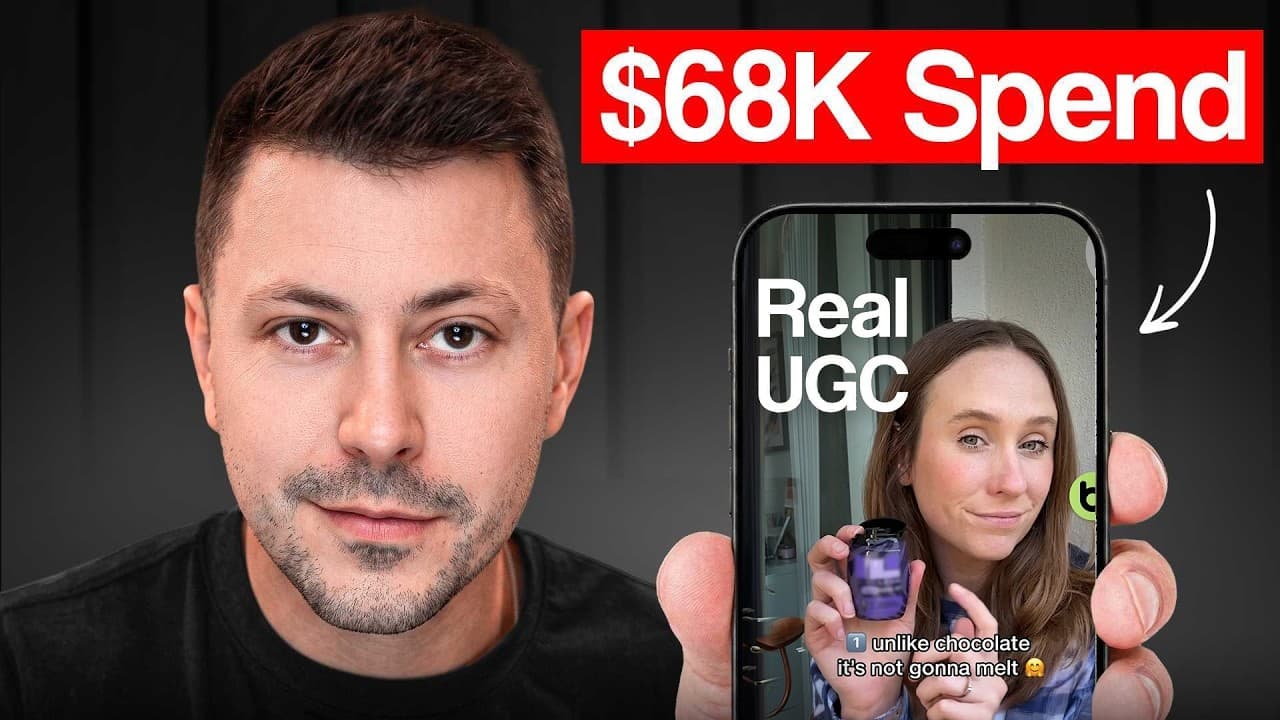
UGC performance depends more on creative strategy than on whether the creator is human or AI. The featured account spent over $68,000 of a $112,000 day on UGC and TikTok Shop content, with most of that spend concentrated among three or four strong creators. The recommended approach is to develop real creators through close collaboration while using AI transparently for narration, animation, B-roll, and otherwise difficult visuals.
Transcript
As you see on screen, this ad account just as of yesterday spent over $112,000 in a single day. And although it is blurred on the left-hand side here, four of the top five videos are actually UGC videos. And on this same day, if we filter by just UGC or TT, which stands for TikTok Shop Content, you can see that we spent over $68,000 of that $112,00... Read More
Key Insights
- Creative strategy is the main factor behind effective UGC, regardless of whether the visible creator is human or generated by AI. Producing many videos can uncover winners, but deliberate concepts, stronger scripts, better filming, and informed iteration can concentrate results among a small group of creators.
- UGC represented over $68,000 of a $112,000 advertising day in the featured account. Four of the five highest-spending videos were UGC, showing that real creator content can still absorb substantial advertising spend when it is supported by an effective strategy.
- Fake AI authority figures are a risky advertising tactic because they present generated people as doctors, veterinarians, or other trusted experts. The transcript reports that advertisers using this approach were having ads banned as platforms improved their ability to distinguish AI people from real people.
- Transparent AI content is presented as a stronger long-term use of generative tools. Claymation, cartoons, animated products, AI narration, and visually distinctive scenes make use of AI's capabilities without pretending that a generated spokesperson personally uses or endorses the advertised product.
- AI avatars can narrate a real person's story without impersonating an authority or claiming direct product experience. One suggested format places an avatar in the corner to introduce a real founder and recount that founder's story, extending the established use of AI voiceovers with a visible narrator.
- The volume UGC strategy works by recruiting many creators and generating thousands of weekly videos, often through TikTok Shop. Brands can identify useful content from this large supply and apply it to Meta advertising, while organized communities and feedback systems help participating creators improve.
- The high-intent UGC strategy focuses resources on a few promising creators and carefully developed advertisements. Instead of asking an in-house creator to make about 30 weekly videos, the team may produce three videos intended to support hundreds of thousands of dollars in spend, ideally millions.
- Creator development is a continuing feedback process involving calls, reviews, shared learnings, script assistance, filming guidance, editing support, and concept iteration. Because creators handle many production responsibilities, collaboration with a skilled creative strategy team can improve both their execution and future advertising output.
Install to Summarize YouTube Videos and Get Transcripts
Explore YouTube Video Summarizer or Get YouTube Transcript Extractor
Questions & Answers
Q: How can ecommerce brands scale with UGC ads?
Ecommerce brands can scale UGC by choosing either a high-volume creator system or a focused, high-intent process. The featured team concentrates spend among three or four strong creators and works closely with them on concepts, scripts, filming, editing, reviews, and iterations. Its account spent over $68,000 on UGC and TikTok Shop content during a day when total advertising spend exceeded $112,000.
Q: Is real UGC still effective for ecommerce advertising?
Real UGC remains effective when it is supported by a strong creative strategy. In the featured account, four of the five highest-spending videos were UGC, and UGC plus TikTok Shop content accounted for over $68,000 of more than $112,000 spent in one day. The results were concentrated among three or four strong creators rather than depending on AI avatars or indiscriminate content production.
Q: What is high-intent UGC advertising?
High-intent UGC is a focused production approach in which a brand develops a small number of carefully planned videos with selected creators. The team described may ask an in-house creator to produce three weekly videos rather than about 30, then support those videos with research, scripts, filming advice, editing help, reviews, and iterations. Each strong video is expected to carry substantial advertising spend.
Q: How does volume UGC differ from high-intent UGC?
Volume UGC relies on thousands of creators and videos, often sourced through TikTok Shop, to create many opportunities for a winning advertisement. High-intent UGC uses fewer creators and fewer videos but gives each concept considerably more strategic attention. Both approaches can work, and volume-focused brands may also coach their strongest creators individually to improve future advertisements through structured feedback loops.
Q: How should brands use AI in UGC advertising?
Brands can use AI transparently for narration, B-roll, claymation, cartoon or Pixar-style scenes, animated products, and visual clips that would be difficult to obtain elsewhere. An AI avatar can also narrate a real founder's story without pretending to be that founder or an independent expert. The recommended principle is to make AI's role clear and use it for distinctive creative possibilities rather than deceptive human imitation.
Q: Why are fake AI authority figures risky in ads?
Fake AI authority figures mislead viewers by presenting generated people as doctors, veterinarians, or other experts who appear to provide genuine advice. The transcript reports that people using AI authorities were having their advertisements banned as platforms became better at recognizing generated people. The practice is also rejected as a long-term strategy because marketing built on false identity claims can damage customer trust.
Q: How can brands help UGC creators make better ads?
Brands can improve creator performance by establishing repeated feedback loops with their strongest contributors. Useful support includes collaborative calls, video reviews, shared learnings, better concept development, script assistance, filming guidance, editing advice, and clear iteration ideas. This support matters because individual creators are responsible for many parts of production, while a dedicated creative team can contribute deeper strategic expertise.
Q: When should a brand use TikTok Shop content on Meta?
A brand can use TikTok Shop as a large content-sourcing system when it can recruit many creators and generate thousands of weekly videos. Strong content found through that process can then be applied to Meta advertising. The approach is described as a legitimate strategy used by major TikTok Shop brands, although the featured team personally relies more heavily on a smaller group of high-intent creators.
Summary & Key Takeaways
-
The account spent more than $112,000 in one day, including over $68,000 on UGC and TikTok Shop content. Four of its five highest-spending videos were UGC. These results support the central argument that real creator content remains viable when brands apply a deliberate creative strategy instead of producing videos without direction.
-
AI content is used most effectively when its artificial nature is clear. Recommended applications include claymation, cartoon or Pixar-style visuals, animated products, AI narrators, and B-roll that would be difficult to capture elsewhere. Fake AI doctors, veterinarians, or other authority figures are discouraged because they mislead customers and risk platform enforcement.
-
Real-creator UGC can follow a volume strategy or a high-intent strategy. TikTok Shop brands may source thousands of weekly videos from large creator networks, while the featured team develops fewer concepts with selected creators. Its highest-spending UGC is concentrated among three or four creators who receive strategic, scripting, filming, editing, and iteration support.
Read in Other Languages (beta)
Share This Summary 📚
Summarize YouTube Videos and Get Video Transcripts with 1-Click
Try YouTube Summary with ChatGPT & Claude or YouTube Transcript Generator
Explore More Summaries from Spencer Pawliw 📚


Summarize YouTube Videos and Get Video Transcripts with 1-Click
Try YouTube Summary with ChatGPT & Claude or YouTube Transcript Generator