How to review ads to spot winning copy patterns
TL;DR
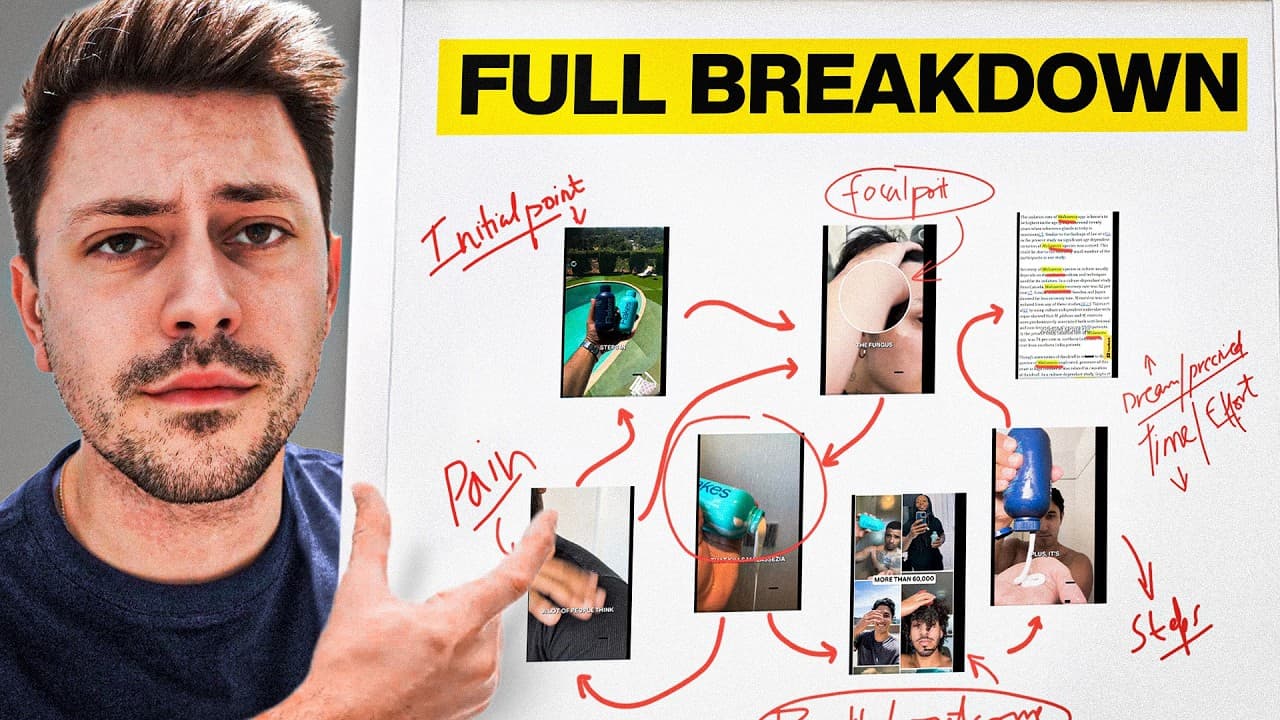
Spot winning ads by analyzing the first two seconds hook, the factual claims, and what the audience values. Break down frame by frame to see how authority is built, beliefs are challenged, and curiosity is created. Use these insights to craft scalable ads that convert.
Transcript
In this video, I'm going to show you how to actually break down and review an ad from a customer perspective, so you can know what is actually happening, the emotions that are being created, the copywriting strategies that are being used, so that way you can apply them to your own brand to actually be able to create ads that can help you scale a lo... Read More
Key Insights
- Ads win when hooks grab attention in the first two seconds.
- Perceived value is driven by speed, low effort, and high payoff likelihood.
- Facts build authority better than opinions in marketing.
- Challenging a common belief creates curiosity and keeps viewers watching.
- Destructive or dramatic visuals can increase scroll-stoppage when tied to a clear payoff.
- Framing moves from problem to solution to a twist, sustaining interest.
- Naming the enemy or opposing belief can position the product as the logical fix.
- Mentioning the specific fungus Malassezia provides concrete context for dandruff solutions.
Install to Summarize YouTube Videos and Get Transcripts
Explore YouTube Video Summarizer or Get YouTube Transcript Extractor
Questions & Answers
Q: How do you begin analyzing a high performing ad frame by frame?
Begin by noting the hook within the first two seconds, then assess how the presenter frames the problem and introduces the claim. Pay attention to the language that creates curiosity gaps and the way visual elements are used to stop scrolling. This setup primes viewers to accept later explanations as credible.
Q: What value drivers should you identify in ad copy?
Identify what customers value most, such as speed, minimal effort, and high likelihood of success. These factors influence how the advertiser phrases promises and structure, shaping the perceived payoff and the urgency to watch further. Reflecting these drivers helps craft hooks that resonate with the audience.
Q: Why is stating facts more effective than opinions in this context?
Facts establish credibility and trust, making viewers more likely to accept subsequent claims. The presenter emphasizes converting opinions into facts, which helps position the brand as an authority and reduces resistance, particularly when discussing complex topics like dandruff causation and treatment.
Q: How can you create a curiosity loop in an ad?
Introduce a claim that contradicts common beliefs and then reveal the actual mechanism later. By challenging what viewers think they know and providing new information, you create an open loop that motivates continued watching to learn the resolution.
Q: What role does the visual of dandruff play in the ad review?
Visuals that show a tangible, potentially gross effect grab attention and illustrate the problem dramatically. When paired with an easy solution claim, they improve engagement by making the issue vivid while reinforcing the perceived payoff.
Q: What is the benefit of framing the problem as easier than expected?
Framing the problem as easier than expected lowers perceived barrier to action and increases openness to the solution. It creates a quick, relatable entry point that encourages viewers to believe there is a simple fix.
Q: How does the video describe the cause of dandruff?
The video explains that dandruff is caused by a fungus called Malassezia that feeds on oil. This factual basis helps reframe the problem from a general scalp issue to a specific biological cause, enabling a targeted solution claim.
Q: Why is it important to name an enemy or opposing belief in ad copy?
Naming an enemy or opposing belief sharpens contrast and positions the product as the logical fix. It creates a clear villain in the narrative, which can mobilize viewers to accept the advertised solution as the superior option.
Summary & Key Takeaways
-
A frame-by-frame breakdown shows how a winning ad captures attention quickly, establishes relevance, and builds credibility through factual statements rather than opinions, guiding viewers toward the product as the logical solution.
-
The analysis highlights value drivers like speed, low effort, and high likelihood of payoff, explaining why hooks that emphasize easiest solutions outperform more complex routines in direct response.
-
The video demonstrates transforming a product pitch into a structured truth claim, using audience psychology to create open loops and a twist that keeps viewers watching and trusting the advertiser.
Read in Other Languages (beta)
Share This Summary 📚
Summarize YouTube Videos and Get Video Transcripts with 1-Click
Try YouTube Summary with ChatGPT & Claude or YouTube Transcript Generator
Explore More Summaries from Spencer Pawliw 📚





Summarize YouTube Videos and Get Video Transcripts with 1-Click
Try YouTube Summary with ChatGPT & Claude or YouTube Transcript Generator