How to Turn Customer Research Into Meta Ads
TL;DR
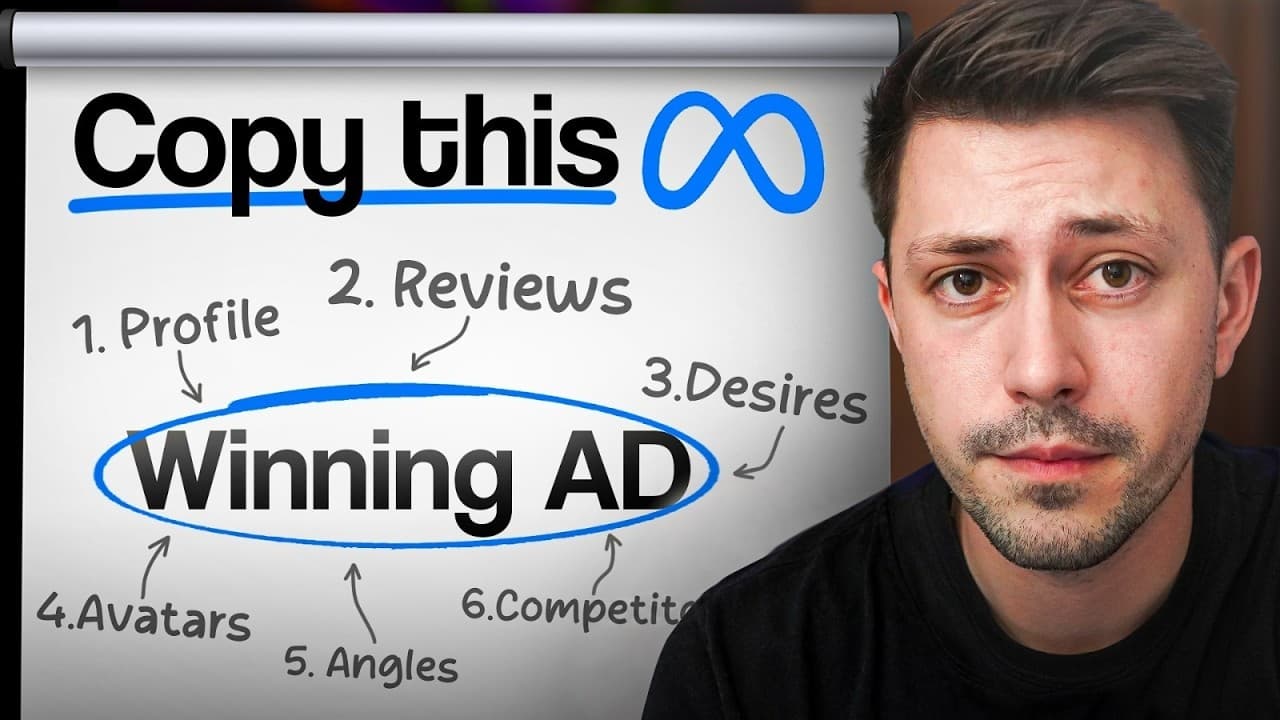
Organize research around customer desire, product mechanism, authority, awareness level, avatar, and angle before writing a Meta ad. Ads often fail because the research remains product-focused, demographic details contribute little to the message, and the final creative does not clearly communicate why the customer should care. Writing inside the final creative environment can make copy clearer and easier to execute.
Transcript
So, you've spent the time doing research. You've gone to Amazon reviews. You've looked at your competitors. You've used tools to look at different ads for inspiration. You've gone on Reddit to try to understand your customers a little bit better. Maybe you've even gone deeper and applied some marketing fundamentals like you've tried to identify des... Read More
Key Insights
- Execution is presented as the primary reason researched Meta ads fail to scale in 2026 and beyond. Collecting customer insights, competitor examples, and proven copy structures does not guarantee success when those inputs are translated poorly into the finished creative.
- Research organization is a required bridge between information gathering and ad production. The recommended framework separates the material into desire, mechanism, authority, awareness level, avatar, and angle so each ad has a defined strategic foundation before copy or editing begins.
- Customer desire is the want or need that the ad chooses to pursue. For the canned cod example, the selected desire is hitting protein goals because it is considered strong, urgent, and replenishable within the framework described in the transcript.
- The product mechanism is the specific way the offer delivers its result. David Protein's example uses 99% Atlantic cod, 1% salt, packing in its own juices, and the absence of oil, brine, or fillers that could affect the macros.
- Authority is strengthened by concrete sourcing information in the product story. Describing the cod as wild-caught Atlantic cod from Greenland makes the claim more specific and supports a perception of fresh, credible fish rather than relying only on the generic word "cod."
- Awareness level determines where an ad meets customers in their buying journey. The example selects solution-aware messaging because protein is described as a competitive market in which many customers already know relevant products or solutions, rather than needing a problem-aware introduction.
- Demographic avatars are mostly unhelpful when their details never influence the creative. Information such as being a 25–35-year-old man, living in California, having no children, working out, or enjoying the beach adds little unless it changes the message or execution.
- Product-focused headlines can sound polished without becoming effective ads. Lines about packing methods, Greenland sourcing, or missed protein grams may have a strong ring, but they still rely mainly on the product to sell itself instead of communicating a sharper customer-focused reason to buy.
- More videos from this channel:
- More from this channel: Spencer Pawliw
Install to Summarize YouTube Videos and Get Transcripts
Explore YouTube Video Summarizer or Get YouTube Transcript Extractor
Questions & Answers
Q: How do you turn customer research into a Meta ad?
Start by organizing the research into six components: desire, mechanism, authority, awareness level, avatar, and angle. Choose the customer want you will address, identify how the product delivers the result, add credible product specifics, decide where the customer is in the buying journey, retain only useful avatar details, and define the reason someone should buy before writing the creative.
Q: Why do Meta ads fail even after extensive research?
Meta ads can fail because research alone does not ensure effective execution. A marketer may review Amazon feedback, competitors, Reddit discussions, customer desires, avatars, and successful ads, then ask Claude to generate headlines or scripts. If the resulting creative does not communicate those findings clearly, the preparation remains disconnected from the final ad and does not produce a scalable result.
Q: What is the execution issue in Meta advertising?
The execution issue is the failure to translate useful research into a finished ad that communicates effectively. It can occur even when the marketer has a strong prompt, proven script structure, competitor inspiration, and detailed customer research. The transcript identifies poor execution as the primary reason many advertisers cannot scale on Meta in 2026 and beyond.
Q: What research components should be defined before writing an ad?
The six components are desire, mechanism, authority, awareness level, avatar, and angle. Desire identifies what the customer wants. Mechanism explains how the product delivers. Authority supplies credible specifics. Awareness level locates the customer in the product journey. Avatar describes the intended customer, and angle states the reason that person should buy the product.
Q: What is a customer desire in ad research?
A customer desire is a want or need that the advertisement intends to address. In the canned cod example, the chosen desire is reaching protein goals. The selection is based on the presenter's judgment that this desire is strong, has urgency, and is replenishable. It gives the creative a customer-centered objective instead of beginning only with product attributes.
Q: How are mechanism and authority different in an ad?
Mechanism describes how the product provides its benefit, while authority adds details that make the offer more specific and credible. In the example, the mechanism includes 99% Atlantic cod, 1% salt, packing in its own juices, and no oil, brine, or fillers. Authority comes from identifying the fish as wild-caught Atlantic cod from Greenland.
Q: Why are demographic customer avatars often ineffective for ad copy?
Demographic avatars are often ineffective when their details do not affect the actual message. The example avatar includes a 25–35-year-old man who might live in California, have no children, work out frequently, and enjoy the beach. The criticism is that most of this information is useless unless it helps determine what the ad says or how the creative presents it.
Q: Why should ad copy be written in the final creative environment?
Writing ads directly in the final creative environment can make the copy sharper, clearer, and easier to execute, according to the description. It helps connect the written message with the format customers will actually see. This addresses the broader execution problem in which organized research and generated headlines fail to survive as effective communication in the finished advertisement.
Summary & Key Takeaways
-
The central problem is often execution, not a lack of research. Marketers may study Amazon reviews, competitors, Reddit discussions, customer desires, avatars, and existing ads, then use Claude to generate copy. Despite that preparation, the finished creative can still fail because it does not communicate the underlying research effectively.
-
Research should be organized into six practical components before ad creation: desire, mechanism, authority, awareness level, avatar, and angle. For David Protein's canned cod, the example desire is hitting protein goals, while the mechanism emphasizes 99% Atlantic cod, 1% salt, its own juices, and no oil, brine, or fillers.
-
Product-focused facts are not enough in a competitive protein market. Details such as wild-caught Atlantic cod from Greenland can supply authority, but the ad still needs a customer-focused reason to buy. The proposed angle connects dense protein with few calories, while solution-aware messaging meets customers who already recognize possible product categories.
Read in Other Languages (beta)
Share This Summary 📚
Summarize YouTube Videos and Get Video Transcripts with 1-Click
Try YouTube Summary with ChatGPT & Claude or YouTube Transcript Generator
Explore More Summaries from Spencer Pawliw 📚
Summarize YouTube Videos and Get Video Transcripts with 1-Click
Try YouTube Summary with ChatGPT & Claude or YouTube Transcript Generator