How Did Spencer Scale eCom Brands From $0 to $150M+ With Ads?

TL;DR
Spencer scaled eCom brands by concentrating on three controllable levers: creative, landing pages and offers. His agency found that proper funnels could move brands from $30,000 to $50,000 in monthly ad spend into the $200,000 to $300,000 range, while one Sean-edited video generated about $1 million in sales. Read on for the operating model behind those results.
Transcript
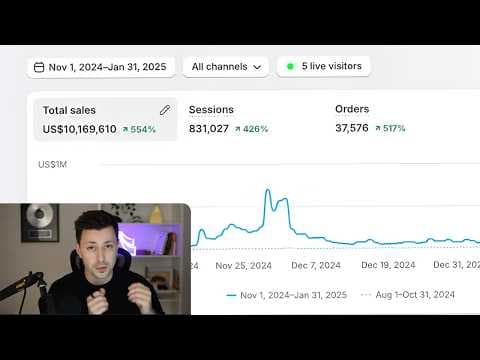
We did $10 million in 90 days on Shopify. We ended up winning school games in November of last year. And I just realized what he was doing was not that complex. I noticed every like eight and nine figure brand was all running LPS. Like 90% of them just be clear, tell people what they want to hear and give them a reason to keep going down. We actual... Read More
Key Insights
- A setback created commitment: Spencer did not treat his first eCom year as a serious agency-building period because crypto remained a major side pursuit. The loss of his money in the 2022 market changed that balance. Needing to figure out the agency gave him a concrete reason to apply more intent before going all in during 2023.
- Visible scale changed ambition: Eddie's description of a 200-person team projected to do more than $20 million made large-scale agency operations feel attainable to Spencer. He concluded that the underlying work was not excessively complex and began scaling hard. That decision eventually took his team to roughly 30 people before the business evolved again.
- Training became a separate asset: The original program was designed to solve an internal hiring problem, not to launch a new company branch. Spencer needed many recruits to learn without receiving repeated one-to-one instruction. By documenting the agency's process once, he created an asset that could train employees and later support paying consulting members.
- Sean unlocked program distribution: Sean saw commercial potential in material Spencer had built for employees and suggested selling access for a couple hundred dollars. He then used Twitter to share what the team was doing. That public distribution helped Evolve take off rapidly and showed Spencer how operational knowledge could become its own scalable offer.
- Consulting absorbed growth differently: Evolve closed more than $50,000 in one month while pursuing the Skool Games win. Spencer contrasted this with an agency, where the same amount of newly closed work could overwhelm delivery and possibly break the operation. The observation explains why the consulting model offered a different path for expansion than client services alone.
- Advanced brands joined Evolve: Spencer expected the consulting program to attract many beginner brands, but its membership also included operators producing six, seven and eight million dollars each month. This changed the character of the community. Evolve was not merely introductory education, because substantial brands were participating and exchanging methods inside it.
- Boutique delivery supports research: After reaching about 30 people, the agency became a boutique operation with a team of roughly 15. It now aims to work with large brands and explore their scaling problems deeply. The consulting program benefits because the agency can pass current findings from client work directly to its members.
- Profitability defines successful scale: Raising an advertising budget is mechanically easy, but Spencer's actual objective is to increase spending profitably. Creative, the destination landing page and the offer determine whether a brand has earned room to scale. The higher budget is therefore a consequence of stronger underlying economics, not the agency's starting tactic.
- Creative displaced media buying: The agency initially operated more like a conventional Facebook ads service, but testing during 2022 and 2023 pointed to creative as the performance driver. Spencer says media buying became commoditized as Shopify made connecting Facebook ads straightforward. The team consequently invested in video editors, graphic designers and copywriters.
- Storytelling drives creative performance: The agency's creative strategy engine emphasizes high-intent storytelling advertisements and static creative. Spencer identifies storytelling as its best-performing creative type at the time discussed. One video that Sean conceived and edited produced about $1 million in sales for a brand, helping Spencer and Sean recognize the importance of creative execution.
- UGC requires trained storytellers: A second creative engine recruits creators and trains them to produce viral videos that can also run as advertisements. This goes beyond gathering generic user-generated footage. The agency wants creators who can tell stories effectively, because the content must capture attention organically while remaining usable for paid acquisition.
- Landing pages unlock larger budgets: Spencer observed that about 90 percent of eight and nine-figure brands were running landing pages. His team found that clear pages, which tell visitors what they want to hear and give them reasons to continue, created major lifts. Proper funnels helped multiple brands advance from $30,000 to $50,000 in monthly spend toward $200,000 to $300,000.
Install to Summarize YouTube Videos and Get Transcripts
Explore YouTube Video Summarizer or Get YouTube Transcript Extractor
Questions & Answers
Q: How did Spencer scale eCom brands from $0 to $150M+ with ads?
Spencer's agency focused on three primary levers: creative, landing pages and offers. It built teams for storytelling ads, static creative and UGC, while shifting attention away from media buying alone. The team also replaced broad CRO work with landing pages after proper funnels produced larger lifts for its clients. These improvements enabled profitable budget increases, including moving multiple brands from $30,000 to $50,000 in monthly spend toward $200,000 to $300,000.
Q: How did Spencer get started in eCommerce?
Spencer entered eCom in 2021 after returning from college, where he had played baseball. He calls himself a COVID graduate and says he wanted to enter the make-money-online space. Crypto was also booming, so he divided his attention and gained only about two agency clients that first year. After the 2022 crypto market wiped out his money, he treated the agency more intentionally and went all in during 2023.
Q: Why did creative become more important than media buying?
The agency began testing creative seriously around 2022 and 2023 and concluded that creative was what made performance. Spencer viewed media buying as increasingly commoditized because Shopify provided an easy connection to Facebook ads. He responded by building teams of video editors, graphic designers and copywriters. The change mattered because stronger advertisements created the performance needed to justify higher, profitable spending.
Q: What landing page strategy helped brands scale ad spend?
Spencer noticed that about 90 percent of eight and nine-figure brands were using landing pages. His approach was to make the page clear, tell visitors what they wanted to hear and provide a reason to continue downward. The agency says proper funnels moved multiple brands from roughly $30,000 to $50,000 in monthly ad spend into six figures, including $200,000 to $300,000. Those results made landing pages one of its three central services.
Q: Why did Spencer move away from traditional CRO?
Traditional CRO involved split-testing details such as buttons, reviews and videos, then waiting for statistical significance. Spencer says this approach was appropriate mainly for brands doing around $1 million per month or more. Many agency clients lacked enough traffic, so the large CRO team became difficult to justify. The agency redirected that capability toward dedicated landing pages because funnels produced more meaningful lifts for those brands.
Q: What is Evolve, and how did it begin?
Evolve is the consulting branch that grew from Spencer's internal employee training program. He originally documented the agency's methods so he would not need to train every new hire one-to-one. Sean suggested selling the program for a couple hundred dollars and began sharing their work on Twitter. The program then grew rapidly, won Skool Games and became the number one eCom community on Skool at the time discussed.
Q: What are the agency's two creative engines?
The first engine is creative strategy, which produces high-intent storytelling advertisements and static creative. Storytelling was the agency's best-performing format at the time discussed. The second is a UGC content engine that recruits creators and trains them to become stronger storytellers. Those creators make viral videos that can also run as advertisements, giving brands another source of scalable creative.
Q: How do the agency and Evolve support each other?
The agency operates as a boutique team of about 15 people and concentrates on substantial brands. Its team goes deeply into the practical problems of increasing advertising spend profitably. Spencer then shares the resulting methods and discoveries with Evolve's consulting members. This connection gives the program lessons from active client work while the agency benefits from concentrating on fewer, larger engagements.
Summary & Key Takeaways
-
Starting after a difficult reset: Spencer describes himself as a COVID graduate who returned from college after playing baseball and entered eCom in 2021. He was also pursuing crypto, so the agency gained only about two clients during its first year. After the crypto market wiped out his money in 2022, he approached the agency with greater intent. He went all in during 2023, setting the foundation for a larger expansion the following year.
-
Scaling the agency in 2024: Spencer attended Eddie's event and heard how Eddie had built a 200-person team projected to generate more than $20 million. That example made the opportunity appear less complex and prompted Spencer to pursue aggressive growth. His own agency expanded to roughly 30 people. Because hiring at that pace required repeatable instruction, he created a program that could train team members without forcing him to teach every person individually.
-
Turning training into Evolve: Spencer's partner Sean proposed selling the internal training program for a couple hundred dollars, creating the consulting branch called Evolve. Sean shared their methods on Twitter, and the program grew rapidly. Evolve won Skool Games in November after closing more than $50,000 in a single month. The result led Spencer to meet Alex Hormozi and Sam, then present what Evolve had done at Eddie's January 2025 event.
-
Combining consulting with boutique delivery: Evolve became the number one community on Skool at the time of the conversation. Although Spencer expected many beginners, the membership included brands producing six, seven and eight million dollars per month. Meanwhile, the agency contracted to a boutique team of about 15 people serving large brands. That arrangement lets the agency study difficult scaling problems deeply, then share what it discovers with members of the consulting program.
-
Focusing on profitable ad growth: Spencer defines the agency's job as spending as much as physically possible while remaining profitable. Its approach centers on creative, landing pages and offers, rather than treating media buying as the decisive advantage. The team develops storytelling ads, static creative, UGC content and proper funnels. Its experience included producing $10 million in 90 days on Shopify and helping brands move from modest monthly ad budgets into six-figure spending levels.
Read in Other Languages (beta)
Share This Summary 📚
Summarize YouTube Videos and Get Video Transcripts with 1-Click
Try YouTube Summary with ChatGPT & Claude or YouTube Transcript Generator
Explore More Summaries from Spencer Pawliw 📚

Summarize YouTube Videos and Get Video Transcripts with 1-Click
Try YouTube Summary with ChatGPT & Claude or YouTube Transcript Generator