10 Best Physics Videos on YouTube

Sep 15, 2026
17 min read
36 views
Last updated: September 2026
This is a ten-video sequence about physics, ordered as a path rather than a ranking. It is for viewers who want to move from quantum ideas to the technologies, experiments, and explanations built around them.
The full set runs just under five hours. Several videos have remained useful for years, including Big Think on physics and modern technology, Kurzgesagt – In a Nutshell on quantum computers, and TED-Ed on Schrödinger's cat.
The videos on this list, in the order to watch them, are:
What Is the Many-Worlds Interpretation of Quantum Mechanics? (Veritasium)
What Has Physics Done for Modern Technology? (Big Think)
What Are Quantum Computers and How Do They Work? (Kurzgesagt – In a Nutshell)
How Does Quantum Mechanics Influence Particle Paths? (Veritasium)
Does Quantum Entanglement Act Faster Than Light? (Veritasium)
How Does Physics Work? Gravity, Energy & Electromagnetism (Wacky Science)
Why Do Shaken Soda, Melting Ice, and a Ring on a Chain Behave So Strangely? 3 Physics Problems Explained (Veritasium)
What Is Schrödinger's Cat and Its Role in Quantum Physics? (TED-Ed)
What Is Quantum Reality: Understanding Space, Time, and Entanglement? (World Science Festival)
Quantum Computing Expert Explains One Concept in 5 Levels of Difficulty | WIRED (WIRED)
Total: 10 videos, 291 minutes of watch time (4 hours 51 minutes), and 140.1M combined views.
1. What Is the Many-Worlds Interpretation of Quantum Mechanics?
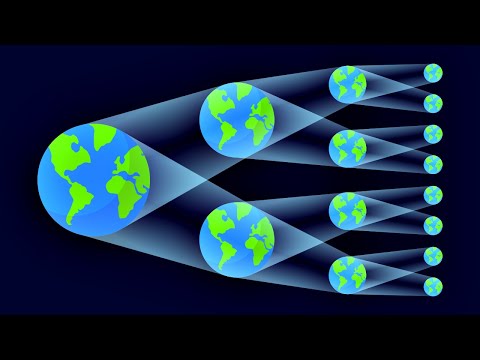
"Parallel Worlds Probably Exist. Here’s Why" · Veritasium · 20 min · 23M views · 2020
In short: The Many-Worlds Interpretation says every possible outcome of a quantum event occurs in a separate branch of reality.
Start here because the video establishes the central break between classical and quantum physics. Classical mechanics predicts future behavior from known initial conditions, while quantum mechanics uses a particle's wave function to calculate probabilities. Veritasium then presents Many-Worlds as an interpretation in which the wave function and its continually branching outcomes form the complete picture, so no single possible result has to be selected as the only reality.
The concrete bridge is the Born rule, which says that squaring a wave function's amplitude gives the probability of finding a particle at a particular point. Schrödinger's cat turns that mathematical problem into a macroscopic thought experiment: the cat is described as both alive and dead until observation. Many-Worlds answers by assigning the outcomes to separate branches, with each possible result taking place in its own parallel universe.
Key takeaways
Classical mechanics uses deterministic equations, while quantum mechanics relies on wave functions and probabilities.
The Born rule calculates the probability of finding a particle at a specific point by squaring the wave function's amplitude.
Schrödinger's cat highlights the difficulty of applying quantum superposition to a macroscopic object.
The Many-Worlds Interpretation says every possible outcome occurs in a separate branch of reality.
Watch on YouTube · Read the summary and Q&A
2. What Has Physics Done for Modern Technology?

"Michio Kaku: The Universe in a Nutshell (Full Presentation) | Big Think" · Big Think · 42 min · 21M views · 2012
In short: Physics made technologies from lasers and transistors to the internet and medical imaging possible by revealing how matter, energy, and fundamental forces behave.
After an abstract quantum interpretation, this video shows why the underlying science matters outside theory. Michio Kaku connects the study of matter, energy, stars, galaxies, and fundamental forces to devices and systems used in modern life. Its position in the sequence makes the practical stakes clear before the list narrows to quantum computing: understanding nature gives physicists ways to manipulate matter and energy and turn that knowledge into working technology.
The evidence is a wide inventory of those results. Physicists contributed to lasers, transistors, computers, the internet, television, radio, and radar. The same foundation reaches healthcare through x-rays, MRI, and PET scans, technologies used for diagnosis and treatment. These examples connect communication, computation, and medicine to the same discipline, while the study of the universe extends that work toward explaining stars, galaxies, and the forces governing them.
Key takeaways
Physicists contributed to the invention of lasers, transistors, computers, the internet, television, radio, and radar.
Medical imaging technologies connected to physics include x-rays, MRI, and PET scans.
Understanding fundamental forces lets physicists manipulate matter and energy to create new technologies.
Physics also explains the behavior of stars and galaxies and expands knowledge of the universe's origins and future.
Watch on YouTube · Read the summary and Q&A
3. What Are Quantum Computers and How Do They Work?
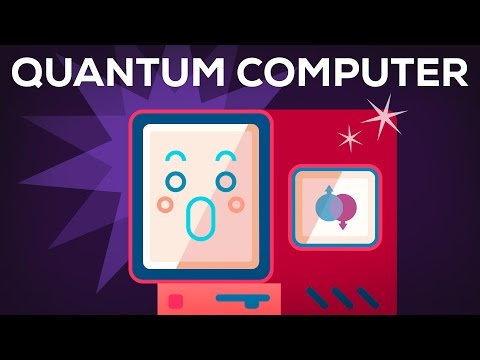
"Quantum Computers Explained – Limits of Human Technology" · Kurzgesagt – In a Nutshell · 7 min · 18M views · 2015
In short: Quantum computers use qubits, superposition, and entanglement to perform parallel calculations that classical bits cannot handle in the same way.
With physics tied to real technology, the sequence now focuses on a device built directly from quantum behavior. Kurzgesagt explains why shrinking classical computer parts toward atomic size introduces physical limits, including quantum tunneling through barriers meant to block electrons. It then replaces the familiar bit with the qubit, which can occupy a superposition of states and use entanglement, opening a different approach to computation rather than merely making existing machines smaller.
The strongest examples are the tasks this approach may change. A quantum search algorithm can find information using only the square root of the usual search time, while quantum machines could threaten encryption systems built around public and private keys. They could also simulate the quantum world more accurately, including molecular problems and protein structures relevant to medicine. The video leaves the scale of the impact open, presenting quantum computers as either specialized tools or a broader technological shift.
Key takeaways
Classical transistors become vulnerable to quantum tunneling as computer components approach the scale of atoms.
Qubits can exist in a superposition of states and use entanglement for parallel computation.
Quantum search can reduce a database search to the square root of the usual search time.
Quantum computers could affect encryption and enable more accurate simulations of molecules and protein structures.
Watch on YouTube · Read the summary and Q&A
4. How Does Quantum Mechanics Influence Particle Paths?

"Something Strange Happens When You Trust Quantum Mechanics" · Veritasium · 33 min · 18M views · 2025
In short: Quantum particles explore every possible path, while constructive interference makes paths of least action the ones most likely to be observed.
The fourth video deepens the quantum rules introduced through qubits by asking what path a particle actually follows. Veritasium rejects the classical picture of one trajectory and presents Feynman's formulation, which calculates probabilities by summing over all possible paths. The principle of least action connects this quantum account back to classical mechanics: nearby paths reinforce one another through constructive interference, making the familiar least-action route the one that becomes visible at ordinary scales.
The double-slit experiment supplies the clearest physical example. Quantum particles can pass through multiple paths and form an interference pattern, displaying both wave-like and particle-like behavior. The explanation follows a historical chain from Planck's quantum of action, which led to quantized energy, through de Broglie's proposal that matter also has wave properties, to Feynman's path integrals. Together, those ideas explain why classical motion can emerge from a calculation that includes every possible route.
Key takeaways
Quantum particles explore all possible paths rather than following only one trajectory.
Feynman's path integral formulation calculates probabilities by summing over every possible path.
Constructive interference favors paths of least action and makes them the paths most likely to be observed.
The double-slit experiment demonstrates the wave-particle duality of quantum objects.
Watch on YouTube · Read the summary and Q&A
5. Does Quantum Entanglement Act Faster Than Light?

"There Is Something Faster Than Light" · Veritasium · 44 min · 16M views · 2025
In short: Entangled particles show non-local correlations that forced physicists to test whether quantum mechanics or predetermined local hidden variables better describes reality.
Once many paths and interference are on the table, the sequence turns to the quantum challenge to locality. Veritasium follows the dispute between Einstein and Bohr over entangled particles, whose linked measurements appear to adjust across distance instantly. Einstein, Podolsky, and Rosen argued that quantum mechanics was incomplete and proposed predetermined local hidden variables, while the Copenhagen interpretation treated the wave function as the complete tool for predicting laboratory results.
Relativity makes the conflict concrete. General relativity replaced instantaneous gravity with changes in spacetime that spread at light speed, so the gravitational effect of the sun disappearing would take about eight minutes to reach Earth. Entanglement brought back an apparent action across distance: measuring one particle fixes the corresponding state of its partner. John Bell's key move was to seek a modified experiment where quantum mechanics and local hidden-variable theories would predict different outcomes.
Key takeaways
Locality says physical effects spread through neighboring regions instead of acting instantly across arbitrary distances.
In an entangled electron-positron pair, the particles have opposite spins even though quantum mechanics assigns neither a definite result before measurement.
The EPR argument contrasted non-local wave-function collapse with predetermined local hidden variables.
Bell searched for an entanglement experiment in which quantum mechanics and local hidden-variable theories made different predictions.
Watch on YouTube · Read the summary and Q&A
6. How Does Physics Work? Gravity, Energy & Electromagnetism

"ALL OF PHYSICS explained in 14 Minutes" · Wacky Science · 14 min · 10M views · 2024
In short: Forces determine acceleration, gravity follows an inverse-square law, energy changes form without disappearing, entropy rises, and moving charges and magnets connect electricity to magnetism.
At the midpoint, this video steps back from quantum interpretation to assemble a compact foundation in classical physics, thermodynamics, and electromagnetism. Wacky Science moves from Newton's force equals mass times acceleration to universal gravitation, energy, work, temperature, entropy, and Maxwell's equations. That reset gives the everyday puzzles next on the list a common vocabulary and shows how several large areas of physics describe motion, change, and fields at familiar scales.
Several examples make the compressed survey concrete. Planets remain in orbit because gravity acts as a centripetal force, so they continually fall toward the sun while missing it. Lifting an apple one meter does about one Joule of work, and braking converts a car's kinetic energy into heat transferred to surrounding air molecules. A moving magnet creates an electric field, while a moving charge creates a magnetic field, producing induction and electromagnetic waves such as visible light.
Key takeaways
Force equals mass times acceleration, so a known force on a fixed mass produces a predictable acceleration.
Gravity between two masses weakens with the square of the distance between them.
Energy cannot be created or destroyed, only converted between forms such as potential energy, kinetic energy, and heat.
Maxwell's four equations connect electric and magnetic fields and describe induction and electromagnetic waves such as light.
Watch on YouTube · Read the summary and Q&A
7. Why Do Shaken Soda, Melting Ice, and a Ring on a Chain Behave So Strangely? 3 Physics Problems Explained

"3 Perplexing Physics Problems" · Veritasium · 14 min · 10M views · 2019
In short: Three familiar puzzles reveal that shaken soda erupts because of nucleation sites, meltwater circulation controls how fast ice melts, and a slight rotation can lock a ring onto a chain.
After the broad survey, this video tests physical reasoning against three demonstrations that resist an obvious first answer. Veritasium examines a shaken carbonated drink, identical ice cubes in fresh and salt water, and a ring dropped onto a closed chain. Its place in the sequence shifts from laws and frameworks to observation: the point is to identify the mechanism that fits what the experiment actually does, even when a familiar explanation sounds plausible.
The pressure gauge is the sharpest correction. An identical bottle reads about 3 atmospheres, or 330 kilopascals, before and after shaking, so increased pressure does not cause the eruption. Shaking instead mixes tiny air bubbles into the liquid, creating nucleation sites where dissolved CO2 escapes rapidly when the bottle opens. In fresh water, cold meltwater sinks and draws warmer water toward an ice cube; in salt water, it stays around the cube and insulates it.
Key takeaways
Shaking a carbonated drink leaves its pressure at about 3 atmospheres, or 330 kilopascals, in the demonstrated setup.
Tiny air bubbles introduced by shaking become nucleation sites where dissolved CO2 rapidly leaves solution.
Ice melts faster in fresh water because cold meltwater sinks and brings warmer water toward the cube.
A slight rotation makes a dropped ring turn about 90 degrees and lock onto a closed loop of chain.
Watch on YouTube · Read the summary and Q&A
8. What Is Schrödinger's Cat and Its Role in Quantum Physics?
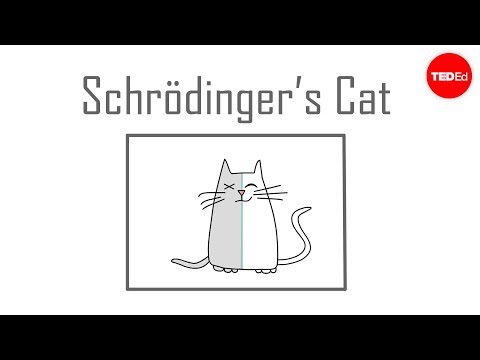
"Schrödinger's cat: A thought experiment in quantum mechanics - Chad Orzel" · TED-Ed · 5 min · 8.2M views · 2014
In short: Schrödinger's cat turns quantum superposition into a thought experiment and connects the same behavior to semiconductors and computer chips.
The shortest video returns to quantum mechanics through a single image after the hands-on demonstrations. TED-Ed explains the sealed-box thought experiment in which a device has a 50 percent chance of killing a cat within an hour. Common sense says the cat must be alive or dead, but the quantum description places it in a superposition of both states until observation. This gives a compact entry point before the longer discussion of quantum reality.
The practical example prevents the cat from remaining only a paradox. Electrons can spread across and be shared among atoms in semiconductor materials, creating superposition states that determine conductive properties. Controlling those properties makes semiconductor devices, transistors, and computer chips possible, and those chips are essential to the internet. The video therefore links a thought experiment about measurement to precise control over materials and to technologies already operating at ordinary human scales.
Key takeaways
Schrödinger's cat describes a cat as simultaneously alive and dead until observation in order to illustrate superposition.
The imagined device has a 50 percent chance of killing the cat during the hour it remains in the sealed box.
Electrons shared among atoms form superposition states that affect a semiconductor's conductive properties.
Control over electron behavior in semiconductors enables transistors and computer chips.
Watch on YouTube · Read the summary and Q&A
9. What Is Quantum Reality: Understanding Space, Time, and Entanglement?

"Quantum Reality: Space, Time, and Entanglement" · World Science Festival · 93 min · 7.8M views · 2018
In short: Quantum mechanics describes a microworld of wave-particle duality, measurement, and entanglement, while black holes test what those ideas mean for information and spacetime.
This long-form discussion gathers the quantum ideas from earlier videos into one broader account of reality. It covers wave functions, wave-particle duality, collapse during measurement, entanglement across large distances, and the questions black holes create about information and spacetime. Its late position lets the panel function as a synthesis: viewers arrive with the cat, multiple paths, and linked particles already in mind, then see how those concepts fit inside a mathematical framework for the microworld.
The double-slit experiment remains the central demonstration. Particles form interference patterns when they pass through two slits, showing both wave-like and particle-like properties, while measurement gives a quantum system a definite value. Entangled particles retain correlated properties even when separated by large distances. The discussion also explains why this feels difficult: human intuition developed around macroscopic tasks such as throwing, catching, and dodging, not direct experience of electrons, probability waves, or wave functions.
Key takeaways
Quantum mechanics is a mathematical framework for describing particles and behavior in the microworld.
The double-slit experiment shows that particles can display wave-like and particle-like properties.
Measurement collapses a wave function and gives the measured quantum system a definite value.
Black holes raise questions about the fate of information and the nature of spacetime.
Watch on YouTube · Read the summary and Q&A
10. Quantum Computing Expert Explains One Concept in 5 Levels of Difficulty | WIRED
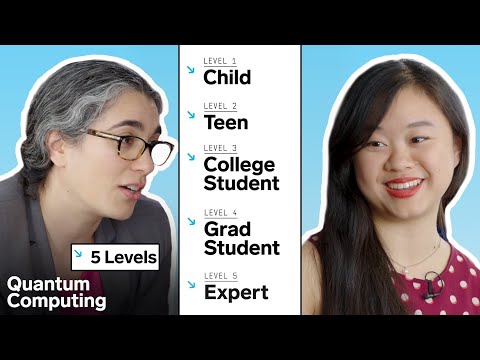
"Quantum Computing Expert Explains One Concept in 5 Levels of Difficulty | WIRED" · WIRED · 19 min · 7.8M views · 2018
In short: Talia Gershon explains quantum computing at five levels, using spinning pennies to make superposition and entanglement understandable from beginner to expert.
The final video turns understanding into explanation. IBM Research scientist Talia Gershon presents quantum computing at five levels of increasing complexity, moving from a child to an expert while keeping the same core rules in view. It closes the sequence because it revisits qubits, superposition, entanglement, and interference through different levels of language, showing how one subject can be introduced simply and then developed without changing its underlying physical claims.
Her pennies provide the concrete model. A classical computer represents information with specific combinations of zeros and ones, while a qubit follows quantum rules. A spinning penny represents superposition because it is not simply heads or tails but a combination of both. Two entangled pennies illustrate linked outcomes: measuring one as heads means the other is also heads, and the same applies to tails. The resulting computing approach may affect chemistry, machine learning, cryptography, simulation, and scientific research.
Key takeaways
Quantum computers solve problems differently from classical computers by using superposition, entanglement, and interference.
Gershon uses a spinning penny to represent a quantum state that combines heads and tails.
Two entangled pennies model linked measurement outcomes rather than independent results.
Current quantum computers remain limited by decoherence and the need for fault tolerance.
Watch on YouTube · Read the summary and Q&A
Frequently asked questions
What are the best physics videos on YouTube?
Three strong places to start are Veritasium's “Parallel Worlds Probably Exist. Here’s Why,” Wacky Science's “ALL OF PHYSICS explained in 14 Minutes,” and the World Science Festival's “Quantum Reality: Space, Time, and Entanglement.” Together they cover quantum interpretation, a compact survey of foundational laws, and a longer discussion of wave-particle duality, entanglement, black holes, and spacetime.
How long does it take to watch all ten physics videos?
The complete sequence takes 291 minutes, or 4 hours 51 minutes. The shortest entry is TED-Ed's five-minute explanation of Schrödinger's cat, while the longest is the World Science Festival's 93-minute discussion of quantum reality. The remaining videos range from seven to 44 minutes, so most can be watched in a single shorter sitting.
What does the Many-Worlds Interpretation say happens during a quantum event?
It says that every possible outcome occurs in a separate branch of reality. Quantum mechanics uses the wave function to calculate probabilities, with the Born rule connecting squared amplitude to the probability of finding a particle at a point. Many-Worlds treats the wave function and branching universes as the complete picture rather than selecting only one outcome.
Why does quantum entanglement appear to act faster than light?
In an entangled pair, measuring one particle fixes the corresponding state of its distant partner, which makes the wave function appear to change across space instantly. Einstein preferred predetermined local hidden variables to this non-local account. John Bell looked for a modified experiment in which local hidden-variable theories and quantum mechanics would predict different results, making the disagreement experimentally testable.
Why does a shaken carbonated drink erupt if its pressure does not increase?
The demonstrated bottle stayed at about 3 atmospheres, or 330 kilopascals, after shaking. Shaking mixed tiny air bubbles into the liquid, and those bubbles became nucleation sites where dissolved CO2 could leave the solution rapidly. Once the bottle opened, gas escaped from many sites at once, producing the eruption without requiring an increase in the sealed bottle's pressure.
How is a quantum computer different from a classical computer?
A classical computer represents information through specific combinations of zeros and ones. A quantum computer uses qubits governed by superposition, entanglement, and interference, so it approaches calculation in a fundamentally different way. The videos connect that difference to database searching, quantum simulations, cryptography, chemistry, and machine learning, while noting that current machines still face decoherence and fault-tolerance limits.
Which physics video should I watch first?
Start with Veritasium's video on the Many-Worlds Interpretation. It establishes the difference between deterministic classical mechanics and the wave functions and probabilities of quantum mechanics. That foundation prepares you for the later videos on qubits, multiple paths, entanglement, Schrödinger's cat, measurement, and quantum reality, while fitting into exactly twenty minutes.
Are the older physics videos on this list still worth watching?
Yes. The older entries explain concepts and applications that the rest of the sequence continues to use. Big Think's 2012 presentation connects physics to lasers, transistors, computers, communication, and medical imaging; TED-Ed's 2014 lesson explains superposition and semiconductors; and Kurzgesagt's 2015 video introduces qubits, quantum tunneling, encryption, and quantum simulation.
Why is quantum mechanics difficult to understand intuitively?
Human intuition developed around the macroscopic world and practical experiences such as throwing, catching, and dodging objects. People do not directly experience electrons, probability waves, or wave functions through their senses. The World Science Festival discussion therefore approaches the microworld through mathematics, experiments, and observation, including the double-slit experiment and its combination of wave-like and particle-like behavior.
How to use this list
Watch the videos in the listed order. The path begins with quantum probability and interpretation, connects physics to modern technology and computing, then develops multiple paths and entanglement before stepping back to foundational laws and everyday experiments. It returns through Schrödinger's cat to a long synthesis of quantum reality and finishes with the same computing ideas explained at five levels. If you only have twenty minutes, start with Veritasium on Many-Worlds. If you want the single video that surveys gravity, energy, thermodynamics, and electromagnetism quickly, choose Wacky Science.
Related lists
💡 Want summaries and transcripts for any YouTube video? Try YouTube Summary with ChatGPT & Claude.