10 Best Kurzgesagt Videos That Explain the Universe

Jul 27, 2026
10 min read
123 views
Last updated: July 2026
This list collects ten Kurzgesagt videos that explain how the universe works, from the size of stars to the fate of galaxies. It is built for founders and curious builders who want a clear, structured tour of cosmology and physics without opening a textbook.
Together the ten run about 100 minutes, roughly a long lunch or two commutes. We ordered them as a learning journey rather than by view count, so each video builds on the scale, physics, and questions raised by the one before it.
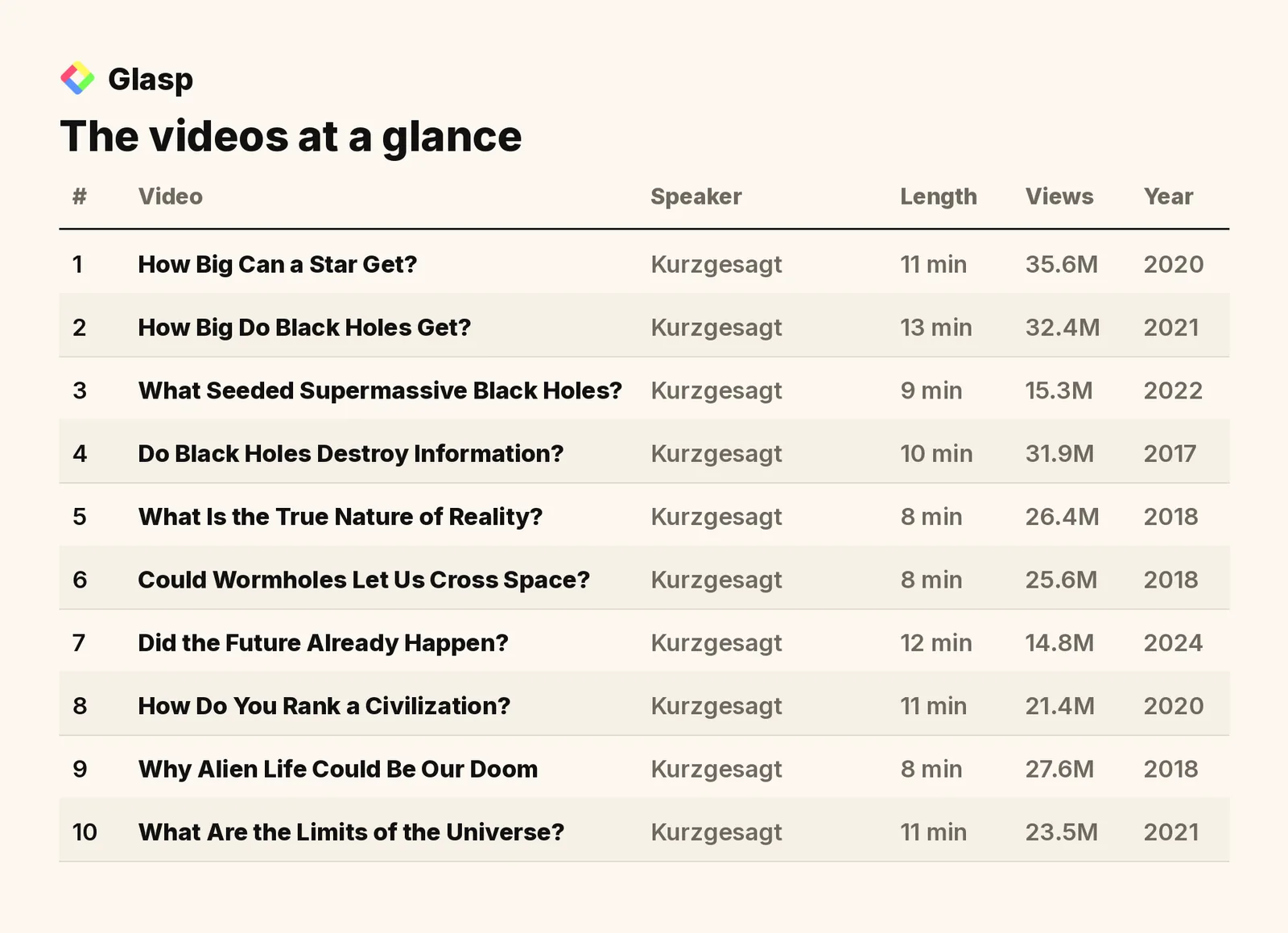
The videos on this list, in the order to watch them, are:
How Big Can a Star Get? (Kurzgesagt)
How Big Do Black Holes Get? (Kurzgesagt)
What Seeded Supermassive Black Holes? (Kurzgesagt)
Do Black Holes Destroy Information? (Kurzgesagt)
What Is the True Nature of Reality? (Kurzgesagt)
Could Wormholes Let Us Cross Space? (Kurzgesagt)
Did the Future Already Happen? (Kurzgesagt)
How Do You Rank a Civilization? (Kurzgesagt)
Why Alien Life Could Be Our Doom (Kurzgesagt)
What Are the Limits of the Universe? (Kurzgesagt)
Total: 10 videos, 101 minutes of watch time, and 254.5M combined views.
1. How Big Can a Star Get?

Kurzgesagt · 11 min · 35.6M views · 2020
In short: The largest known star, Stephenson 2-18, spans about 2150 solar radii and shines with nearly half a million times the Sun's power.
The best starting point is a simple sense of scale, and few things stretch the imagination like the size range of stars. This video answers how large a single star can grow and where our own Sun sits among the extremes.
Key takeaways
Stephenson 2-18 is the largest star currently known, estimated at 2150 solar radii and radiating almost half a million times the Sun's power.
Red dwarfs are the most abundant type of star in the universe, while blue and yellow hypergiants remain extremely rare.
Main sequence stars like the Sun fuse hydrogen and can grow to hundreds of thousands of times their original size.
Gas giants and sub-brown dwarfs share some star-like properties but do not qualify as true stars in the universe.
Watch on YouTube · Read the summary and Q&A
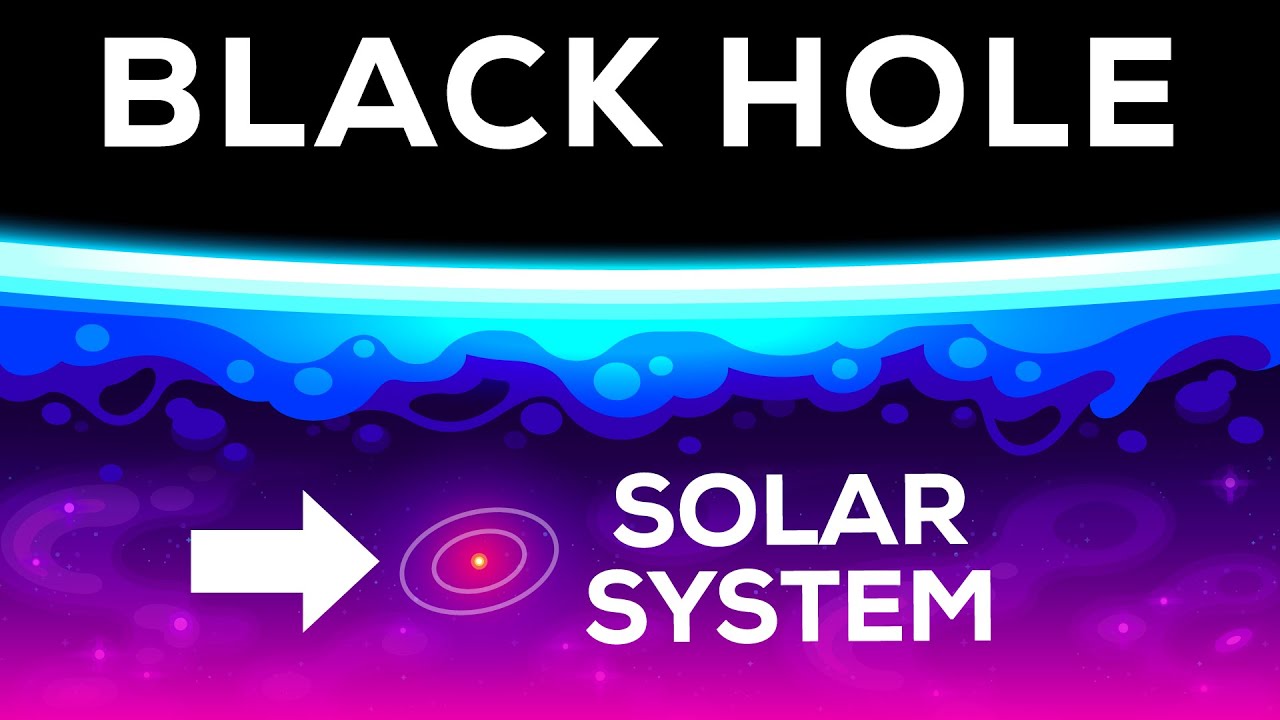
2. How Big Do Black Holes Get?
Kurzgesagt · 13 min · 32.4M views · 2021
In short: The largest known black hole, TON 618, holds roughly 66 billion times the Sun's mass, and black holes have no physical size limit.
Once stars make sense, black holes are the natural next scale to grasp. This video walks through every class, from theoretical primordial specks to ultramassive giants, and explains the startling gap between them.
Key takeaways
TON 618 is the largest known black hole, an ultramassive giant with roughly 66 billion times the mass of our Sun.
Stellar black holes range from about 16 kilometers wide to 92 kilometers wide and form from collapsing stars or neutron star mergers.
Sagittarius A Star, the Milky Way's supermassive black hole, holds about 4 million solar masses yet only 0.001% of the galaxy's mass.
Primordial black holes, if they exist, formed after the big bang and could account for some of the universe's dark matter.
Watch on YouTube · Read the summary and Q&A
3. What Seeded Supermassive Black Holes?

Kurzgesagt · 9 min · 15.3M views · 2022
In short: Black hole stars, theorized giants with a black hole at their core, may have seeded the supermassive black holes seen in galaxies today.
This video bridges stars and black holes by proposing an object that was both at once. It answers how galaxies got their central giants so early, a puzzle standard stellar evolution struggles to explain.
Key takeaways
Black hole stars were theorized giants born from dense gas clouds in the early universe, millions of times larger than modern stars.
A black hole at the core drove a growth process that defied traditional theories of stellar evolution.
These stars may have served as the seeds for the supermassive black holes found at the centers of galaxies.
The James Webb Space Telescope may confirm black hole stars by observing far enough back in time to catch them.
Watch on YouTube · Read the summary and Q&A
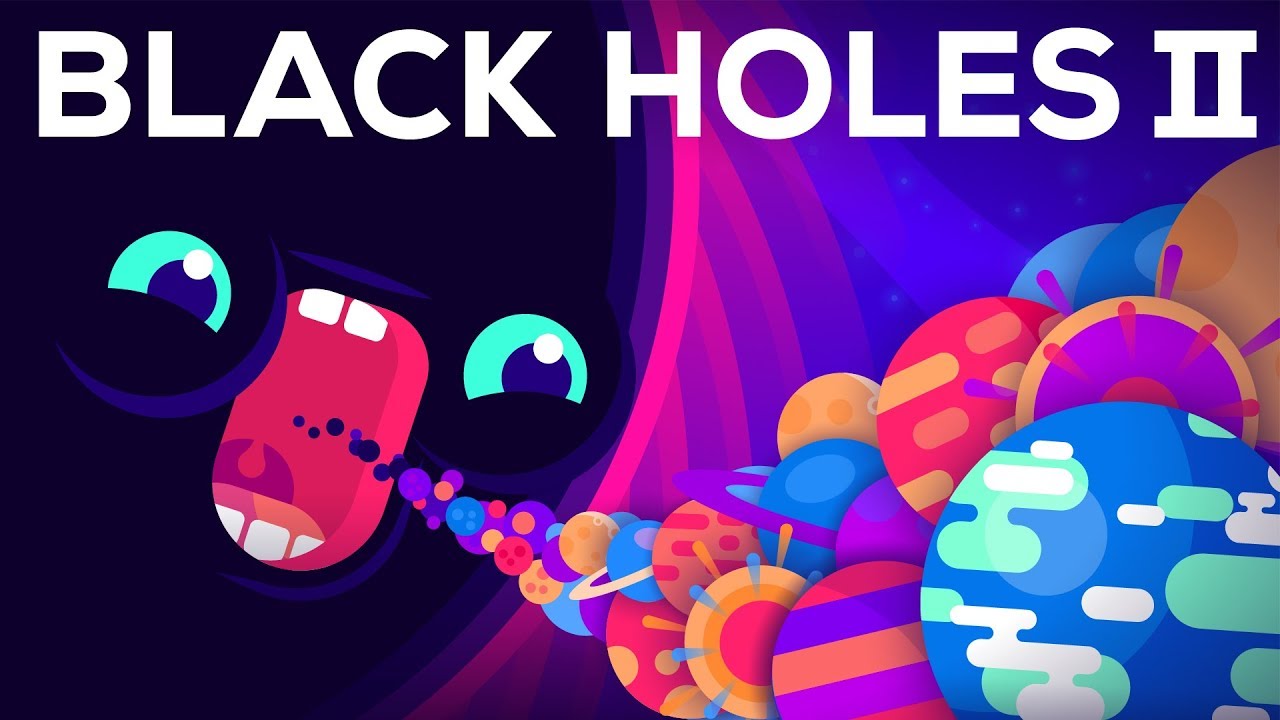
4. Do Black Holes Destroy Information?
Kurzgesagt · 10 min · 31.9M views · 2017
In short: Black holes may store information on their event horizons rather than deleting it, which the holographic principle uses to resolve the paradox.
Here the series turns from scale to deep physics, using black holes to probe the nature of reality itself. It answers whether anything falling in is truly lost, and why that question threatens the laws of physics.
Key takeaways
Hawking radiation slowly evaporates black holes, which raises the worry that the information they swallowed could be permanently lost.
The holographic principle suggests black holes encode swallowed information on their surfaces, which challenges conventional theories of physics.
Information defines the uniqueness and diversity of objects, so losing it would undermine the consistency of physical law.
Resolving the information paradox could force drastic revisions to the existing laws of physics and how we model reality.
Watch on YouTube · Read the summary and Q&A
5. What Is the True Nature of Reality?

Kurzgesagt · 8 min · 26.4M views · 2018
In short: String theory describes particles as vibrations of tiny strings and tries to unify gravity with quantum physics, though it lacks experimental evidence.
With black holes hinting at deeper laws, string theory is the ambitious attempt to write those laws down. This video answers what everything might be made of, and why the idea remains contested.
Key takeaways
String theory describes elementary particles as different vibrations of strings, offering a potential unification of the universe's fundamental forces.
The Heisenberg uncertainty principle means elementary particles cannot be measured precisely, which pushed physicists toward the fiction of point particles.
String theory's mathematics require extra dimensions that do not match the three we observe, one reason it stays controversial.
Even without proof, string theory offers insight into quantum gravity and puzzles like black holes and the information paradox.
Watch on YouTube · Read the summary and Q&A
6. Could Wormholes Let Us Cross Space?

Kurzgesagt · 8 min · 25.6M views · 2018
In short: Wormholes are theoretical shortcuts through spacetime that could allow near-instant travel across vast distances, though their existence stays uncertain.
This video takes the spacetime introduced by relativity and asks whether it can be folded into a shortcut. It answers what a wormhole would take to build and why physics is not sure they can exist.
Key takeaways
Einstein's theory of relativity shows that space and time are interconnected and can be bent and warped.
Different wormhole types, such as Einstein-Rosen bridges and traversable wormholes, offer different possibilities and constraints for travel.
Exotic matter with negative mass may be required to hold a wormhole open and stable enough to cross.
Wormholes carry potential risks including time travel paradoxes and violations of causality, and none have ever been observed.
Watch on YouTube · Read the summary and Q&A
7. Did the Future Already Happen?

Kurzgesagt · 12 min · 14.8M views · 2024
In short: Relativity implies past, present, and future may coexist, while quantum mechanics adds uncertainty, leaving time far more complex than a simple line.
Wormholes raise questions about time, and this video confronts time directly. It answers whether the future is already fixed, drawing on both relativity and quantum mechanics to unsettle our everyday picture of now.
Key takeaways
According to relativity, different observers each experience their own now based on how they move through spacetime.
Past, present, and future can be understood as existing simultaneously, which challenges the idea of a linear flow of time.
Quantum processes introduce genuine uncertainty into the future, complicating any notion of a fully predetermined timeline.
The concept of cosmic democracy holds that every observer's perspective on the present moment is equally valid across the universe.
Watch on YouTube · Read the summary and Q&A
8. How Do You Rank a Civilization?

Kurzgesagt · 11 min · 21.4M views · 2020
In short: The Kardashev Scale ranks civilizations by energy use, from Type 1 harnessing a planet to Type 3 harnessing a whole galaxy.
Having covered the physics of the cosmos, the list turns to who might live in it. This video answers how you would measure a civilization's progress and where humanity currently stands.
Key takeaways
The Kardashev Scale categorizes civilizations by their ability to harness energy from a planet, a star, or a whole galaxy.
Energy consumption serves as a measure of a civilization's progress and its potential for interstellar exploration.
Humanity currently ranks at roughly Type 0.75 on the scale, indicating significant room to grow toward more advanced levels.
The universe's vast scale and age raise the possibility of alien civilizations at many different stages of development.
Watch on YouTube · Read the summary and Q&A
9. Why Alien Life Could Be Our Doom

Kurzgesagt · 8 min · 27.6M views · 2018
In short: Finding advanced alien life could mean a Great Filter lies ahead of us, hinting most civilizations fail to survive beyond a certain point.
If civilizations can be ranked, the obvious question is why we do not see many. This video answers the eerie silence of the cosmos with the Great Filter and its uncomfortable implications for our future.
Key takeaways
The Great Filter proposes that most civilizations fail to advance beyond a certain stage of development.
If we have already passed the hardest filters, then complex life like ours may be genuinely rare.
If the filter still lies ahead of us, a catastrophic barrier could threaten humanity's long-term survival in the cosmos.
Discovering advanced alien civilizations would raise the odds that a dangerous filter is still in our future.
Watch on YouTube · Read the summary and Q&A
10. What Are the Limits of the Universe?

Kurzgesagt · 11 min · 23.5M views · 2021
In short: About 94% of observable galaxies are permanently beyond our reach because the universe's expansion accelerates, leaving only 6% potentially reachable.
The journey ends at the outer boundary of everything we could ever touch. This video answers how much of the universe is truly reachable and why accelerating expansion quietly closes the door on the rest.
Key takeaways
Roughly 94% of the galaxies we can observe are already permanently beyond any ability of ours to reach or interact with them.
The accelerating expansion of the universe keeps pushing distant galaxies beyond our cosmic horizon at ever increasing speeds.
Only about 6% of galaxies recede slowly enough to remain potentially reachable, and even those are a long shot.
Our local group will eventually merge into one giant galaxy, Milkdromeda, ending interaction with the wider universe.
Watch on YouTube · Read the summary and Q&A
Frequently asked questions
What is the largest star in the universe?
The largest known star is Stephenson 2-18, estimated at about 2150 solar radii and shining with nearly half a million times the Sun's power.
What is the biggest black hole ever found?
TON 618 is the largest known black hole, an ultramassive giant with roughly 66 billion times the mass of our Sun.
Do black holes destroy information?
The holographic principle suggests black holes store information on their event horizons rather than destroying it, which helps resolve the information paradox.
What is the Kardashev Scale?
The Kardashev Scale ranks civilizations by energy use, from Type 1 using a planet's energy to Type 3 using a galaxy's, and humanity sits near Type 0.75.
Can we travel through wormholes?
Wormholes are theoretical shortcuts through spacetime that could allow near-instant travel, but their existence is unconfirmed and holding one open may require exotic matter.
Where should I start with Kurzgesagt videos about space?
A good entry point is How Big Can a Star Get?, which begins with familiar objects and scales upward, followed by How Big Do Black Holes Get? and What Are the Limits of the Universe? for the widest possible view of cosmic scale.
Do you need a physics background to understand Kurzgesagt videos?
No physics background is required to follow Kurzgesagt videos on stars, black holes, wormholes and the nature of reality, because each one is built as an animated explainer aimed at a general audience rather than at students of the subject.
Which Kurzgesagt videos are about black holes?
Three Kurzgesagt videos cover black holes from different angles: How Big Do Black Holes Get? looks at their size, What Seeded Supermassive Black Holes? asks where the largest ones came from, and Do Black Holes Destroy Information? deals with the physics puzzle they create.
Which Kurzgesagt videos are about aliens and other civilizations?
Two videos deal with life beyond Earth and how civilizations can be measured: Why Alien Life Could Be Our Doom considers what the existence of alien life could mean for humanity, and How Do You Rank a Civilization? explains how civilizations can be classified by scale.
How to use this list
Watch these in order for a guided climb from cosmic scale to the fundamental physics and open questions behind it. If you only have ten minutes, start with The Largest Star in the Universe for an immediate sense of scale, then come back for the black holes and the edge of the cosmos when you have more time.
Related lists
💡 Want summaries and transcripts for any YouTube video? Try YouTube Summary with ChatGPT & Claude.