What Is the Largest Star in the Universe?
TL;DR
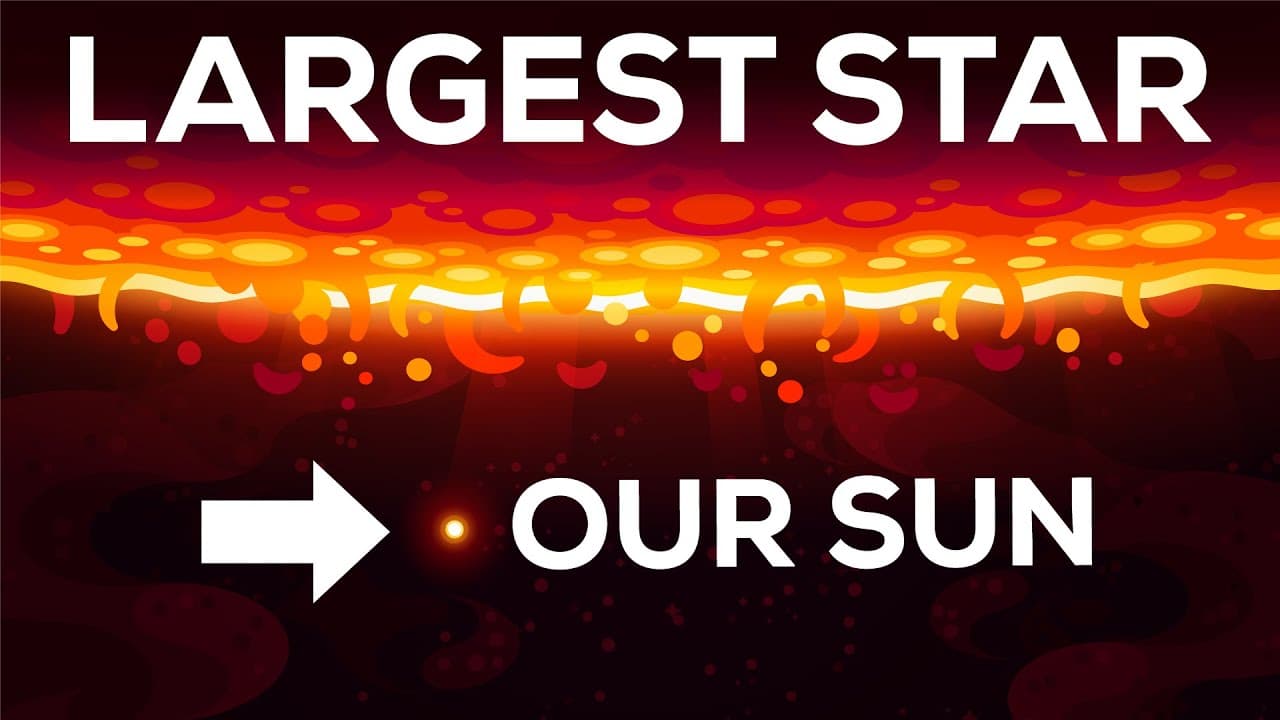
The largest star in the universe is Stephenson 2-18, estimated to be 2150 solar radii and shining with nearly half a million times the Sun's power. It exemplifies the extreme and varied sizes of stars, with hypergiants like R136a1 also representing this group but being less massive. Stars come in different stages, each with unique properties and lifespans.
Transcript
What is the largest star in the universe and why is it that large? And what are stars anyway? Things That Would Like To Be Stars We begin our journey with Earth. Not to learn anything, just to get a vague sense of scale. The smallest things that have some star-like properties are large gas giants, or sub-brown dwarfs. Like Jupiter, the most massive... Read More
Key Insights
- 🤩 Gas giants and sub-brown dwarfs have star-like properties but are not true stars.
- 🤩 Main sequence stars, like our Sun, go through hydrogen fusion and can grow to hundreds of thousands of times their original size.
- 🤩 Red dwarfs are the most abundant type of star in the universe, while blue hypergiants like Pistol Star and yellow hypergiants like Rho Cassiopeiae are extremely rare.
- 🤩 The largest star currently known is Stephenson 2-18, which is estimated to be 2150 solar radii and shines with almost half a million times the power of the Sun.
Install to Summarize YouTube Videos and Get Transcripts
Explore YouTube Video Summarizer or Get YouTube Transcript Extractor
Questions & Answers
Q: What are the smallest stars in the universe?
The smallest stars are red dwarfs, which are about 100 times the mass of Jupiter. They are not very massive, small, not very hot, and shine dimly compared to other main sequence stars.
Q: What is the most massive star known?
The most massive star known is R136a1, with 315 solar masses. Despite its tremendous mass and power, it is only about 30 times the size of the Sun.
Q: Do all stars follow the same life cycle?
No, stars go through different stages in their life cycles, starting from the main sequence phase, then transitioning into red giants, and finally, some may become hypergiants before exploding in a supernova.
Q: How do hypergiants differ from other stars?
Hypergiants are the most massive stars in the universe, with enormous surface areas and powerful stellar winds. They are so large that gravity is too weak to hold on to their hot mass, causing them to blow themselves apart.
Summary & Key Takeaways
-
Stars come in various sizes and stages, starting with gas giants and sub-brown dwarfs, which have star-like properties but are not true stars.
-
The main sequence stars, like our Sun, are fueled by hydrogen fusion in their core and can grow to hundreds of thousands of times their original size.
-
The largest stars in the universe are hypergiants, with examples such as Pistol Star and Rho Cassiopeiae, which have enormous surface areas and radiate immense amounts of light.
Read in Other Languages (beta)
Share This Summary 📚
Summarize YouTube Videos and Get Video Transcripts with 1-Click
Try YouTube Summary with ChatGPT & Claude or YouTube Transcript Generator
Explore More Summaries from Kurzgesagt – In a Nutshell 📚



Summarize YouTube Videos and Get Video Transcripts with 1-Click
Try YouTube Summary with ChatGPT & Claude or YouTube Transcript Generator