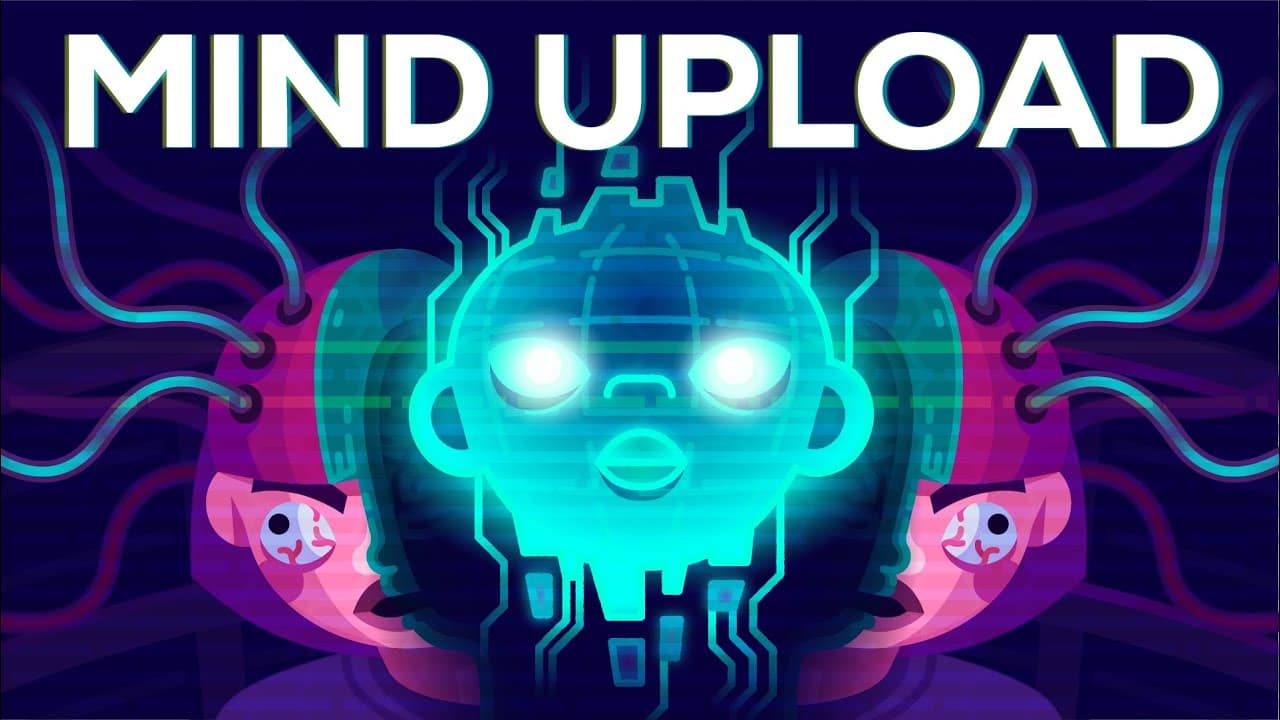
Can You Upload Your Mind & Live Forever?
TL;DR
Uploading a human mind and living forever is not currently known to be possible. The idea depends on three disputed assumptions: the mind resides in the brain’s structure and biochemistry, every relevant aspect can eventually be simulated, and software can host a mind. A 2019 mapping of one cubic millimeter of mouse brain produced 2 million GB of data, illustrating the immense challenge. Read on for the technical hurdles and implications.
Transcript
the desire to be free from the limits of the human experience is as old as our first stories we exist in an endless universe only bound by the laws of physics and yet our consciousness is trapped in mortal machines made of meat with the breathtaking explosion of innovation and progress for the first time the concept of leaving our flesh piles behin... Read More
Key Insights
- 🔬 The desire for mind uploading and digital immortality is a core theme of the game Cyberpunk 2077, exploring the idea of leaving behind our physical bodies and transferring consciousness into a digital world.
- 💡 Mind uploading is based on three assumptions: that the mind is within the structure and biochemistry of the brain, that we will understand the brain well enough to simulate it, and that computer software can host our minds.
- 🧠 The brain is an incredibly complex structure with billions of neurons and connections, and our understanding of it is limited. Scanning technology, such as MRI, is currently not advanced enough to accurately map the brain.
- ⚙️ To attempt mind uploading, a brain would need to be scanned at a microscopic level with an electron microscope, which requires immense time and resources. Mapping a whole human brain would be even more challenging.
- 🌐 One of the biggest hurdles is turning the static blueprint of the brain into an active, dynamic simulation. We need to understand the laws and rules that animate the wiring diagram and give it life. ⏳ The pace of progress in understanding the brain and achieving mind uploading is uncertain. We may need to simplify elements into probabilistic models and find innovative solutions to overcome the complexity of the brain.
- 🔁 Successful mind uploading could lead to functional immortality, but the risks of corruption and potential negatives like eternal pain or psychosis must be considered.
- 🌍 Mind uploading could change our outlook on life, offering a sense of safety from death and the ability to coexist with our biological selves. It may also lead to new experiences and changes in priorities as digital minds exist in a liberated form.
Install to Summarize YouTube Videos and Get Transcripts
Explore YouTube Video Summarizer or Get YouTube Transcript Extractor
Questions & Answers
Q: Is it possible to upload a human mind into a computer?
It is not currently known whether a human mind can be uploaded into a computer. Mind uploading remains a hypothetical process that would copy a person’s inner world and run a simulation of their consciousness.
Q: What is mind uploading?
Mind uploading is the hypothetical concept of copying the collective abilities associated with consciousness and intelligence and transferring that copy into a computer. The result would be a computer simulation of the person’s consciousness rather than their biological brain.
Q: What assumptions does mind uploading depend on?
The concept depends on three assumptions. The mind must reside in the brain’s structure, arrangement, and biochemistry; technology must become capable of understanding and simulating every relevant aspect of the brain; and software must be able to host the mind accurately.
Q: Why is the human brain so difficult to simulate?
The brain has around 100 billion neurons communicating through 1 million billion connections, producing one quadrillion events during every second of waking life. Its activity also involves supporting and immune cells, chemical receptors, hormones such as serotonin and histamine, heart nerves, and gut bacteria.
Q: Can current brain-scanning technology create a mind upload?
Current scanning technology, including fMRI machines, does not provide enough detail to attempt mind uploading. A more promising method involves cutting a brain into tiny slices and scanning them with a high-resolution electron microscope, but applying this process to an entire human brain would require an enormous expansion of existing efforts.
Q: What did scientists achieve by mapping mouse brain tissue in 2019?
Scientists mapped one cubic millimeter of mouse brain containing 100,000 neurons, a billion synapses, and 4 km of nerve fibers. They cut it into 25,000 slices, ran five electron microscopes continuously for five months, collected more than 100 million images, and spent three months assembling a 3D model.
Q: How much data could detailed brain mapping require?
The 2019 mouse-brain map filled 2 million GB of cloud storage, even though it represented only a cubic millimeter of tissue. Scanning an entire human brain would require repeating that effort a million times, and mapping proteins or individual molecules could generate more data than all storage on Earth can hold.
Q: Would a complete brain map be enough to reproduce consciousness?
A static map would not be sufficient by itself because the simulation would also need rules governing chemical binding and electrodynamics. Those rules would have to animate the wiring diagram so it evolves over time and can think, see, and act, but the transcript concludes that we do not yet know whether technology can create a real mind this way.
Summary & Key Takeaways
-
Mind uploading is the hypothesis of transferring one's consciousness into a computer simulation.
-
Three assumptions for mind uploading: the mind is in the brain's structure and biochemistry, understanding the brain enough to simulate it, and computers can host the mind.
-
Mapping and scanning the brain poses challenges, but with advancements, the potential for mind uploading becomes more tangible.
Read in Other Languages (beta)
Share This Summary 📚
Summarize YouTube Videos and Get Video Transcripts with 1-Click
Try YouTube Summary with ChatGPT & Claude or YouTube Transcript Generator
Explore More Summaries from Kurzgesagt – In a Nutshell 📚


Summarize YouTube Videos and Get Video Transcripts with 1-Click
Try YouTube Summary with ChatGPT & Claude or YouTube Transcript Generator