We Did The Math - You Are Dead! Could You Be a Brain in a Dead Universe?
TL;DR
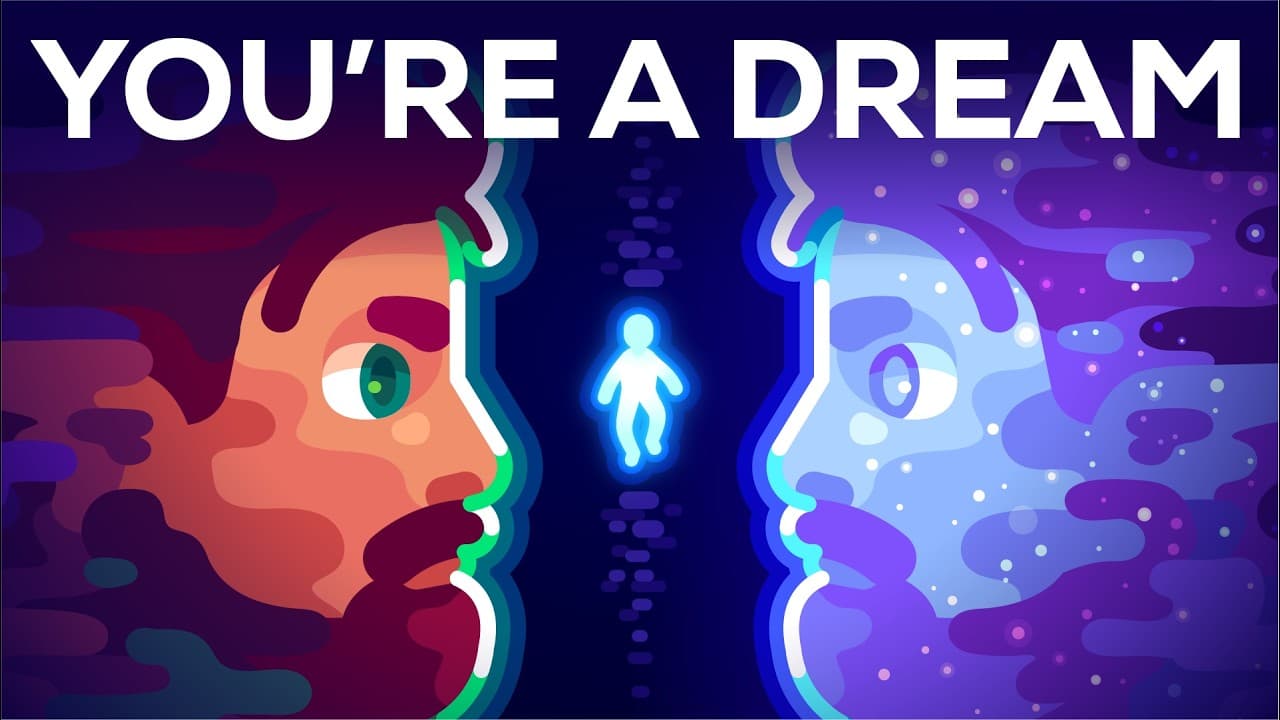
You could be a brain-like fluctuation dreaming reality inside a dead universe, but the idea has no solid evidence. The argument combines three concepts: the probabilistic arrow of time, a far future dominated by dark energy, and random particle arrangements occurring across eternity. Smaller fluctuations would be more probable than entire pop-up universes, raising unsettling questions about existence, and giving you a reason to read how the thought experiment unfolds.
Transcript
Absolutely everything you think about yourself and the universe could be an illusion. As far as you know, you are real and exist in a universe that was born 14 billion years ago and that gave rise to galaxies, stars, the Earth, and finally you. Except, maybe not. You may actually not exist for real but be the dream of a dead universe – you and ev... Read More
Key Insights
- 💘 The arrow of time is an illusion created by probabilities.
- 🚥 The universe will eventually become a dark and expansive place with a cosmic horizon.
- 🦛 Pop-up universes could be random fluctuations with funny glitches.
- 💀 The probability of being a floating brain in a dead universe is larger than being a real human.
- 💀 The concept of being a dream in a dead universe is intriguing but lacks solid evidence.
- ❓ Our understanding of the cosmos is not conclusive enough to worry about the nature of our existence.
- 🧠 Considering topics like Boltzmann brains is important for discussing the limitations of our theories.
Install to Summarize YouTube Videos and Get Transcripts
Explore YouTube Video Summarizer or Get YouTube Transcript Extractor
Questions & Answers
Q: Could you be a brain dreaming reality in a dead universe?
The scenario says you could be a randomly formed brain whose apparent memories and universe are an illusion. The transcript presents this as a consequence worth considering, but the existing insights emphasize that it lacks solid evidence and that our understanding of the cosmos is not conclusive.
Q: Why does time seem to flow in only one direction?
The arrow of time arises from probability rather than a fundamental microscopic rule. Ink has vastly more ways to spread throughout water than to gather into one spot, so spreading is overwhelmingly more likely even though the reverse motion is not forbidden.
Q: Could dispersed ink ever spontaneously form a drop again?
Yes, the laws of physics do not forbid the molecules from concentrating again, but the event is extremely unlikely. The stated waiting time is about 10 to the power of 100,000,000,000,000,000,000,000 years.
Q: What will happen when the universe reaches its far future?
The last star is expected to die in about 100 trillion years, after which the universe will eventually become dark, rapidly expanding, and dominated by dark energy. It will be almost devoid of matter and bounded, for practical purposes, by a cosmic horizon.
Q: What is the cosmic horizon in a dark-energy-dominated universe?
It is a boundary created as space expands so dramatically that nothing beyond it can ever reach you, including light. The resulting observable region is described as a finite space about 36 billion light-years wide.
Q: Why would particles remain in an apparently dead universe?
The cosmic region is compared to a giant black hole turned inside out. Quantum effects produce Hawking radiation, which eventually fills this region with particles at an extremely low but finite temperature, allowing random motion to continue.
Q: Could our universe be a random pop-up universe?
The transcript proposes that particles fluctuating across an infinite amount of time could randomly form planets, galaxies, or a universe resembling ours. Such a pop-up universe would exist temporarily before dissolving and might contain unexplained glitches.
Q: Why would a randomly formed brain be more likely than an entire universe?
Smaller fluctuations are described as much more probable than larger ones: a planet is more likely than a galaxy, and a human brain is even more likely. This creates the possibility that an observer with apparent memories could arise without the full universe that those memories seem to describe.
Summary & Key Takeaways
-
The arrow of time is a concept that explains why time seems to flow in one direction, even though at a microscopic level, there are no rules or forwards/backwards motion.
-
The far future of the universe suggests that it will eventually become a dark and expansive place, with a cosmic horizon that separates us from the rest of the universe.
-
The idea of typing monkeys and fake universes explores the possibility of our universe being a fluctuation that randomly emerged and will eventually dissolve, creating funny glitches and variations.
Read in Other Languages (beta)
Share This Summary 📚
Summarize YouTube Videos and Get Video Transcripts with 1-Click
Try YouTube Summary with ChatGPT & Claude or YouTube Transcript Generator
Explore More Summaries from Kurzgesagt – In a Nutshell 📚



Summarize YouTube Videos and Get Video Transcripts with 1-Click
Try YouTube Summary with ChatGPT & Claude or YouTube Transcript Generator