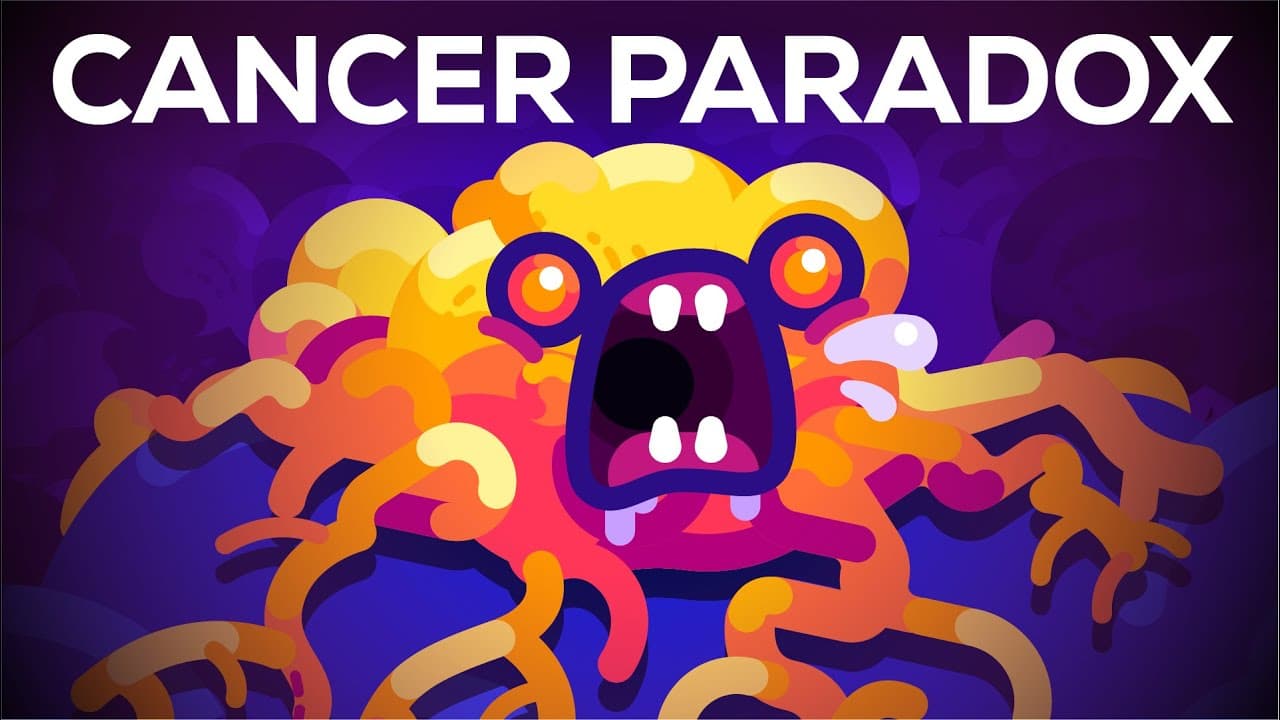
Why Blue Whales Don't Get Cancer - Peto's Paradox
TL;DR
Large animals have fewer instances of cancer than expected, and possible explanations include the presence of tumor suppressor genes and the occurrence of "hypertumors" within the body.
Transcript
Cancer is a creepy and mysterious thing. In the process of trying to understand it, to get better at killing it, we discovered a biological paradox that remains unsolved to this day: Large animals seem to be immune to cancer, which doesn't make any sense. The bigger a being, the more cancer it should have. To understand why we first need to take a ... Read More
Key Insights
- 🍧 Large animals having fewer instances of cancer than expected is known as Peto's paradox, which remains an unsolved biological mystery.
- ☠️ The presence of an increased number of tumor suppressor genes in large animals may contribute to their reduced cancer rate.
- ♋ Hypertumors, the tumors of tumors, occur when mutated cancer cells turn against each other, cutting off the blood supply to the original cancer cells.
Install to Summarize YouTube Videos and Get Transcripts
Explore YouTube Video Summarizer or Get YouTube Transcript Extractor
Questions & Answers
Q: Why do large animals have a lower rate of cancer compared to smaller animals?
Large animals have an increased number of tumor suppressor genes, which help prevent critical mutations in cells and order cells to kill themselves if they are beyond repair. This makes it harder for tumors to develop.
Q: How do hypertumors contribute to the lower rate of cancer in large animals?
Hypertumors occur when mutated cancer cells within a tumor stop cooperating with each other and cut off the blood supply to the original cancer cells. This process prevents tumors from becoming a problem for a large organism.
Q: Are there any other proposed explanations for Peto's paradox?
Yes, other proposed explanations include different metabolic rates or cellular architecture in large animals. However, researchers are still studying and gathering more evidence to fully understand the phenomenon.
Q: How could understanding Peto's paradox lead to new therapies and treatments for cancer?
By studying how large animals are resilient to cancer, scientists might uncover new insights and pathways that could be targeted for developing more effective therapies and treatments.
Summary & Key Takeaways
-
Cancer is a complex biological phenomenon that occurs when cells mutate and reproduce at a rapid rate, eventually forming tumors.
-
Large animals, despite having more cells and a longer lifespan, have a lower rate of cancer compared to smaller animals like mice.
-
One explanation for this paradox is the presence of an increased number of tumor suppressor genes in large animals, making them more resilient to developing tumors.
-
Another possible explanation is the occurrence of hypertumors, where mutated cancer cells within a tumor turn against each other, cutting off the blood supply and ultimately killing the original cancer cells.
Read in Other Languages (beta)
Share This Summary 📚
Summarize YouTube Videos and Get Video Transcripts with 1-Click
Try YouTube Summary with ChatGPT & Claude or YouTube Transcript Generator
Explore More Summaries from Kurzgesagt – In a Nutshell 📚


Summarize YouTube Videos and Get Video Transcripts with 1-Click
Try YouTube Summary with ChatGPT & Claude or YouTube Transcript Generator