What Is Emergence and How Does It Create Complexity?
TL;DR
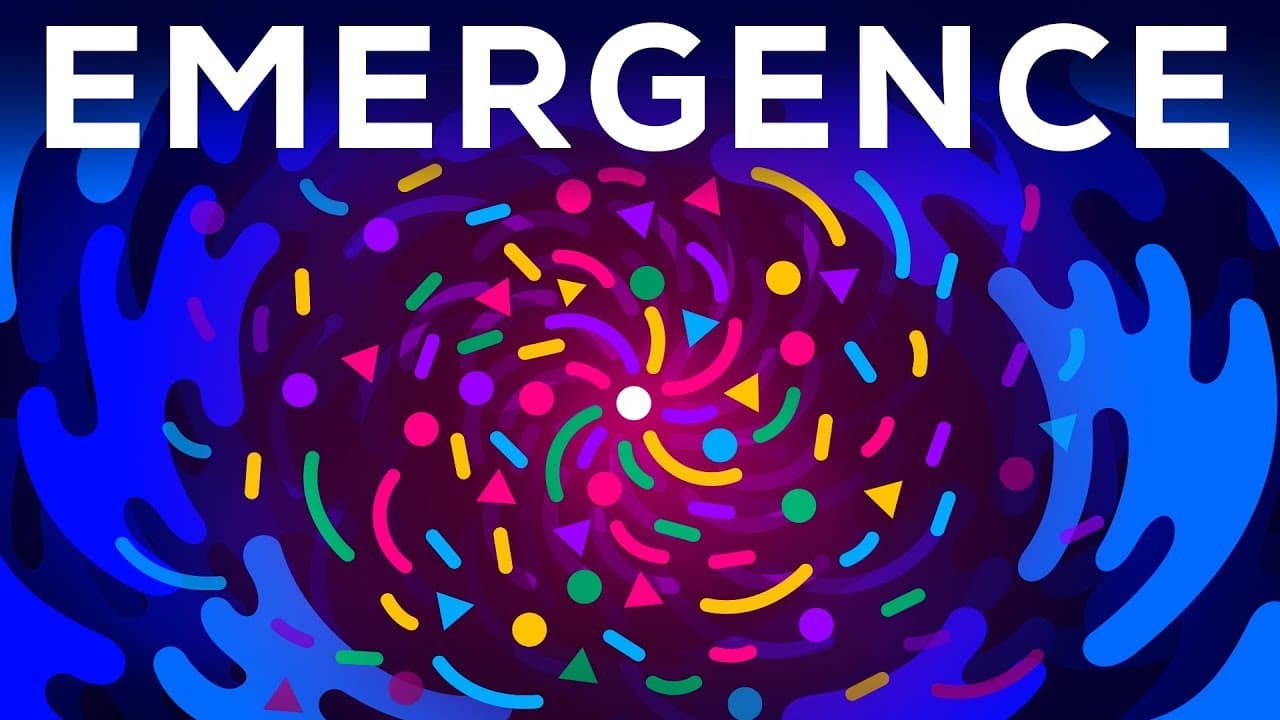
Emergence is the process by which simple components interact to form complex systems with unique properties. For example, ants create a colony by following simple rules and communicating through chemicals, enabling them to adapt and restore balance without central control. This phenomenon can also be observed in nature at various levels, from molecules forming water to cells creating complex organisms.
Transcript
An ant is pretty stupid. It doesn't have much of a brain, no will, no plan, and yet, many ants together are smart. An ant colony can construct complex structures. Some colonies keep farms of fungi, others take care of cattle. They can wage war or defend themselves. How is this possible? How can a bunch of stupid things do smart things together? Thi... Read More
Key Insights
- ❓ Emergence is a fundamental property of our universe, where complexity arises from simplicity.
- 💦 Wetness, the property of being wet, is an example of emergence in water, resulting from interactions between molecules.
- 💁 The concept of emergence applies to various levels, from atoms forming molecules to individuals forming societies.
- 📏 Emergence relies on simple rules or interactions to create complex systems or structures.
- 💱 Ant colonies demonstrate emergence by distributing jobs and adapting to changes through individual interactions and chemical communication.
- 💁 Cells in organisms exhibit emergence by exchanging information, coordinating tasks, and creating complex structures like organs.
- 🧠 The emergence of consciousness from brain cells remains a question to be explored further.
Install to Summarize YouTube Videos and Get Transcripts
Explore YouTube Video Summarizer or Get YouTube Transcript Extractor
Questions & Answers
Q: What is emergence?
Emergence is complexity arising from simplicity. It occurs when many small things interact under a set of rules and form something larger with properties different from those of its individual parts.
Q: Why is wetness considered an emergent property of water?
Wetness is created by many interactions between water molecules. If wet fabric is examined closely enough, there is no separate wetness, only molecules occupying spaces between the cloth’s atoms.
Q: How do ant colonies demonstrate emergence?
Individual ants have no overall plan, yet their interactions allow a colony to build complex structures, keep fungi farms, care for cattle, wage war, and defend itself. These colony-level abilities emerge from ants following simple behavioral and communication rules.
Q: How does an ant colony distribute jobs without a leader?
Ants communicate their current jobs through chemicals and track the ants they encounter. In the example, a colony has 25% workers, 25% caretakers, 25% soldiers, and 25% gatherers, and ants can change roles when their encounters reveal that one group has become too small.
Q: How does an ant colony replace gatherers after an attack?
If an anteater kills most gatherers, worker ants begin encountering almost no gatherers. When the count becomes too low and reaches a critical point, workers switch jobs until enough gatherers exist and the colony’s balance is restored.
Q: How does emergence occur in cells and organisms?
Complicated molecules interact to maintain a cell, the smallest unit of life described in the transcript. Cells then combine, cooperate, specialize, and respond to one another, producing organs and complex organisms with abilities unlike those of their individual parts.
Q: How do heart cells coordinate without a central commander?
Pacemaker cells exchange chemical information with neighboring cells and respond to the feedback they receive. When surrounded by many cells performing the same task, a cell joins that task and synchronizes with them, creating a heartbeat without a master mind issuing commands.
Q: How does emergence apply to nations and human societies?
Nations emerge because many humans interact, much as colonies emerge from ants. Although a nation has no single face, brain, or body, it can change landscapes, wage wars, grow, decline, or stop existing; communities, companies, cities, and societies emerge similarly.
Summary & Key Takeaways
-
Emergence describes the phenomenon of small things coming together to form bigger things with unique properties.
-
Ant colonies are an example of emergence, where individual ants follow a ruleset to create a complex colony.
-
In nature, emergence can be seen at various levels, from molecules forming water to cells creating complex organisms.
Read in Other Languages (beta)
Share This Summary 📚
Summarize YouTube Videos and Get Video Transcripts with 1-Click
Try YouTube Summary with ChatGPT & Claude or YouTube Transcript Generator
Explore More Summaries from Kurzgesagt – In a Nutshell 📚


Summarize YouTube Videos and Get Video Transcripts with 1-Click
Try YouTube Summary with ChatGPT & Claude or YouTube Transcript Generator