What Is the Paradox of Time and Its Implications?
TL;DR
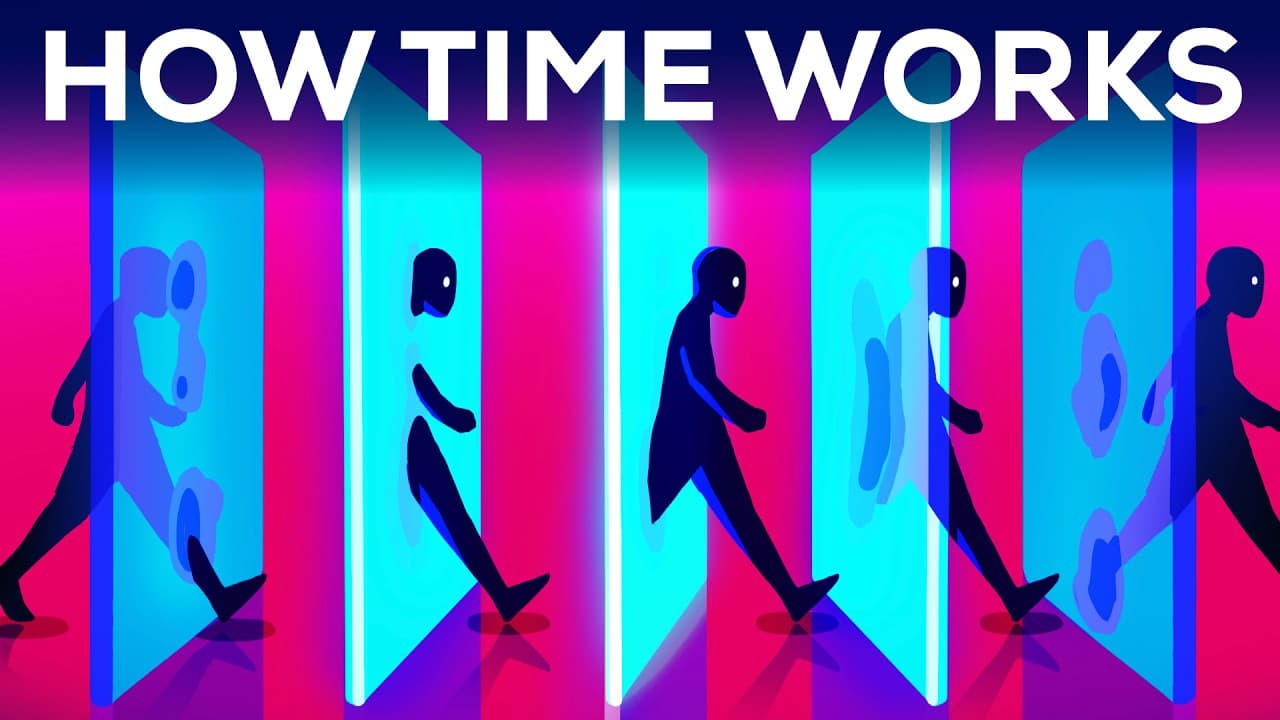
The paradox of time suggests that past, present, and future may all coexist simultaneously rather than progressing linearly. According to relativity, different observers experience their own 'now' based on their movement through spacetime, while quantum mechanics introduces uncertainty that challenges the notion of a predetermined future. Thus, our understanding of time remains complex and elusive.
Transcript
Do your past, present and future all exist right now? Are you watching this video, being born and lying on your deathbed at this very moment? Surprisingly, the answer could be yes. But how can that be? What does that even mean? How does time work? Imagine the universe like a child painting pictures on paper. Each picture shows everything ... Read More
Key Insights
- 👾 The theory of relativity suggests that time and space are interconnected, and our perception of time is influenced by our movement through space.
- 🍝 Past, present, and future can be understood as existing simultaneously, challenging the idea of a linear progression of time.
- ❓ Quantum processes introduce uncertainty into the future, complicating the understanding of a predetermined future.
- 🥺 Different observers experience different "nows," leading to the concept of cosmic democracy, where all perspectives are equally valid.
- ⌛ Time is a complex and abstract concept that may be beyond complete human comprehension.
- 🧑🔬 The nature of time is still a subject of debate among scientists, with various theories proposing different explanations.
- 🥶 The concept of free will and decision-making becomes complicated when considering the possibility of a predetermined future.
Install to Summarize YouTube Videos and Get Transcripts
Explore YouTube Video Summarizer or Get YouTube Transcript Extractor
Questions & Answers
Q: How does the theory of relativity impact our perception of time?
The theory of relativity suggests that time and space are interconnected, and different observers experience different "nows" based on their movement through space. This means that what someone perceives as "now" is a specific moment in time and can be different for other observers.
Q: Does the future already exist?
According to the concept that past, present, and future all exist simultaneously, the future can be considered already written. However, our experience of decision-making and free will creates the illusion that we can shape our own future.
Q: How do quantum processes affect our understanding of time?
Quantum processes, which are inherently unpredictable and random, introduce uncertainty into the future. This challenges the notion of a predetermined future and further blurs the line between past, present, and future.
Q: Is time an illusion?
Some scientists propose that time is an illusion created by human perception, while others suggest that time is an emergent property of a deeper level of reality. There is no definitive answer to the nature of time.
Summary & Key Takeaways
-
Time is often understood as a sequential series of moments, with the past being behind us and the future yet to come.
-
According to the theory of relativity, time and space are interconnected, and different observers experience different "nows" depending on their movement through space.
-
Quantum processes add an element of uncertainty to the future, challenging the idea of a predetermined future but also complicating the understanding of "now."
Read in Other Languages (beta)
Share This Summary 📚
Summarize YouTube Videos and Get Video Transcripts with 1-Click
Try YouTube Summary with ChatGPT & Claude or YouTube Transcript Generator
Explore More Summaries from Kurzgesagt – In a Nutshell 📚

Summarize YouTube Videos and Get Video Transcripts with 1-Click
Try YouTube Summary with ChatGPT & Claude or YouTube Transcript Generator