How Does Quantum Mechanics Influence Particle Paths?
TL;DR
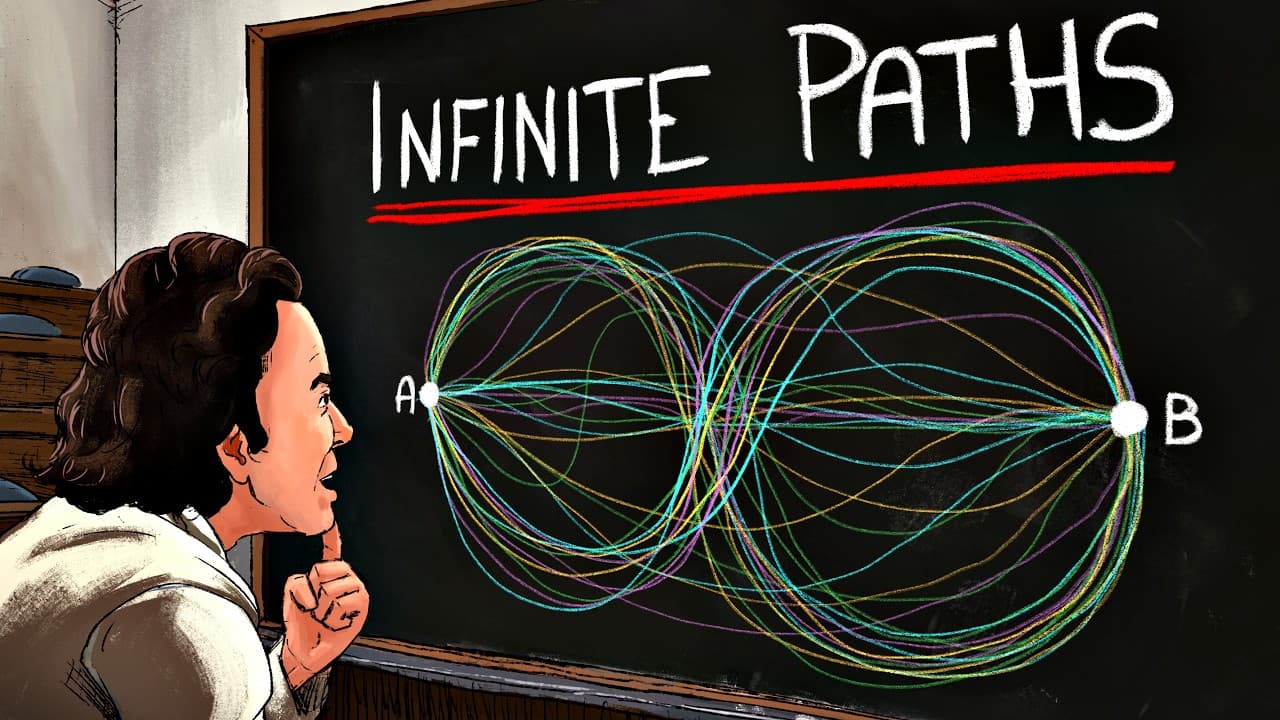
Quantum mechanics reveals that particles do not follow a single trajectory but explore all possible paths simultaneously. This phenomenon is explained through the concept of 'action', where paths of least action exhibit constructive interference, making them the most probable paths observed. The principle of least action unifies classical and quantum mechanics, offering insights into the behavior of light, electrons, and other quantum particles.
Transcript
As a 42 year old who's spent most of my life studying physics, I must admit that I had a big misconception. I believed that every object has one single trajectory through space, one single path. But in this video, I will prove to you that this is not the case. Everything is actually exploring all possible paths all at once. So let's start with a si... Read More
Key Insights
- Quantum particles explore all possible paths simultaneously, not just one.
- The principle of least action dictates the paths particles are most likely to take.
- Constructive interference occurs along paths of least action, making them observable.
- Planck introduced the quantum of action, leading to the quantization of energy.
- De Broglie proposed that matter particles also exhibit wave properties.
- Feynman’s path integral formulation emphasizes the sum over all possible paths.
- Classical mechanics emerges from quantum mechanics through the principle of least action.
- The double slit experiment illustrates the wave-particle duality of quantum objects.
Install to Summarize YouTube Videos and Get Transcripts
Explore YouTube Video Summarizer or Get YouTube Transcript Extractor
Questions & Answers
Q: How do particles travel according to quantum mechanics?
In quantum mechanics, particles do not travel along a single, defined path. Instead, they explore all possible paths simultaneously, a concept that is central to the theory. The paths that are most likely to be observed are those that follow the principle of least action, where constructive interference occurs.
Q: What is the principle of least action?
The principle of least action is a fundamental concept in physics stating that the path taken by a system between two states is the one for which the action is minimized. In quantum mechanics, this principle explains why certain paths are more probable, as they result in constructive interference of the wave functions.
Q: How does the double slit experiment demonstrate quantum behavior?
The double slit experiment demonstrates quantum behavior by showing that particles like electrons and photons can pass through two slits simultaneously, creating an interference pattern on a screen. This pattern is a result of the wave-like properties of particles, illustrating their ability to explore multiple paths at once.
Q: What role does Planck's constant play in quantum mechanics?
Planck's constant is a fundamental constant in quantum mechanics that relates the energy of a photon to its frequency. It introduced the concept of quantization, where energy is exchanged in discrete amounts, or quanta, leading to the development of the quantum theory and the understanding of atomic and subatomic processes.
Q: How did De Broglie contribute to quantum theory?
De Broglie contributed to quantum theory by proposing that particles of matter, like electrons, exhibit wave-like properties. He introduced the concept of matter waves, with a wavelength inversely proportional to the particle's momentum, which helped explain the quantization of atomic orbits and laid the groundwork for wave mechanics.
Q: How does Feynman's path integral formulation work?
Feynman's path integral formulation works by summing over all possible paths that a particle can take between two points. Each path contributes an amplitude, and the probability of finding the particle at a particular location is determined by the constructive or destructive interference of these amplitudes, emphasizing the wave nature of particles.
Q: What is the significance of action in physics?
Action is a central concept in physics, particularly in the principle of least action, which unifies classical and quantum mechanics. It is defined as the integral of the Lagrangian over time, representing the difference between kinetic and potential energy, and determines the most probable paths particles take due to constructive interference.
Q: Why do we observe only certain paths in quantum mechanics?
In quantum mechanics, we observe only certain paths due to the principle of least action. Paths that are close to the path of least action interfere constructively, making them more probable and observable. Other paths experience destructive interference due to rapid phase changes, canceling out their contributions and rendering them unobservable.
Summary & Key Takeaways
-
Quantum mechanics challenges the classical view that particles follow a single trajectory. Instead, particles explore all possible paths, with the principle of least action determining the paths that are most likely observed. This principle is rooted in the concept of 'action', which plays a crucial role in both classical and quantum physics.
-
Planck's introduction of the quantum of action and De Broglie's hypothesis of wave properties in matter revolutionized our understanding of physics. These concepts laid the groundwork for Feynman's path integral formulation, which calculates probabilities by summing over all possible paths a particle might take.
-
The double slit experiment exemplifies the strange behavior of quantum particles, demonstrating that they can pass through multiple paths simultaneously. This wave-particle duality is central to quantum mechanics, where constructive interference along paths of least action produces observable phenomena.
Read in Other Languages (beta)
Share This Summary 📚
Summarize YouTube Videos and Get Video Transcripts with 1-Click
Try YouTube Summary with ChatGPT & Claude or YouTube Transcript Generator
Explore More Summaries from Veritasium 📚

Summarize YouTube Videos and Get Video Transcripts with 1-Click
Try YouTube Summary with ChatGPT & Claude or YouTube Transcript Generator