What Is Counter-Snapping and How Does It Work?
TL;DR
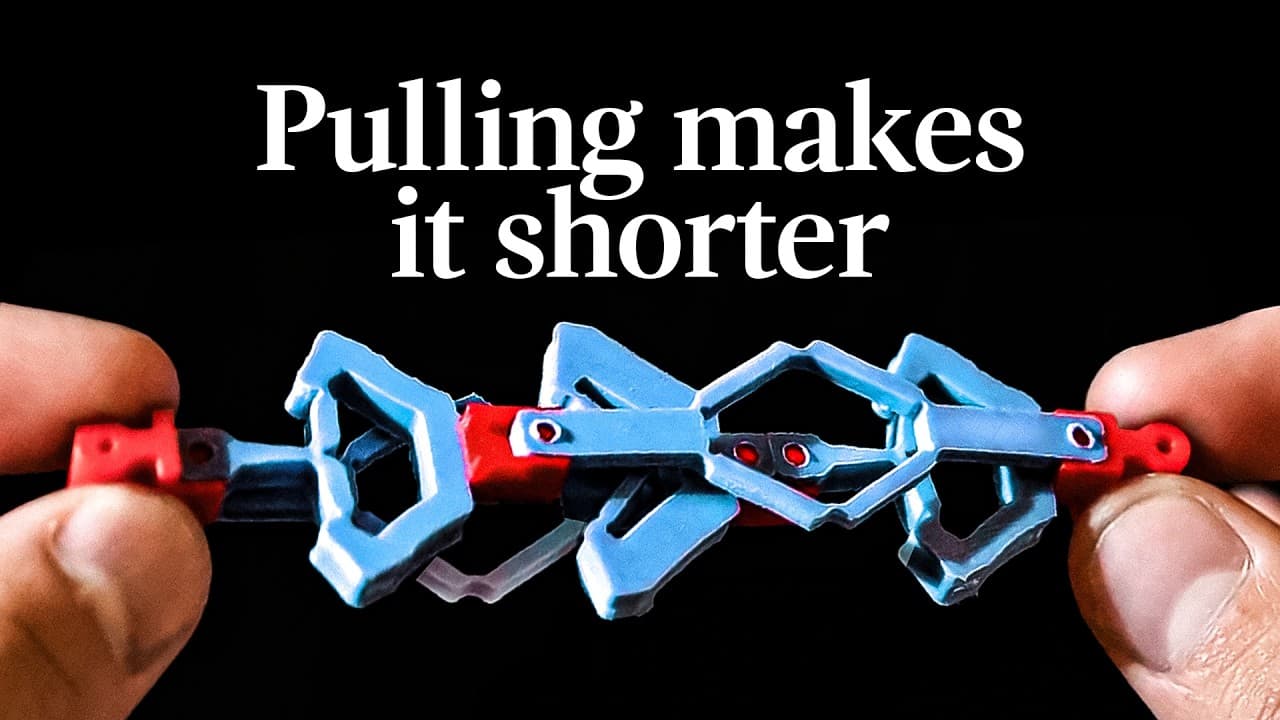
Counter-snapping is a mechanism that contracts when you pull it apart: cut the green rope holding it and the weight jumps up instead of dropping. It works because cutting the rope switches two springs from a series arrangement to a parallel one, so each spring stretches only about half as far (x/2 instead of 2x). It is a mechanical version of Braess's Paradox, where removing a connection improves the result. Read on to see how the same paradox once eased New York traffic.
Transcript
Read and summarize the transcript of this video on Glasp Reader (beta).
Key Insights
- The video explores a mechanism that shrinks when pulled, defying typical physical expectations and illustrating a counterintuitive concept.
- Braess's Paradox is introduced, explaining how adding elements to a network, like roads, can worsen overall performance.
- The mechanism's behavior is compared to real-world scenarios, like traffic flow and power grids, where similar paradoxes can occur.
- The transition from series to parallel spring configurations is key to understanding the mechanism's contraction upon rope cutting.
- New York's Earth Day traffic experiment is highlighted as a real-life example of Braess's Paradox, where closing roads improved traffic flow.
- The concept of counter-snapping is introduced, where systems snap in the opposite direction of applied force, unlike typical snapping behavior.
- The potential applications of counter-snapping include controlling resonance and vibrations in structures, offering innovative engineering solutions.
- The video discusses privacy concerns and promotes a service to remove personal data from the internet, linking less data exposure to better outcomes.
Install to Summarize YouTube Videos and Get Transcripts
Explore YouTube Video Summarizer or Get YouTube Transcript Extractor
Questions & Answers
Q: What is the counter-snapping mechanism that shrinks when pulled?
It is a small mechanism that pulls back and contracts when you try to stretch it. In a controlled demo, a cup hangs from it, and as you add water the cup shoots upward by a tiny amount instead of sinking. The physics is counterintuitive enough that it initially seems to violate the way materials should behave.
Q: What happens when you cut the green rope in the setup?
A weight hangs from a spring, which connects via a green rope to a second spring, with slack red and black ropes on the sides carrying no tension. When you cut the green rope, the only rope under tension, the weight rises rather than falls. A larger version of the experiment shows the same surprising upward motion in slow motion.
Q: Why does the weight go up instead of falling when the rope is cut?
With the springs in series, both feel the full weight and each extends by x, giving 2x of total displacement under Hooke's Law. Cutting the green rope forces the springs into a parallel arrangement, where each spring carries only half the weight and extends just x/2. That shift from series to parallel shortens the overall length, pushing the weight up.
Q: What is counter-snapping and how does it differ from regular snapping?
Counter-snapping is when a system snaps in the opposite direction of the applied force, contracting when it is stretched. In ordinary snapping, displacement follows the direction of the force. This reversed behavior is rare and is the counterintuitive effect the mechanism demonstrates.
Q: How does Braess's Paradox connect this mechanism to traffic?
Braess's Paradox is the idea that removing a connection from a network can improve overall performance. In April 1990, during New York's 20th annual Earth Day, officials banned traffic on major streets including 42nd Street, and despite predictions of gridlock the closure actually improved traffic flow. The spring mechanism is a reversible mechanical version of the same paradox.
Q: What role do the slack red and black ropes play?
The slack ropes carry no tension in the initial setup, so they create the impression that the weight will simply drop when the green rope is cut. In reality they set up the parallel configuration that appears once the green rope is gone. Each slack rope must be longer than a spring plus the green rope, but not so long that the extra slack cancels the contraction.
Q: What are the potential applications of counter-snapping?
Counter-snapping could be used to control resonance and vibrations in structures. By changing a system's natural frequency without altering its length, such mechanisms offer a way to manage unwanted vibrations and improve structural stability.
Summary & Key Takeaways
-
The video examines a mechanism that contracts when pulled, showcasing a physics paradox. It relates this to Braess's Paradox, where removing elements from a network can enhance performance, as seen in traffic and power grids.
-
By cutting a rope, the mechanism transitions from a series to a parallel spring configuration, causing contraction. This is likened to real-world scenarios where removing roads improved traffic flow, demonstrating Braess's Paradox.
-
Counter-snapping is introduced as a novel concept, where systems snap opposite to the applied force. This has potential applications in controlling vibrations, and the video also discusses the importance of managing personal data online.
Read in Other Languages (beta)
Share This Summary 📚
Summarize YouTube Videos and Get Video Transcripts with 1-Click
Try YouTube Summary with ChatGPT & Claude or YouTube Transcript Generator
Explore More Summaries from Veritasium 📚





Summarize YouTube Videos and Get Video Transcripts with 1-Click
Try YouTube Summary with ChatGPT & Claude or YouTube Transcript Generator