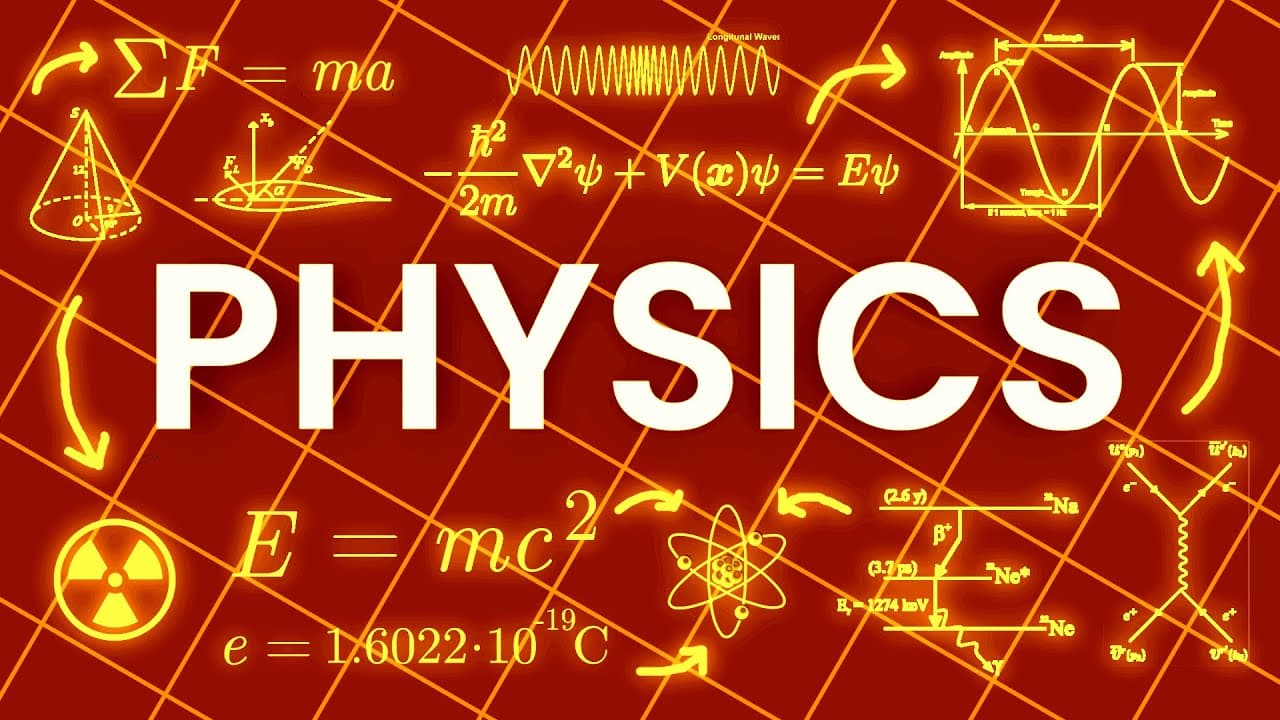
How Is All of Physics Explained in 14 Minutes?
TL;DR
Physics explains how forces, gravity, energy, thermodynamics, and electromagnetism govern motion and change. Newton’s equation says force equals mass times acceleration, gravity weakens with the square of distance, and energy can only be converted, not created or destroyed. Maxwell’s four equations connect electric and magnetic fields and explain electromagnetic waves such as visible light, so read on for clear answers to the core concepts.
Transcript
Hi! You’re on a rock. Floating in space. Surrounded by more rocks. And gas. And a bunch of nothing, mainly. Oh hey, look at that, the rocks are going around the gas. Hold on, what the heck, is going on here? To understand, let’s look a little bit of Physics. Wait, did I say a little bit? To find out what kind of magic this is, we’ll have to go back... Read More
Key Insights
- Force equals mass times acceleration, meaning a known force on a fixed mass produces a predictable acceleration, so if you know every force on a basketball mid-air you can predict with certainty whether it lands in the hoop.
- The Law of Universal Gravitation states two masses attract each other based on their mass and distance, and because the pull weakens by the square of the distance, this is called the Inverse-Square Law.
- Planets orbit the sun because they gained initial velocity from the spinning gas that formed the solar system, and gravity acts as a centripetal force making them constantly fall toward the sun but miss it.
- Mass and weight are different: mass measures how much of something there is and stays constant, while weight is the force of gravity on that mass, so you weigh less on the moon due to its weaker pull.
- Energy cannot be created or destroyed, only converted, which is the conservation of energy; held objects store gravitational potential energy that becomes kinetic energy when they fall.
- Work is force applied over distance, so lifting an apple one meter does about one Joule of work; if an object does not move, no work is done regardless of how much effort it feels like.
- Entropy measures disorder and the number of possible microstates a system can occupy, and the whole universe moves unstoppably toward higher entropy, which is why time appears to flow only forward.
- Maxwell's four equations show electric and magnetic fields are linked: a moving magnet creates an electric field and a moving charge creates a magnetic field, producing induction and electromagnetic waves like light.
Install to Summarize YouTube Videos and Get Transcripts
Explore YouTube Video Summarizer or Get YouTube Transcript Extractor
Questions & Answers
Q: What does force equals mass times acceleration mean?
Force is a directional push or pull, mass measures how much matter an object contains and its inertia, and acceleration describes how quickly velocity changes. Applying a known force to a fixed mass therefore produces a predictable acceleration.
Q: How does gravity work according to Newton’s Law of Universal Gravitation?
Every pair of masses attracts one another, with the strength of the pull determined by their masses and the distance between them. Greater mass creates a stronger pull, while increasing distance weakens the force by the square under the Inverse-Square Law.
Q: Why do planets orbit the sun instead of flying away or falling into it?
The planets gained initial velocity from the spinning gas that formed the solar system, and space provides nothing to stop their motion. The sun’s gravity continually pulls them inward, but their speed makes them fall toward the sun while missing it, so gravity acts as a centripetal force.
Q: What is the difference between mass and weight?
Mass measures how much of an object there is, while weight is the gravitational force acting on that mass. Your mass stays the same on Earth and the moon, but you weigh less on the moon because its gravitational pull is weaker.
Q: What is the difference between kinetic and potential energy?
Kinetic energy is the energy of movement, while potential energy is stored because of an object’s circumstances. A phone held above the ground has gravitational potential energy, which converts into kinetic energy as the phone falls.
Q: How are energy and work different?
Energy is the total amount of work something could possibly do, while work is force actually applied over a distance. Both are measured in Joules; lifting an apple by 1 meter does about 1 Joule of work, but pushing a weight without moving it does no mathematical work.
Q: Where does a car’s kinetic energy go when it brakes?
Friction between the brakes and wheels slows the car and converts its kinetic energy into heat. That heat transfers to the surrounding air, making its molecules move faster, so the energy is converted rather than destroyed.
Q: How are electric and magnetic fields connected?
Electric and magnetic fields are linked parts of one electromagnetic field, as described by Maxwell’s four equations. A moving magnet creates an electric field, while a moving charge creates a magnetic field, enabling induction and electromagnetic waves such as visible light.
Summary & Key Takeaways
-
Isaac Newton established that force equals mass times acceleration and that two masses attract each other through gravity, which weakens by the square of the distance under the Inverse-Square Law. This gravity keeps planets orbiting the sun as a centripetal force, making them fall toward it endlessly.
-
Energy exists as kinetic energy of movement and potential energy from stored circumstance, and it can only be converted, never created or destroyed. Work is force applied over distance measured in Joules, and when a car brakes its kinetic energy becomes heat transferred to surrounding air molecules.
-
Temperature is the average kinetic energy of wiggling atoms, and thermodynamics shows entropy or disorder always increases across the universe. Electromagnetism, described by Maxwell's four equations and Coulomb's Law, links electric and magnetic fields through motion, producing induction and electromagnetic waves including visible light.
Read in Other Languages (beta)
Share This Summary 📚
Summarize YouTube Videos and Get Video Transcripts with 1-Click
Try YouTube Summary with ChatGPT & Claude or YouTube Transcript Generator
Explore More Summaries from Wacky Science 📚
Summarize YouTube Videos and Get Video Transcripts with 1-Click
Try YouTube Summary with ChatGPT & Claude or YouTube Transcript Generator