What Is the Basics of General Chemistry?
TL;DR
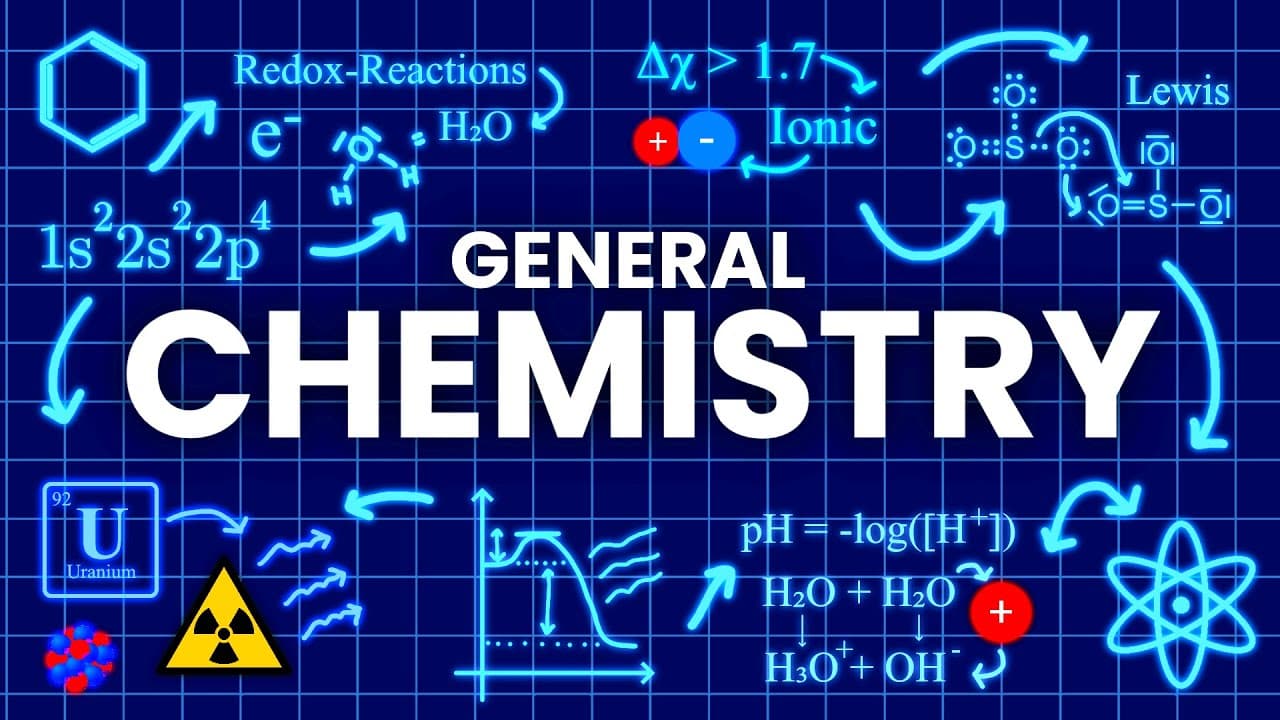
General chemistry revolves around the properties and interactions of atoms, which are composed of protons, neutrons, and electrons. Key concepts include valence electrons that dictate bonding behavior, various types of chemical bonds (ionic, covalent, metallic), and the principles governing chemical reactions like activation energy and stoichiometry.
Transcript
Everything is made of atoms. Yes, even you. Atoms consist of a core and some electrons. The core is made of protons and neutrons. And depending on the number of protons, you get different elements. Water is made of Hydrogen and Oxygen. This is some Sodium. Hm, I wonder what happens when you mix them…oh, whoopsie. Quantum mechanics tells us that thi... Read More
Key Insights
- 🫀 Atoms are the building blocks of matter, composed of protons, neutrons, and electrons; their configuration defines chemical properties.
- 🥺 Valence electrons dictate how elements bond, leading to common patterns observed in the periodic table.
- ❓ Ionic, covalent, and metallic bonds result from different electron sharing behaviors, affecting physical properties and reactions.
- 🪛 Chemical reactions are driven by energy changes, where exothermic reactions release energy, and endothermic reactions absorb it.
- ☠️ Understanding activation energy and catalysts is crucial for controlling reaction rates and processes in chemistry.
- 😥 Acid-base chemistry is essential for many biological and chemical processes, with pH measuring the strength of acids and bases.
- ❓ The concepts of Gibbs Free Energy and entropy are significant for predicting reaction spontaneity under varying conditions.
Install to Summarize YouTube Videos and Get Transcripts
Explore YouTube Video Summarizer or Get YouTube Transcript Extractor
Questions & Answers
Q: What are atoms composed of, and how do their structures affect their properties?
Atoms consist of a core made of protons and neutrons, with electrons orbiting in shells surrounding this core. The arrangement and number of protons determine the element, while the number of valence electrons influences how atoms will bond chemically. The properties of these substances, such as reactivity and state of matter, are determined by their atomic structure.
Q: Can you explain the significance of valence electrons in chemical reactions?
Valence electrons are the electrons in the outermost shell of an atom and are crucial in determining how atoms interact and form bonds. Atoms tend to react to achieve a full outer shell, which often means they will share or transfer electrons to form covalent or ionic bonds. This behavior underlies much of chemistry, as elements with similar valence electron numbers exhibit similar reactivity patterns.
Q: What is the difference between exothermic and endothermic reactions?
Exothermic reactions release energy into the surroundings, usually in the form of heat, resulting in a decrease in enthalpy. Conversely, endothermic reactions absorb energy, leading to an increase in system enthalpy. The nature of these reactions affects temperature and can determine if a reaction occurs spontaneously or requires continuous energy input.
Q: How do ionic bonds form, and why are they significant?
Ionic bonds form when one atom transfers electrons to another, resulting in positively charged ions (cations) and negatively charged ions (anions). These opposite charges create an electrostatic attraction that holds the ions together. Ionic bonding is significant because it results in compounds with high melting points, such as table salt, and governs many chemical properties.
Q: What role does the periodic table play in understanding elements and their behavior?
The periodic table organizes elements based on their atomic structure, including the number of protons and valence electrons, which influences their chemical properties and reactivity. Elements within the same groups share similar characteristics, aiding in predicting how they will interact in reactions and their compound formation.
Q: Can you explain stoichiometry and its importance in chemical reactions?
Stoichiometry is the calculation of reactants and products in chemical reactions based on the conservation of mass. Understanding stoichiometric ratios enables chemists to predict how much of each substance is needed for a reaction to occur fully without leftover reactants, especially important in quantitative analyses and laboratory settings.
Summary & Key Takeaways
-
Atoms, made of protons, neutrons, and electrons, are fundamental to elements and their behaviors in chemical reactions. Valence electrons play a crucial role in how elements interact with one another.
-
Chemical bonding types include ionic, covalent, and metallic bonds, which are determined by electron sharing and electronegativity differences. These bonds impact properties like melting points and conductivity.
-
Understanding chemical reactions involves concepts like activation energy, stoichiometry, and enthalpy, leading to insights about exothermic and endothermic reactions, equilibrium, and the role of acids and bases in chemistry.
Read in Other Languages (beta)
Share This Summary 📚
Summarize YouTube Videos and Get Video Transcripts with 1-Click
Try YouTube Summary with ChatGPT & Claude or YouTube Transcript Generator
Explore More Summaries from Wacky Science 📚
Summarize YouTube Videos and Get Video Transcripts with 1-Click
Try YouTube Summary with ChatGPT & Claude or YouTube Transcript Generator