What Is Quantum Reality: Understanding Space, Time, and Entanglement?
TL;DR
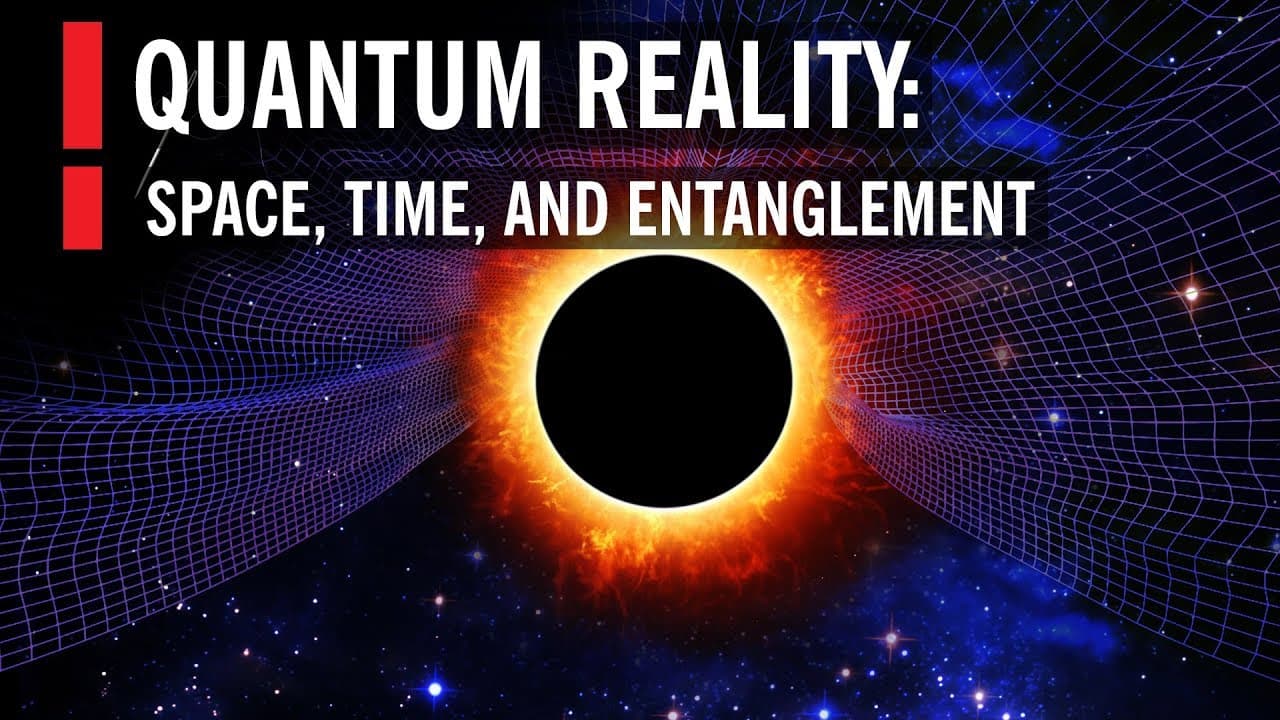
Quantum reality involves the study of particles and their behavior in the micro-world, revealing concepts like wave-particle duality and the collapse of the wave function upon measurement. The double slit experiment exemplifies this behavior, while entanglement describes how particles can be interconnected regardless of distance. Additionally, black holes present challenges regarding information fate and the nature of spacetime.
Transcript
Good to see all of you.You see a quote up there by Niels Bohr, one of the founding figures of quantum mechanics: “Anyone who thinks they can talk about quantum mechanics without getting dizzy hasn’t yet understood the first word of it.” Now, why would that be? What did Niels Bohr mean by that? Well, basically he meant that we all have a good intuit... Read More
Key Insights
- 👋 Quantum mechanics challenges our intuitive understanding of the everyday world, introducing concepts like wave-particle duality, entanglement, and the collapse of the wave function.
- 👋 The double slit experiment demonstrates the strange behavior of particles, which can exhibit both wave-like and particle-like characteristics simultaneously.
- 💨 Entanglement is a phenomenon in which two or more particles become correlated in such a way that their properties are linked, even when separated by large distances.
- 🤨 Black holes provide a unique testing ground for quantum mechanics, as their extreme gravitational pull raises questions about the nature of spacetime and the fate of information that falls into them.
Install to Summarize YouTube Videos and Get Transcripts
Explore YouTube Video Summarizer or Get YouTube Transcript Extractor
Questions & Answers
Q: Why is quantum mechanics so difficult to understand intuitively?
Human intuition developed around the everyday macroscopic world, where people learned practical skills such as throwing, catching, and dodging objects. Because we lack direct sensory experience of electrons, probability waves, and wave functions, quantum mechanics must be explored through mathematics, experiments, and observation.
Q: What does quantum mechanics describe?
Quantum mechanics is a mathematical framework for accurately describing what happens in the microworld of particles. It addresses behavior beyond ordinary sensory experience, including wave-particle duality, probability waves, wave functions, and entanglement.
Q: Does quantum weirdness affect the macroscopic world?
Yes, because macroscopic beings and objects are collections of particles rather than things separated sharply from the microworld. The discussion notes that quantum weirdness therefore applies to us as well, even if its effects may be suppressed at larger scales.
Q: What does the double-slit experiment demonstrate?
The double-slit experiment demonstrates wave-particle duality. Particles can display both wave-like and particle-like behavior, including interference patterns when passing through two slits, challenging classical expectations.
Q: What is wave-function collapse?
Wave-function collapse occurs when a quantum system is measured and its properties acquire a definite value. Before measurement, the wave function represents multiple possible states, making collapse central to questions about measurement and reality.
Q: What is quantum entanglement?
Quantum entanglement occurs when particles become correlated so that their properties remain linked. These correlations can persist even when the particles are separated by large distances, challenging classical ideas about locality and raising questions about reality and information.
Q: Is quantum mechanics a finished theory?
David Wallace says quantum mechanics is not yet fully understood and may still contain considerable depth, though there is currently no empirical or theoretical reason to think another theory will replace it. K. Birgitta Whaley expects it to remain, potentially with extensions, modifications, or a more complete framework.
Q: Why are black holes important to quantum mechanics?
Black holes are important because physicists are trying to combine quantum mechanics with gravity to understand them and, eventually, the big bang. Mark Van Raamsdonk describes this as a frontier where it remains unclear whether quantum mechanics must be modified or will continue to apply unchanged.
Summary & Key Takeaways
-
Quantum mechanics is a mathematical framework that describes the behavior of particles at the quantum level, involving concepts like wave-particle duality and the collapse of the wave function.
-
The double slit experiment illustrates the strange behavior of particles in which they can exhibit both wave-like and particle-like properties at the same time.
-
The collapse of the wave function occurs when a measurement is made on a quantum system, causing it to suddenly have a definite value.
-
Entanglement is a phenomenon in which two particles become connected in such a way that their properties are correlated, even when separated by large distances.
-
Black holes, which are extremely dense regions of space, raise questions about the fate of information that falls into them and the nature of spacetime.
Read in Other Languages (beta)
Share This Summary 📚
Summarize YouTube Videos and Get Video Transcripts with 1-Click
Try YouTube Summary with ChatGPT & Claude or YouTube Transcript Generator
Explore More Summaries from World Science Festival 📚

Summarize YouTube Videos and Get Video Transcripts with 1-Click
Try YouTube Summary with ChatGPT & Claude or YouTube Transcript Generator