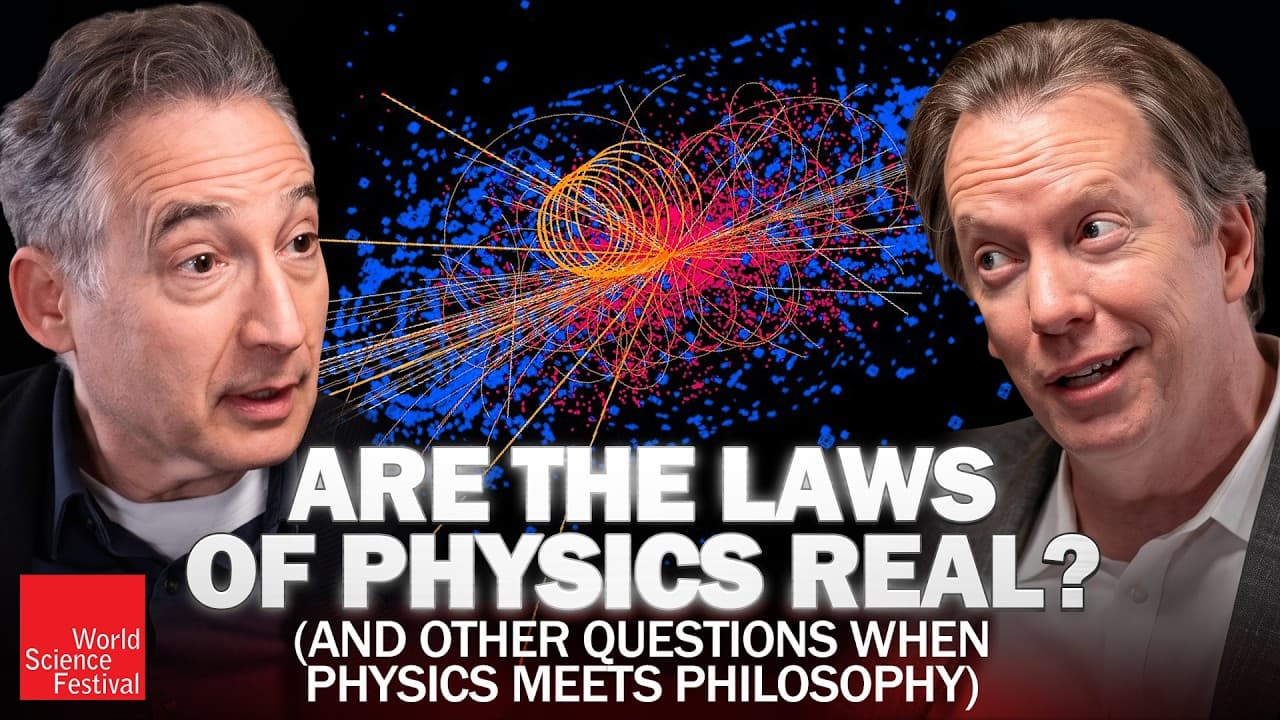
Are Physics Laws Real or Inventions? Explained
TL;DR
The video argues that it may not matter whether physics laws are real or invented; what matters is a minimal, practical framework that yields reliable predictions. It explores mathematical realism, the status of laws of physics, and whether our universe can be described by a universal quantum state, while noting that different formulations can predict the same phenomena.
Transcript
- So how then do you make peace with the fact that there are such replicable, and repeatable, and reliable patterns that happen out there? - If, you know, you have this feeling from your experience of the everyday world that if you see patterns, if you see things that, you know, reliably happen again and again in the same way, there is a reason why... Read More
Key Insights
- The key to physics practice is the predictive power of theories, not whether their underlying reality is discovered or invented.
- Mathematics can be viewed as a language for pattern description, while physical laws may be tools for organizing these patterns rather than ontic entities.
- The debate spans mathematical realism and anti realism, and how each stance informs interpretation of equations and models.
- Feynman’s idea that theories can be predictively equivalent but philosophically different is applied to the discussion of physics and mathematics.
- Godel’s incompleteness theorem is invoked to question the possibility of a complete axiomatization of mathematics, highlighting limits in human knowledge.
- Humean versus anti Humean views about laws of physics are discussed, with emphasis on whether laws have governing power or are descriptive.
- The Many Worlds interpretation is presented as a concrete example of how different ontological commitments can yield the same experimental predictions.
- The speakers stress that modern physics may not yet be finished and that new insights could change the perceived status of laws and mathematical objects.
- More videos from this channel:
- More from this channel: World Science Festival
Install to Summarize YouTube Videos and Get Transcripts
Explore YouTube Video Summarizer or Get YouTube Transcript Extractor
Questions & Answers
Q: What is the central question about the status of physics laws and mathematics?
The central question is whether physical laws exist independently and govern the universe or whether they are human constructs that we use to describe patterns we observe. The discussion contrasts realism, which treats laws as real entities, with anti realism, which sees them as descriptions or tools. This consideration shapes how physicists pursue theories, tests, and the interpretation of mathematical models.
Q: Why might mathematics be considered a language for patterns rather than an external reality?
Mathematics may be viewed as a language because it provides symbols and rules to articulate patterns we observe in the world. If the world can be described by consistent patterns, math serves as a highly effective descriptive tool, even if mathematical objects themselves are not physically real. This view emphasizes utility over ontological status.
Q: What is the argument for mathematical realism discussed in the dialogue?
The argument for mathematical realism rests on the claim that mathematical objects and structures have a form of existence that transcends human invention. Proponents argue that because we can reliably use mathematics to model and predict physical phenomena, there is something real about these mathematical forms beyond mere convenience.
Q: How does the conversation illustrate Feynman’s idea about theories?
The conversation echoes Feynman by suggesting that theories can yield identical predictions yet be philosophically different in interpretation. This implies that practical success does not necessarily settle questions about the true nature of reality, and multiple frameworks can be equally valuable for understanding and predicting phenomena.
Q: What role does Gödel’s incompleteness theorem play in the discussion?
Gödel’s theorem is invoked to illustrate that no finite set of axioms can fully capture mathematical truth without leaving gaps. This challenges the idea of a complete, final foundation for mathematics and suggests limits to any dream of a perfect, all-encompassing axiomatization of the sciences.
Q: What are Humean and anti-Humean views of physical laws?
Humean views treat laws as descriptions of regularities in the world without intrinsic governing power, while anti-Humean views posit that laws have a governing role that structures the behavior of physical systems. The dialogue weighs these positions in relation to how we explain patterns and regularities.
Q: How is the Many Worlds interpretation used in the discussion?
Many Worlds is presented as a concrete example where a particular ontological commitment (multiple coexisting universes) yields the same empirical predictions as other interpretations. This highlights how differing philosophical assumptions can coexist with identical experimental outcomes.
Q: What future possibilities does the dialogue suggest for physics and mathematics?
The speakers imply that physics and mathematics are not finished yet and that new discoveries could alter our understanding of reality, laws, and math. The anticipation is that future theories may revise how we describe patterns, possibly changing our view of whether laws are real or invented and how mathematics relates to the world.
Summary & Key Takeaways
-
A broad discussion about the nature of physical laws and mathematics, evaluating realism versus inventions and how this shapes scientific practice and interpretation.
-
The conversation touches on mathematical realism versus instrumentalism, and whether laws have independent existence or are human constructs used to describe patterns.
-
The dialogue closes by considering how future theories might alter our understanding of patterns, laws, and the connection between math and the physical world.
Read in Other Languages (beta)
Share This Summary 📚
Summarize YouTube Videos and Get Video Transcripts with 1-Click
Try YouTube Summary with ChatGPT & Claude or YouTube Transcript Generator
Explore More Summaries from World Science Festival 📚
Summarize YouTube Videos and Get Video Transcripts with 1-Click
Try YouTube Summary with ChatGPT & Claude or YouTube Transcript Generator