How do conflicting physics rules shape the universe
TL;DR
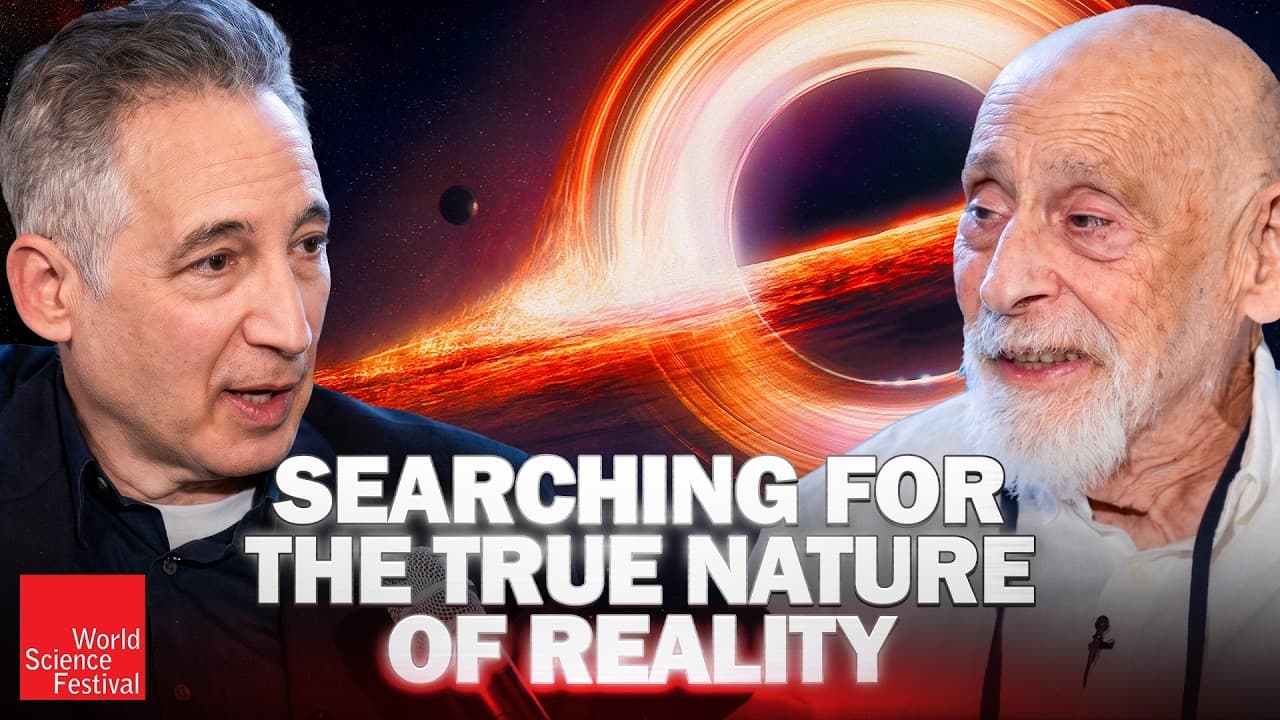
Conflicting core principles drive progress in physics and force bold ideas. Susskind explains how intuition, not just math, guides breakthroughs like black holes and holography, and how being wrong is part of discovery. The talk blends personal history with big questions about information and reality.
Transcript
- When there's something that you are pretty sure has to be right, and there's something else, which you're pretty sure has to be right, but they conflict with each other, they can't both be true. To me, that's where my mind is drawn. I think almost everything I ever did was a product of that. But yeah, that's where I am. - And it does take a certa... Read More
Key Insights
- Conflicting principles draw the mind toward the hardest questions in physics. This tension fuels ambitious theories and the search for deeper understanding.
- Intuition plays a crucial role alongside mathematics, guiding physicists to see connections that pure calculation might miss.
- Being willing to be wrong is essential in science, a quality Susskind endorses as a driver of genuine progress.
- Individuals like Witten and Susskind demonstrate that collaboration and dialogue can unite different mathematical approaches with physical insight.
- Black holes illuminate information paradoxes and test the limits of known physics, pushing toward a more complete theory of quantum gravity.
- String theory serves as a framework that has influenced thinking about space, time, and cosmology even as it faces unanswered questions.
- Holography proposes that a higher-dimensional universe might be described by lower-dimensional information, reshaping conceptions of reality.
- The human element of science—background, mentorship, and persistence—shapes how theories are formed and communicated.
- More videos from this channel:
- More from this channel: World Science Festival
Install to Summarize YouTube Videos and Get Transcripts
Explore YouTube Video Summarizer or Get YouTube Transcript Extractor
Questions & Answers
Q: What initially drew Susskind to physics and how did his path begin?
Leonard Susskind describes growing up in a Bronx environment, starting in plumbing to support his family, and discovering math as his strong suit. A pivotal moment was learning of Einstein and deciding to pursue physics, aided by mentors who redirected him from engineering toward science. This origin shows how practical beginnings can lead to profound theoretical breakthroughs.
Q: How does Susskind describe the role of intuition in physics?
Susskind explains intuition as a blend of experience and imaginative thinking that helps identify fruitful questions and connections between seemingly incompatible ideas. He emphasizes that intuition works with mathematics, not as a replacement, and that a good physicist uses it to navigate conflicts between principles just as much as to perform calculations.
Q: What is the significance of conflict between principles in Susskind’s view?
Conflict between principles acts as a catalyst for deep inquiry. When two ideas seem individually correct but cannot both be true, the struggle to reconcile them drives the development of new theories and a deeper understanding of fundamental physics, a pattern that mirrors many of Susskind’s key contributions.
Q: What does the dialogue with Edward Witten illustrate about physics?
The dialogue with Edward Witten illustrates that different strong minds can share a common language despite differing strengths. Their conversations highlight how mathematical intuition and physical insight complement each other, reinforcing that collaboration across styles can advance understanding in theoretical physics.
Q: What topics does the discussion cover beyond black holes?
Beyond black holes, the talk covers quantum mechanics, space and time, cosmology, information theory in physics, and the holographic principle. These topics reflect the breadth of Susskind’s influence and show how ideas in one area inform others within the quest to describe reality.
Q: How does Susskind view being wrong in science?
Susskind views being wrong as an acceptable and even necessary part of scientific progress. He argues that confidence in a wrong direction can still propel future discoveries, and cites Einstein as an example of a great mind who was wrong at times, reinforcing that error is a natural ingredient of advancement.
Q: What is the holographic principle and why is it important?
The holographic principle proposes that the information content of a higher-dimensional space can be encoded on a lower-dimensional boundary. This idea reshapes notions of reality and has implications for understanding gravity, quantum mechanics, and information conservation in extreme conditions like black holes, influencing ongoing research in theoretical physics.
Q: Why are experiments in this field described as cathedral-building efforts?
Experiments in fundamental physics are described as cathedral-building because they require enormous, collaborative infrastructure and long timescales to test subtle, high-level theories. The scale and complexity reflect the ambition of validating ideas like string theory and holography, illustrating the challenging path from theory to empirical confirmation.
Summary & Key Takeaways
-
The speaker recounts a life shaped by conflicts between established ideas and new evidence, showing how disagreement can spark progress in physics.
-
The discussion foregrounds intuition alongside math, arguing that insight often comes from reconciling incompatible truths.
-
The talk surveys major topics from black holes to holography and emphasizes the human side of scientific breakthroughs.
Read in Other Languages (beta)
Share This Summary 📚
Summarize YouTube Videos and Get Video Transcripts with 1-Click
Try YouTube Summary with ChatGPT & Claude or YouTube Transcript Generator
Explore More Summaries from World Science Festival 📚

Summarize YouTube Videos and Get Video Transcripts with 1-Click
Try YouTube Summary with ChatGPT & Claude or YouTube Transcript Generator