What is time really, and how does relativity reframe it?
TL;DR
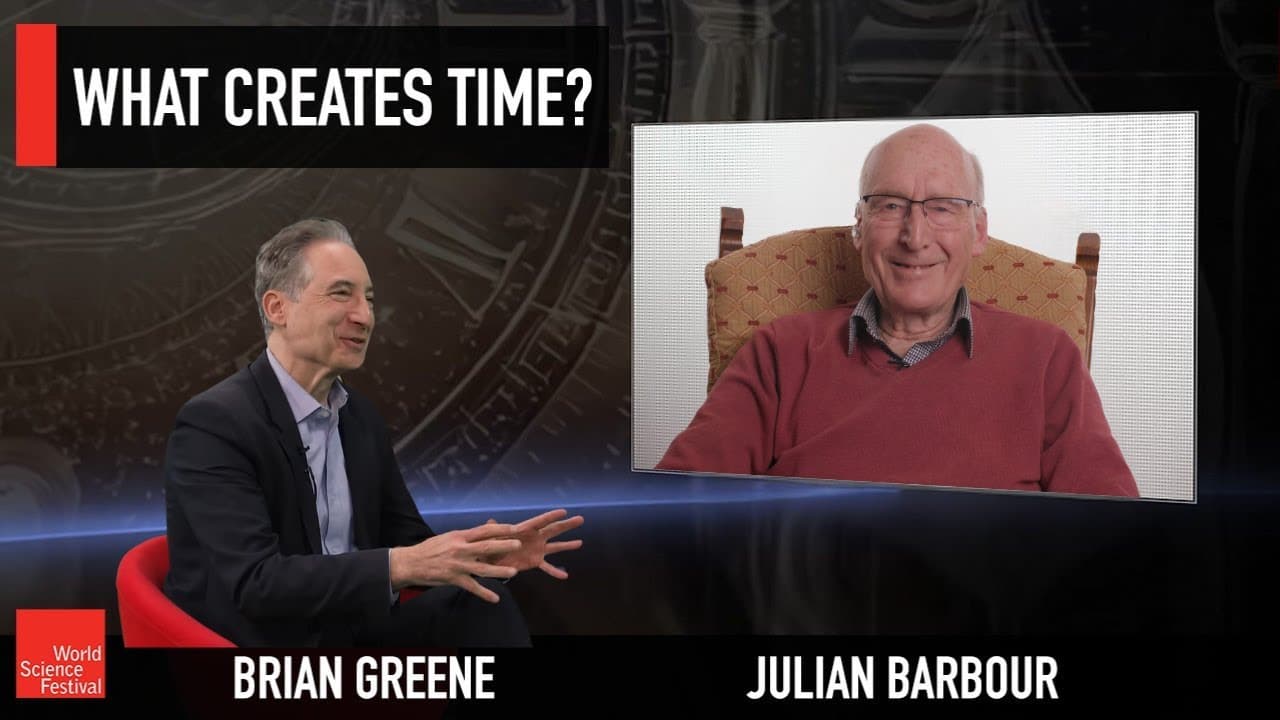
Time is not a fixed backdrop but emerges from the changing relationships between objects and fields. Barbour argues that the standard space-time view is only part of the story and that local inertial frames arise from the collective motion of all bodies in the universe. The discussion reframes how we understand time, motion, and the structure of gravity.
Transcript
In today's conversation I'm pleased to be speaking with Julian Barbour who has spent decades thinking about the deep mysteries surrounding the nature of time. You may know of him through his books that he's written among which we have the book The End of Time, the Janice Point - these are wonderful treaties on the nature of time that are ... Read More
Key Insights
- Time is an abstraction derived from changes in things, not an absolute backdrop, according to Mach and Barbour.
- Mach’s ideas motivate a relational view where inertial frames come from the universe’s overall motion, not from an absolute space.
- Barbour argues Minkowski space-time is the end product of a deeper, more fundamental structure.
- General relativity can be reinterpreted so that local space-time structure emerges from a swarm of relational motions.
- The initial value problem in general relativity is essential for defining viable solutions rather than starting from a fixed space-time stage.
- Dirac’s questioning of four-dimensional symmetry inspired Barbour to rethink time as dynamical rather than purely geometric.
- Bertotti and O Murchadha contributed to showing how inertial frames could emerge from global dynamics, not preexisting.
- The discussion situates time, motion, and geometry within a broader relational and historical context rather than as standalone absolutes.
- More videos from this channel:
- More from this channel: World Science Festival
Install to Summarize YouTube Videos and Get Transcripts
Explore YouTube Video Summarizer or Get YouTube Transcript Extractor
Questions & Answers
Q: What does Julian Barbour mean when he says time is an abstraction derived from changes?
Barbour argues that time does not exist independently as a universal clock. Instead, time emerges from the sequence of changes in the universe. By examining how configurations of matter and radiation evolve, one can define a relational ordering that serves as a time parameter. This view challenges the notion of time as a fixed stage on which events play out and emphasizes the interdependence of events.
Q: How does Mach influence Barbour’s view of time and inertia?
Mach’s ideas about relativity of motion and the origin of inertial frames underpin Barbour’s relational approach. He suggests that local inertial frames arise from the collective motion of all bodies in the universe rather than from an absolute space. This perspective places inertia and time within the network of cosmic relationships.
Q: Why does Barbour discuss Minkowski and Leibniz together in this context?
Barbour uses Minkowski to acknowledge the conventional space-time framework but argues it is a late, end product rather than a starting point. Leibniz is cited to emphasize that variety and relations generate structure. Together, they illustrate a shift from absolute space-time to a relational, dynamic foundation for physics.
Q: What is the initial value problem and why is it important in Barbour’s view?
The initial value problem concerns specifying suitable initial data to determine the evolution of a gravitational system. Barbour emphasizes that viable solutions require careful formulation, and that the emergence of local space-time structure depends on these dynamical initial conditions. This challenges simplistic, fixed notions of space-time from the outset.
Q: How does Barbour’s collaboration with Bertotti influence his ideas on time?
Collaborations with Bertotti and others helped demonstrate how inertial structures can emerge from the global dynamics of the universe. These partnerships provided concrete models where local physics arises from relational motion, supporting Barbour’s claim that the universe’s collective behavior creates the appearance of time and a stable framework.
Q: What role does Dirac’s question about four-dimensional symmetry play in this discussion?
Dirac’s inquiry into whether four-dimensional symmetry is fundamental motivates Barbour to question time and space as primary. This influence pushes toward a dynamical, relational interpretation where symmetry emerges from the interaction of changing configurations, rather than dictating an absolute backdrop for physical laws.
Q: What is the significance of viewing general relativity as emergent rather than foundational?
If general relativity is viewed as emergent from deeper relational dynamics, then the Minkowski structure is treated as a final product. This shifts the emphasis from starting with space-time to understanding how local geometric structure arises from the whole-universe motion, potentially altering how we model gravity and cosmology.
Q: How does this discussion connect to the broader World Science Festival context?
The conversation, as part of the World Science Festival, engages public audiences with frontier ideas about time, entropy, and cosmic origins. It situates Barbour’s heterodox views within a larger effort to explore fundamental questions through dialogue, collaboration, and accessible scientific storytelling.
Summary & Key Takeaways
-
Barbour proposes that time arises from the changes in the universe rather than existing as a fundamental backdrop, challenging the conventional space-time picture.
-
The conversation traces the influence of Mach, Dirac, and Leibniz on the interpretation of time, motion, and relativity, arguing for a relational view.
-
The dialogue highlights how initial value formulations and collective dynamics of the cosmos could redefine general relativity as a locally emergent framework.
Read in Other Languages (beta)
Share This Summary 📚
Summarize YouTube Videos and Get Video Transcripts with 1-Click
Try YouTube Summary with ChatGPT & Claude or YouTube Transcript Generator
Explore More Summaries from World Science Festival 📚

Summarize YouTube Videos and Get Video Transcripts with 1-Click
Try YouTube Summary with ChatGPT & Claude or YouTube Transcript Generator