What Is Quantum Reality and the Many Worlds Idea?
TL;DR
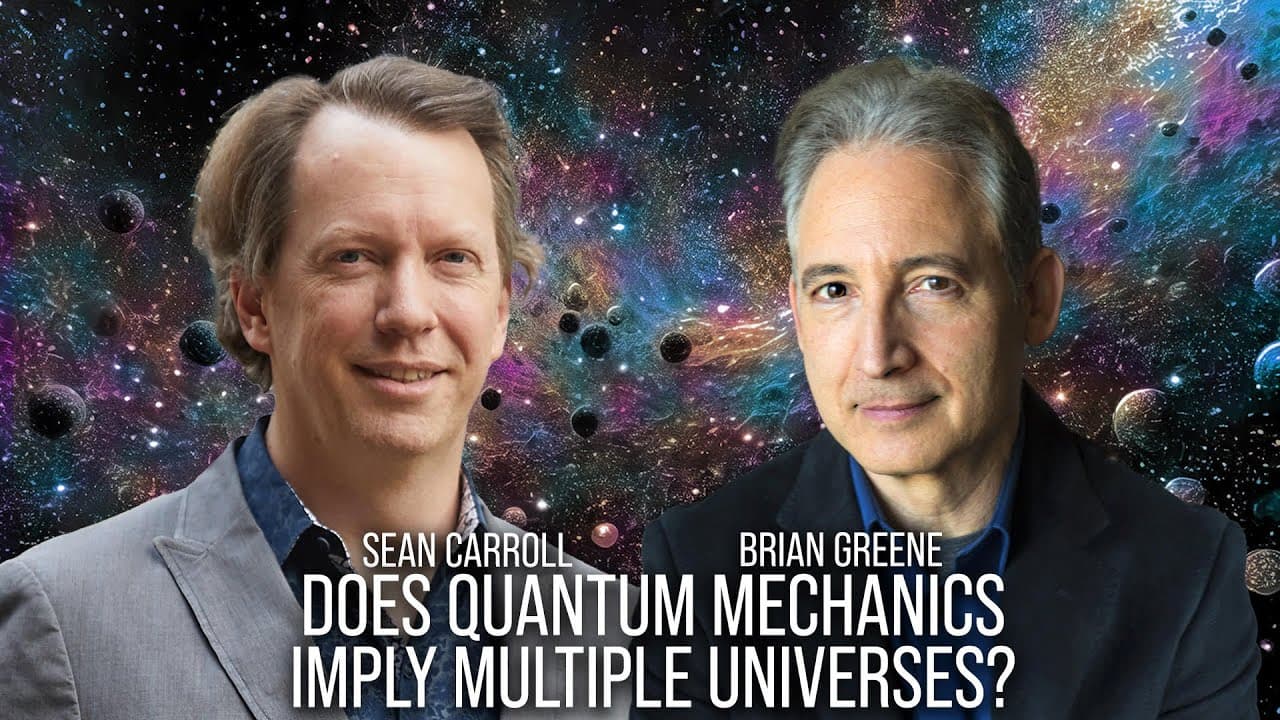
The measurement problem questions how a quantum system becomes a definite outcome. Everett’s many worlds interpretation proposes no collapse, only a branching of the universal wave function as decoherence occurs. This view implies all possible outcomes exist in parallel, realized in separate branches of reality.
Transcript
welcome to the second in our series of conversations on Quantum reality in the first part with theise crw we reviewed the essential conception at the heart of quantum mechanics which is that the theory is probabilistic in its pronouncements that is whereas newtonium mechanics takes as input the state of the world right now and as output predicts th... Read More
Key Insights
- Reality in quantum mechanics is described probabilistically rather than deterministically.
- The wave function encodes possible outcomes and their probabilities prior to observation.
- Measurement problem asks how definite outcomes arise from quantum possibilities.
- Grw-style spontaneous collapse theories propose real collapses as a physical process.
- Decoherence explains apparent classical outcomes without requiring a collapse.
- Everett’s many worlds interprets the wave function as real and uncollapsed, with branching.
- In many worlds, observers become part of the universal wave function and split into branches.
- Non locality and entanglement are discussed as features any interpretation must address.
- More videos from this channel:
- More from this channel: World Science Festival
Install to Summarize YouTube Videos and Get Transcripts
Explore YouTube Video Summarizer or Get YouTube Transcript Extractor
Questions & Answers
Q: What is the measurement problem in quantum mechanics?
The measurement problem asks how a quantum system transitions from a superposition of multiple possible states to a single definite outcome when observed. The standard account introduces collapse rules that are not derived from the Schrödinger evolution, which creates a conceptual gap. Various approaches seek to explain this transition without ad hoc rules, such as decoherence, collapse theories, or many worlds.
Q: What is the GRW theory in brief?
GRW theory proposes that wave function collapse is a real physical process that happens spontaneously and rarely, but with so many particles in macroscopic objects that the effect becomes practically certain. This spontaneous localization reduces superpositions and explains definite outcomes without observer intervention.
Q: What did Hugh Everett propose regarding quantum mechanics?
Hugh Everett proposed that the wave function never collapses. Instead, the universe evolves according to the Schrödinger equation, and when measurements occur, the system and observer form a superposed state that branches into multiple non interacting outcomes, with each branch representing a different realized reality.
Q: How does decoherence relate to the measurement problem?
Decoherence describes how interactions with the environment effectively suppress interference between components of a quantum superposition. This makes certain outcomes appear classical by choosing a preferred basis, but it does not by itself select a single definite result; it helps explain why observers perceive definite states without invoking collapse.
Q: Why is the many worlds interpretation appealing to some physicists?
Many worlds preserves unitary evolution and avoids adding special collapse rules. It accounts for the appearance of definite outcomes by positing a branching multiverse where every possible result occurs in its own branch. This avoids paradoxes associated with measurement and wave function collapse.
Q: What role does entanglement play in the discussion of reality?
Entanglement shows that correlations between distant systems can exist in a way that challenges local realism. Any interpretation must explain how entangled states relate to observed outcomes, whether through collapse, decoherence, or the existence of multiple branches where each branch reflects a different correlation pattern.
Q: What is non locality and why is it important here?
Non locality refers to correlations that appear to connect distant events instantaneously beyond classical limits. In quantum interpretations, explanations must address how entangled systems exhibit such correlations, whether through hidden variables, nonlocal influences, or the structure of a branching multiverse.
Q: Does the dialogue take a definitive stance on which interpretation is correct?
The dialogue presents multiple viewpoints including collapse theories, decoherence, and many worlds, emphasizing ongoing debate and experimental tests. It argues that current textbook quantum mechanics is insufficient as a fundamental theory and that exploring different interpretations can advance our understanding of quantum reality.
Summary & Key Takeaways
-
In this discussion, the nature of quantum reality is examined through the measurement problem and the many worlds proposal. The conversation highlights how the wave function evolves and how observation relates to definite outcomes. Everett’s idea suggests that all outcomes exist in a sprawling multiverse rather than collapsing to a single result.
-
The talk contrasts collapse theories with decoherence and the many worlds hypothesis. It emphasizes that measurement and interaction define outcomes, while the underlying theory may predict a superposition of states that split into distinct branches.
-
The program explores whether quantum non locality and entanglement fit better with a single definite world or with a framework where multiple universes realize each possible outcome as reality expands.
Read in Other Languages (beta)
Share This Summary 📚
Summarize YouTube Videos and Get Video Transcripts with 1-Click
Try YouTube Summary with ChatGPT & Claude or YouTube Transcript Generator
Explore More Summaries from World Science Festival 📚

Summarize YouTube Videos and Get Video Transcripts with 1-Click
Try YouTube Summary with ChatGPT & Claude or YouTube Transcript Generator