How did Schwarzschild, Penrose, and LIGO reshape gravity science
TL;DR
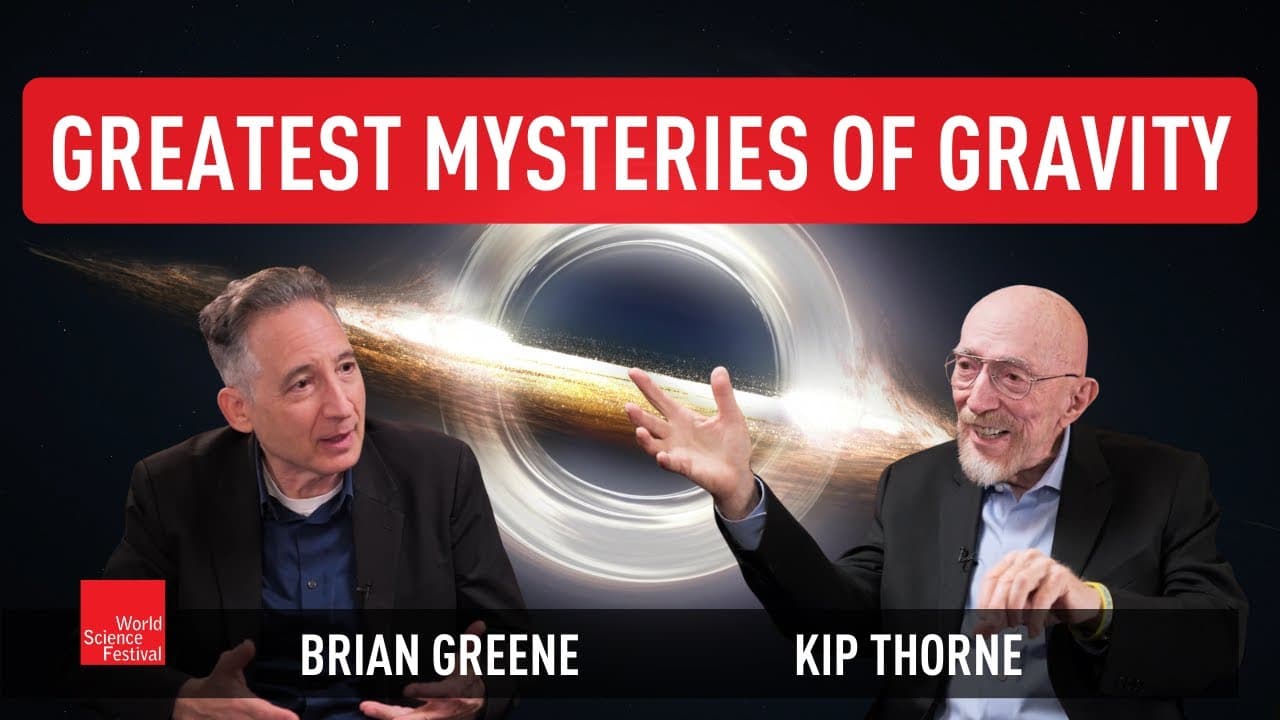
The talk traces how early ideas about black holes evolved from Schwarzschild’s exact solution to Penrose’s topological proofs and the later confirmation of gravitational waves by LIGO. It highlights how simplifying assumptions and new mathematics helped reveal horizons, singularities, and the reality of black hole mergers, linking theory to experiment and cinema.
Transcript
Kip: My collaboration with Christopher Nolan is just a wonderful collaboration, a wonderful experience. He is a highly creative man, very different background from me, and he could ask questions of me that I would never have asked myself. Brian: Hey, everyone. Thanks for joining us. Today we are going to be talking about gravitational phys... Read More
Key Insights
- Black holes began as a hypothetical idea and evolved through exact solutions like Schwarzschild’s, which described the external field and horizon concepts.
- The Schwarzschild radius marks a boundary where traditional coordinates fail, creating a mathematical singularity that is not necessarily physical but required newer interpretation.
- Einstein did not find the Schwarzschild solution initially, and later works showed that collapsing matter can form horizons even with pressure.
- Oppenheimer and Snyder demonstrated dynamical collapse, illustrating that a star can shut itself off from the universe as it crosses the horizon.
- Differential topology, introduced by Penrose, provided tools to prove horizon formation under broad conditions, even with pressure, changing the consensus.
- Penrose’s methods were initially alien to many physicists but eventually gained acceptance and reshaped understanding of black holes.
- The Moscow physicists’ skepticism shows that new mathematical ideas can face cultural resistance before becoming standard.
- LIGO’s detection of gravitational waves connected theory to observation, completing a long chain from Einstein’s equations to experimental confirmation.
- More videos from this channel:
- More from this channel: World Science Festival
Install to Summarize YouTube Videos and Get Transcripts
Explore YouTube Video Summarizer or Get YouTube Transcript Extractor
Questions & Answers
Q: What is the Schwarzschild radius and why does it matter in black hole physics?
The Schwarzschild radius is a location in the Schwarzschild solution where the mathematics becomes singular, indicating a boundary associated with a black hole. It matters because it marks where traditional descriptions break down and signals that a collapsing body may form a horizon. This concept helped physicists understand how black holes could form and what observers outside might see, while revealing limits of earlier coordinate systems.
Q: How did Oppenheimer and Snyder contribute to the understanding of collapse?
Oppenheimer and Snyder showed, for the first time, a dynamical collapse of a ball of dust could shrink through the Schwarzschild radius and form a horizon. Their work demonstrated that a collapsing star could effectively shut itself off from the rest of the universe, validating key ideas about black holes and horizons beyond static models.
Q: Why was Penrose's work important in black hole theory?
Penrose introduced differential topology to gravity, enabling theorems that prove horizon formation under broad conditions, including with pressure. His approach provided rigorous support for the existence of black hole horizons beyond simplistic dust models, convincing a skeptical community and expanding the mathematical foundation of black hole physics.
Q: What role did skepticism play in the acceptance of black hole horizons?
Skepticism existed because early solutions suggested strange behavior near the Schwarzschild radius, and some physicists doubted whether horizons could exist under realistic conditions. The shift came as new mathematics showed horizons could form with pressure, and as observational and theoretical advances aligned, leading to broader acceptance across the field.
Q: How are theory and experiment linked in this discussion?
The narrative traces a path from early theoretical ideas and exact solutions to dynamical collapse models, then to Penrose’s theorems, and finally to LIGO’s empirical detection of gravitational waves. This progression shows how mathematical rigor and experimental observation together validate concepts about black holes, horizons, and cosmic gravity.
Q: What is the connection between physics and cinema mentioned in the talk?
The discussion mentions collaborations with Christopher Nolan and the way black holes and gravitational physics influence storytelling in films like Interstellar. This highlights how scientific ideas inspire artistic representations and how cinema can reflect and amplify public interest in complex topics like black holes and gravitational waves.
Q: Why did Einstein resist certain black hole interpretations?
Einstein struggled with shrinking a star below the Schwarzschild radius and initially doubted what happened inside that region. His skepticism reflects the difficulty of interpreting highly curved spacetime and dynamical collapse within the framework of general relativity, which later work by Oppenheimer, Snyder, and Penrose helped to resolve.
Q: What lasting impact did LIGO have according to the talk?
LIGO confirmed gravitational waves, a major prediction of general relativity, and played a central role in the Nobel Prize recognition for Thorne and others. This empirical validation linked theoretical work on black holes and horizons to real, measurable phenomena, advancing gravitational physics into a new observational era.
Summary & Key Takeaways
-
The discussion begins with historical roots from Michell and Schwarzschild, then moves to how exact solutions revealed the nature of black holes and horizons. It explains how Einstein’s equations required new mathematics to understand dynamical collapse, and how LIGO confirmed gravitational waves, tying science to culture. The narrative emphasizes collaboration and cross discipline.
-
The speakers discuss the role of differential topology in proving horizon formation under various conditions, and how Penrose’s ideas finally convinced the community years later, including resistance within the Moscow physics community. The conversation also touches on how cinematic representations, like Interstellar, intersect with scientific progress.
-
The program showcases the human and collaborative journey in gravitational physics, from trenches and early skepticism to Nobel Prize and modern observatories, illustrating how theory, experiment, and storytelling converge to deepen our understanding of the cosmos.
Read in Other Languages (beta)
Share This Summary 📚
Summarize YouTube Videos and Get Video Transcripts with 1-Click
Try YouTube Summary with ChatGPT & Claude or YouTube Transcript Generator
Explore More Summaries from World Science Festival 📚

Summarize YouTube Videos and Get Video Transcripts with 1-Click
Try YouTube Summary with ChatGPT & Claude or YouTube Transcript Generator