How does time flow in cosmology and relativity explained
TL;DR
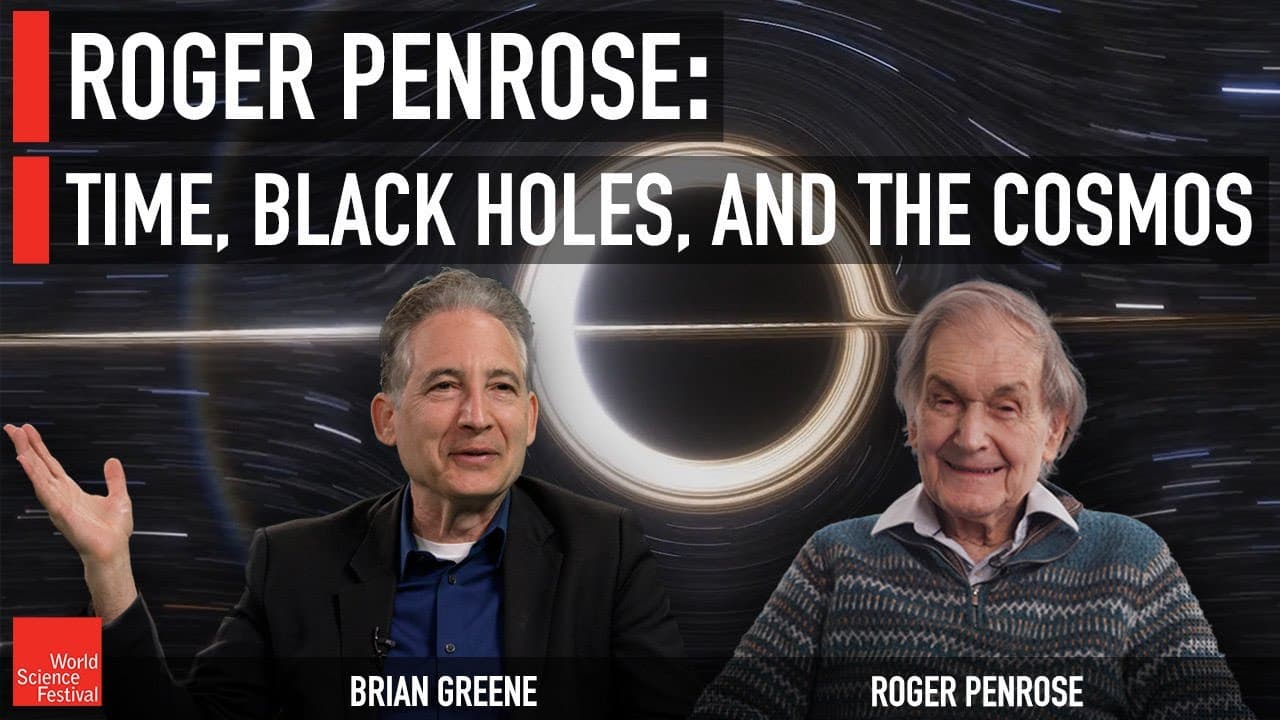
Time is a component of four dimensional space time, and its flow depends on motion and gravity. Penrose discusses how entropy, the second law, and the early universe's conditions relate to the arrow of time, and how general relativity changes our understanding of time across observers and cosmic scales. This brings questions about beginning, end, and orientation in time within cosmology.
Transcript
good evening everyone today's conversation is about the nature of time big issues that we have thought about for a long time did time have a beginning will time have an end why does time seem to have an orientation a Direction Why does the past seem so different from the the future what does this all mean for human perception and perhaps even for t... Read More
Key Insights
- Time is a component of space time and not separable from space.
- Different observers can slice space time differently, yet agree on the invariant reality within relativity.
- Entropy and the second law give time an arrow, but the early universe involves gravity and radiation in contrasting ways.
- The microwave background reveals a nearly perfect Planck curve, implying thermal equilibrium in the radiation field.
- Gravity drives structure formation and black holes, whose entropy is extremely large.
- Minkowski space time provided a precursor to general relativity by unifying space and time.
- Einstein embraced space time in general relativity after initial hesitation with Minkowski’s view.
- Penrose emphasizes rethinking time concepts to align cosmology with a true nature of time.
- More videos from this channel:
- More from this channel: World Science Festival
Install to Summarize YouTube Videos and Get Transcripts
Explore YouTube Video Summarizer or Get YouTube Transcript Extractor
Questions & Answers
Q: How is time defined in the context of space time and relativity?
Time is described as one component of the four dimensional space time, which combines three space dimensions with one time dimension. In relativity, time varies with velocity and motion, so different observers can experience time differently. The invariant reality exists, but how it is sliced into space and time depends on the observer, while maintaining consistency with the four dimensional framework.
Q: Why does time have a direction or arrow according to the discussion?
The direction of time is tied to the second law of thermodynamics, where entropy tends to increase, giving a progression from less to more disorder. This entropy increase defines a temporal orientation, helping distinguish past from future, even though local observers may experience time differently due to motion and gravity.
Q: What does the Planck curve of the microwave background imply about entropy?
The Planck curve observed in the microwave background is a precise signature of thermal equilibrium, indicating maximum entropy for the radiation field at that epoch. This shows that the early universe had radiation at near equilibrium, while gravity and structure were evolving under different entropy considerations.
Q: How does gravity affect entropy differently from other forces?
Gravity tends to condense matter, leading to clumping and black hole formation, which correspond to extremely large entropy. This is opposite to the behavior of non gravitational forces, where entropy tends to spread molecules evenly. The overall entropy of the universe increases as gravity shapes large scale structures and black holes emerge.
Q: What is the role of Minkowski space time in understanding relativity?
Minkowski introduced the four dimensional space time concept, which Einstein later built upon to develop general relativity. This framework allowed the unification of space and time and the understanding that observers can slice space time differently, depending on their frame of reference, while the invariant space time persists.
Q: Why did Einstein resist Minkowski’s space time idea, and what happened later?
Einstein initially resisted the idea of separating time from space because he valued a more relational, observer dependent view. However, Minkowski’s space time picture proved crucial for the development of general relativity, as it provided the mathematically robust framework in which space and time are inseparably linked across all observers.
Q: What is Penrose’s broader goal about time in cosmology?
Penrose aims to rethink conventional notions about time to better align cosmology with the true nature of time as a four dimensional space time. This includes addressing entropy, the direction of time, and how gravity and quantum aspects fit into a global, consistent description of the cosmos that honors observed phenomena like the microwave background and black holes.
Q: What is the significance of observing time from a cosmological perspective?
Cosmological time requires integrating relativity, thermodynamics, and gravitational phenomena to understand the evolution of the universe. By considering the invariant space time, observer dependent slicing, and entropy driven direction, we gain a coherent view of how time operates on the largest scales and across different frames of reference.
Summary & Key Takeaways
-
Penrose explains that time is part of space time and varies with velocity, demanding a four dimensional view.
-
The second law and entropy create a time direction, with the early universe showing high order in gravity versus radiation.
-
General relativity links space and time into a unified picture, where observers slice space time differently without changing the invariant reality.
Read in Other Languages (beta)
Share This Summary 📚
Summarize YouTube Videos and Get Video Transcripts with 1-Click
Try YouTube Summary with ChatGPT & Claude or YouTube Transcript Generator
Explore More Summaries from World Science Festival 📚

Summarize YouTube Videos and Get Video Transcripts with 1-Click
Try YouTube Summary with ChatGPT & Claude or YouTube Transcript Generator