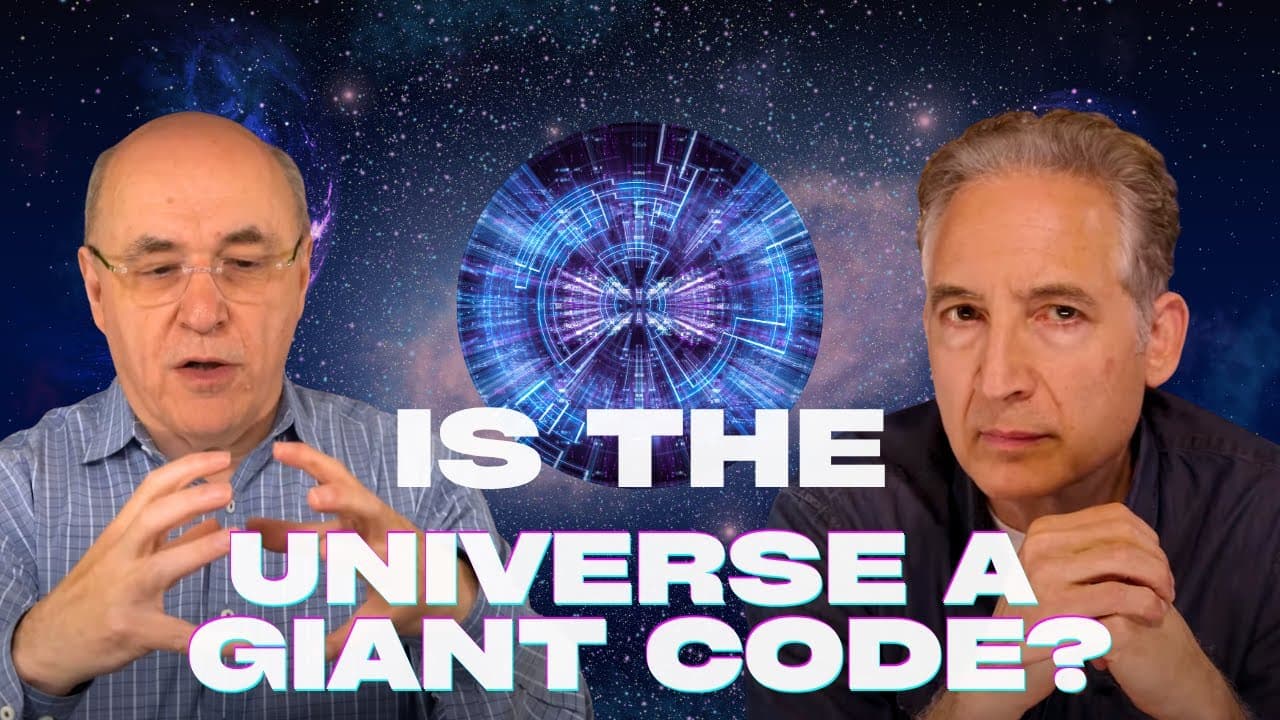
How do simple rules create space and time?
TL;DR
Space and time may emerge from simple computational rules, according to Wolfram. He argues that a computational view reveals coherent connections between basic science and technology, with rules becoming complex behavior and providing insights beyond traditional continuous mathematics. The discussion links cellular automata, physics, and computation as foundational thinking for understanding reality.
Transcript
I was a pretty successful young particle physics operative when I was a late teenager and so I had the feature- Wait, you're doing particle physics as a teenager? Yeah, I wrote my first paper when I was 15. 15? Yeah. What age were you in graduate school? I got my PhD when I was 20. Oh, so you finished at 20? Yeah. Wow. Hey, everyone, thanks... Read More
Key Insights
- Space and time could emerge from simple computational rules rather than being fundamental, according to the interview.
- The interlocutors argue that the computational viewpoint provides a useful metaphor for understanding complex systems.
- Technology development and fundamental science can be deeply interconnected, with each domain shaping the other.
- Computational experiments reveal phenomena that traditional mathematics may overlook or dismiss as noise.
- Discrete computational methods can capture essential features that continuous mathematics might miss in certain contexts.
- Wolfram connects ideas from cellular automata to questions in physics like quantum field theory and relativity.
- The approach stresses looking at consequences of rules through repeated application to understand systems.
- Time in some physical theories can be more like a structured, non-discrete process rather than a simple epsilon step.
- More videos from this channel:
- More from this channel: World Science Festival
Install to Summarize YouTube Videos and Get Transcripts
Explore YouTube Video Summarizer or Get YouTube Transcript Extractor
Questions & Answers
Q: What is the central idea about space and time in this discussion?
The central idea is that space and time may emerge from applying simple, definite rules in a computational framework. Rather than assuming space and time are fundamental, the conversation suggests that complex phenomena can arise from basic rule-based processes, and that studying these processes can yield new insights into physics and reality. This view emphasizes consequences and patterns generated by rules.
Q: How does Wolfram relate technology development to basic science?
Wolfram describes a deep coherence between technology development and basic science. He explains that concepts useful in technology, such as transformations for symbolic expressions, have parallels with foundational questions in physics. He notes that the same foundational thinking informs both domains, and tools from technology can illuminate scientific problems, while scientific insights can guide technological strategy.
Q: Why does the discussion challenge continuous time models?
The discussion challenges continuous time models by pointing out that discrete computational rules can exhibit complex behavior not captured by continuous mathematics. It argues that applying continuous time and calculus may overlook structure arising from simple rule-based evolution, and that computational experiments reveal phenomena that traditional continuous methods might miss.
Q: What role do computational experiments play according to Wolfram?
Computational experiments play a crucial role in revealing how simple rules can produce intricate and unexpected outcomes. They show that the chips fall in ways not always predicted by narrative based on traditional mathematics, and that observing these outcomes can provide new intuition about how complex systems operate, including in physics and computation.
Q: How is lattice QCD related to the discussion’s theme?
Lattice QCD is mentioned as an area where time is treated in a way that resembles space, and the conversation suggests that understanding the configuration of quantum fields could benefit from looking at more detailed, computed configurations rather than just measured numbers. This ties into the broader theme of analyzing fundamental theories through computational perspectives.
Q: What does the talk say about the relationship between simultaneity and foundational problems?
The talk notes that questions about how to choose simultaneity surfaces were found to be related to the same foundational problems in both physics and computation. This reveals a common underlying structure across disciplines, supporting the view that a unified, computation-based approach can address deep questions about reality.
Q: How does Wolfram describe the connection between computation and universal operation?
Wolfram describes computation as applying definite rules and observing their consequences, which can be the essential metaphor for understanding systems. He emphasizes that computers are the quintessential example of this idea in modern times, and that such a perspective could apply broadly to how we analyze biological evolution, machine learning, and physics, highlighting a common strategic approach to problem solving.
Q: What does the discussion suggest about the nature of foundational thinking?
The discussion suggests that foundational thinking centers on identifying the core primitives and rules underlying diverse phenomena. Whether in physics, evolution, or technology, the emphasis is on understanding how simple beginnings, when processed through rules, lead to complex structures. This perspective underpins the idea that a unified computational view can illuminate multiple disciplines.
Summary & Key Takeaways
-
The discussion proposes that space and time emerge from simple rules and computational processes, offering a fresh lens on physics and reality.
-
Wolfram emphasizes the coherence between basic science and technology development, and how each informs the other.
-
The conversation explores how computation can illuminate foundational questions in physics, such as gauge theory and quantum field theory, through concrete experiments and new perspectives.
Read in Other Languages (beta)
Share This Summary 📚
Summarize YouTube Videos and Get Video Transcripts with 1-Click
Try YouTube Summary with ChatGPT & Claude or YouTube Transcript Generator
Explore More Summaries from World Science Festival 📚
Summarize YouTube Videos and Get Video Transcripts with 1-Click
Try YouTube Summary with ChatGPT & Claude or YouTube Transcript Generator