Did Einstein Have a Choice in Relativity Theory?
TL;DR
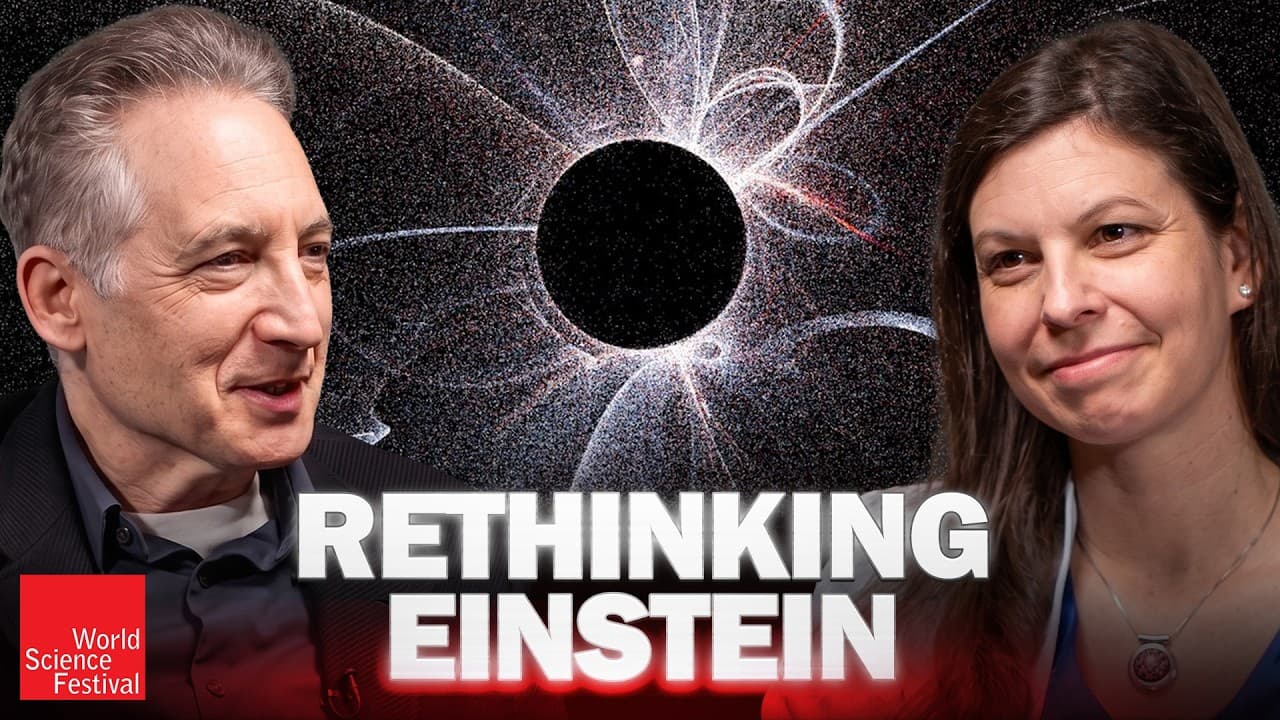
Albert Einstein’s general relativity question is explored by Brian Greene and Claudia de Rham, focusing on whether Einstein could have chosen a different path and how gravity is described by geometry. They discuss the link between gravity and quantum ideas, the role of the graviton, and the possibility of massive gravity in explaining cosmic acceleration, all while highlighting the deep structure of spacetime.
Transcript
- You know, even if you're not a physicist, you kind of look at the equations and you can't help but feel that in these few symbols there's just such power and such beauty.
- Yeah, yeah. - When one looks at massive gravity, you don't quite get the same sense of beauty because of the additional sort of complexity of it. But is that merely a remnant ... Read More
Key Insights
- Einstein’s general relativity is framed as a geometric description of gravity rather than a force in traditional terms.
- Gravity is treated as a universal phenomenon encoded in the fabric of spacetime, unlike other forces that depend on charge or mass details.
- A particle level perspective is used to connect gravity with quantum field theory concepts like gravitons and photon analogies.
- The graviton is discussed as a hypothetical quantum carrier of gravity, with emphasis on experimental proof still pending.
- Semi classical gravity is used as a practical approach when fully quantum gravity is not yet developed or observed.
- Massive gravity introduces a small graviton mass as a theoretical possibility to modify gravity at large scales.
- No go theorems in the 1970s challenged alternatives to Einstein’s gravity, shaping modern massive gravity research.
- The cosmological constant problem and the accelerating expansion of the universe are linked to the broader questions in gravity theory.
- More videos from this channel:
- More from this channel: World Science Festival
Install to Summarize YouTube Videos and Get Transcripts
Explore YouTube Video Summarizer or Get YouTube Transcript Extractor
Questions & Answers
Q: What is the core idea behind Einstein's general relativity as discussed in the video?
The core idea is that gravity is described not as a traditional force but as the geometry of spacetime itself. This geometric description unifies the universal nature of gravity, showing that it affects all matter and energy in the same way and is encoded in the structure of spacetime rather than in a force acting at a distance.
Q: Why is gravity considered universal compared to other forces?
Gravity is universal because it acts on all forms of energy and matter without dependence on specific charges or properties, unlike electromagnetic or nuclear forces that depend on electric charge or other traits. This universality is what led Einstein to describe gravity through the curvature of spacetime rather than a conventional force.
Q: How do the speakers view the photon and graviton in relation to gravity?
They compare the photon as the quantum of electromagnetism to the graviton as the hypothetical quantum of gravity. While photons are well established, gravitons have not been observed. The discussion emphasizes the possibility that gravity may be quantum mechanical and the need for experimental proof to confirm the graviton’s existence.
Q: What is semi classical gravity and why is it used?
Semi classical gravity is a framework where classical gravity is coupled to quantum matter, allowing physicists to study gravitational effects without a full quantum theory of gravity. It is used because a complete quantum gravity theory remains elusive, providing a practical way to explore quantum influences on gravity.
Q: What challenges arise with the idea of massive gravity?
Massive gravity introduces a small mass to the graviton, which could modify gravity at large scales. However, historic no go theorems and consistency conditions pose mathematical and physical challenges, demanding careful construction to avoid instabilities and contradictions with established gravitational phenomena.
Q: Do the speakers think Einstein had no choice in formulating relativity?
The discussion centers on the philosophical angle of whether Einstein could have chosen a different formulation. It explores whether the structure of gravity and spacetime compelled a geometric view, while also considering alternative theoretical paths like quantum or massive gravity and how they might alter our understanding.
Q: What role does the cosmological constant play in these ideas?
The cosmological constant is linked to the universe’s accelerating expansion and represents a major part of the broader puzzle in gravity theories. The conversation notes that understanding this constant intersects with questions about gravity’s quantum nature, spacetime geometry, and how gravity behaves on cosmological scales.
Q: How might massive gravity relate to the accelerating expansion of the universe?
Massive gravity proposes modifications to gravity at cosmic scales which could potentially account for acceleration without invoking dark energy. The discussion frames this idea as part of a broader effort to reconcile gravity’s behavior with observed cosmological phenomena while maintaining theoretical consistency.
Summary & Key Takeaways
-
Greene and de Rham discuss whether Einstein had a choice in formulating general relativity and how geometry frames gravity.
-
The conversation covers the quantum angle, including the potential role of gravitons and the semi classical approach to gravity.
-
The dialogue surveys massive gravity, no go theorems, and the cosmological constant puzzle in the context of the universe’s expansion.
Read in Other Languages (beta)
Share This Summary 📚
Summarize YouTube Videos and Get Video Transcripts with 1-Click
Try YouTube Summary with ChatGPT & Claude or YouTube Transcript Generator
Explore More Summaries from World Science Festival 📚
Summarize YouTube Videos and Get Video Transcripts with 1-Click
Try YouTube Summary with ChatGPT & Claude or YouTube Transcript Generator