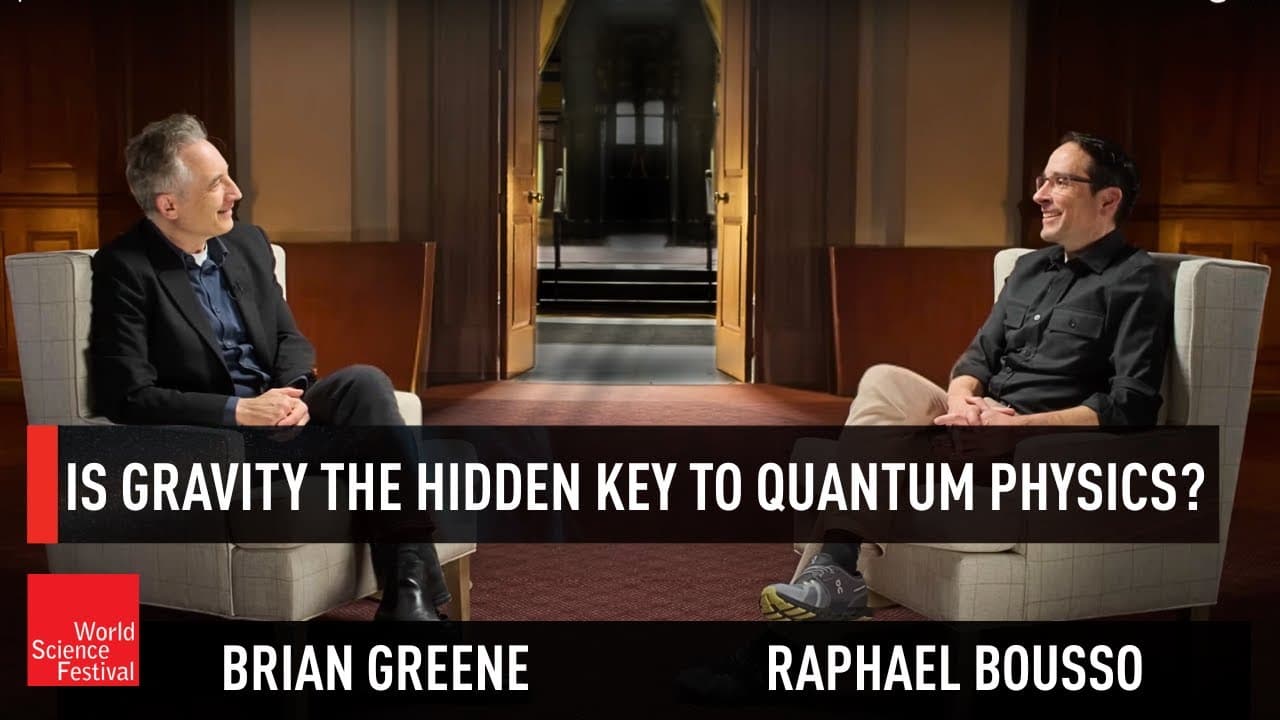
What is gravity's role in quantum physics?
TL;DR
Gravity and quantum mechanics intersect in deep ways, but quantum mechanics shows no cracks to date while general relativity is not the final word. The discussion highlights how space and time can emerge from deeper objects, how decoherence explains why we don't see macroscopic superpositions, and how measurements and simplicity guide theory choice.
Transcript
Hello everyone. Welcome to today's conversation which is going to straddle the arenas of quantum mechanics, general relativity, some cosmology, probably some black holes, and certainly the idea of holography will no doubt make an appearance. And I'm so pleased that our guest today is someone who has contributed so profoundly to our understanding of... Read More
Key Insights
- Gravity and quantum mechanics are deeply linked, but no final synthesis exists yet.
- General relativity is highly successful, yet not the last word in physics.
- Space and time may emerge from deeper fundamental objects rather than being fundamental.
- Quantum mechanics is remarkably successful and highly resistant to revision.
- Decoherence explains why macroscopic superpositions are not observed in everyday life.
- Physics advances by making precise measurements and ensuring theories fit them with simplicity.
- Quantum theory requires accepting that different observers may have different descriptions of the same system.
- The history of physics is the ongoing replacement of theories with more comprehensive frameworks.
- More videos from this channel:
- More from this channel: World Science Festival
Install to Summarize YouTube Videos and Get Transcripts
Explore YouTube Video Summarizer or Get YouTube Transcript Extractor
Questions & Answers
Q: What is the current evidence about cracks in quantum mechanics?
The conversation states that quantum mechanics has no cracks in the armor and remains the best tested framework, even when combined with gravity to the extent currently achieved. The implication is that there is no experimental evidence necessitating a revision or replacement of quantum mechanics, though researchers explore potential mergers with gravity through fully quantum theories of gravity.
Q: Why is general relativity not considered the final word in physics?
General relativity is fantastically successful at describing gravity and cosmic evolution, but it predicts singularities and infinities that signal it is not the ultimate theory. The history of physics shows theories are replaced by better ones that explain more with fewer ingredients, suggesting gravity will be integrated into a deeper, more complete framework.
Q: What does it mean that space and time could emerge from deeper objects?
The discussion suggests that space and time are not fundamental in the deepest sense, but can arise from more fundamental constructs. This aligns with the idea that geometry and gravity could be emergent properties of a deeper theory, which could reconcile gravity with quantum mechanics by describing gravity as a feature of underlying quantum structure.
Q: How does decoherence help explain the appearance of classical reality?
Decoherence involves interactions with the environment, such as a light particle bouncing off a chair, which cause different components of a quantum state to evolve differently and effectively suppress interference. This mechanism makes superpositions appear to collapse into definite outcomes without requiring an observer, resolving a major conceptual hurdle in quantum theory.
Q: What is Bohr’s view on the role of quantum mechanics in physics?
The discussion references Niels Bohr’s view that physics, and quantum mechanics in particular, is about explaining measurement readouts. If measurements can be explained, the physics is successful, regardless of debates about what is considered ‘real.’ This view emphasizes predictive power and empirical adequacy over metaphysical interpretation.
Q: What is the role of measurement in quantum theory according to the speakers?
Measurements are central to quantum theory; the theory is judged by its ability to explain observed data points accurately. The speakers stress that successful physics provides simple yet powerful explanations of measurements, highlighting the practical, empirical nature of quantum mechanics over philosophical debates about reality.
Q: Why is quantum mechanics considered counterintuitive and hard to grasp?
Quantum mechanics permits superpositions and state descriptions that differ for observers with varying knowledge, which clashes with everyday intuition. The discussion notes that science accepts that a system can exist in multiple potential states, and decoherence and measurement select definite outcomes, challenging conventional notions of a single, objective reality.
Q: What future directions does the conversation imply for tying gravity to quantum physics?
The dialogue points to ongoing work on merging gravity with quantum mechanics through fully quantum gravity candidates. The idea is to develop a framework where space and time are emergent, and gravity is described within a quantum theory, moving beyond current partial unifications toward a deeper, more comprehensive theory.
Summary & Key Takeaways
-
The discussion frames gravity and quantum mechanics as intertwined yet not fully reconciled, with general relativity accurately describing many phenomena but not being the ultimate theory. The cosmos may feature space and time emerging from deeper structures, guiding future theories.
-
Quantum mechanics remains robust with no confirmed need for revision, and its success hinges on explaining measurements and keeping theories simple while expanding explanatory scope.
-
Decoherence is presented as the mechanism by which quantum superpositions become classical outcomes, resolving intuition about why we do not observe dead and alive states macroscophically.
Read in Other Languages (beta)
Share This Summary 📚
Summarize YouTube Videos and Get Video Transcripts with 1-Click
Try YouTube Summary with ChatGPT & Claude or YouTube Transcript Generator
Explore More Summaries from World Science Festival 📚
Summarize YouTube Videos and Get Video Transcripts with 1-Click
Try YouTube Summary with ChatGPT & Claude or YouTube Transcript Generator