How does the brain map space with grid cells
TL;DR
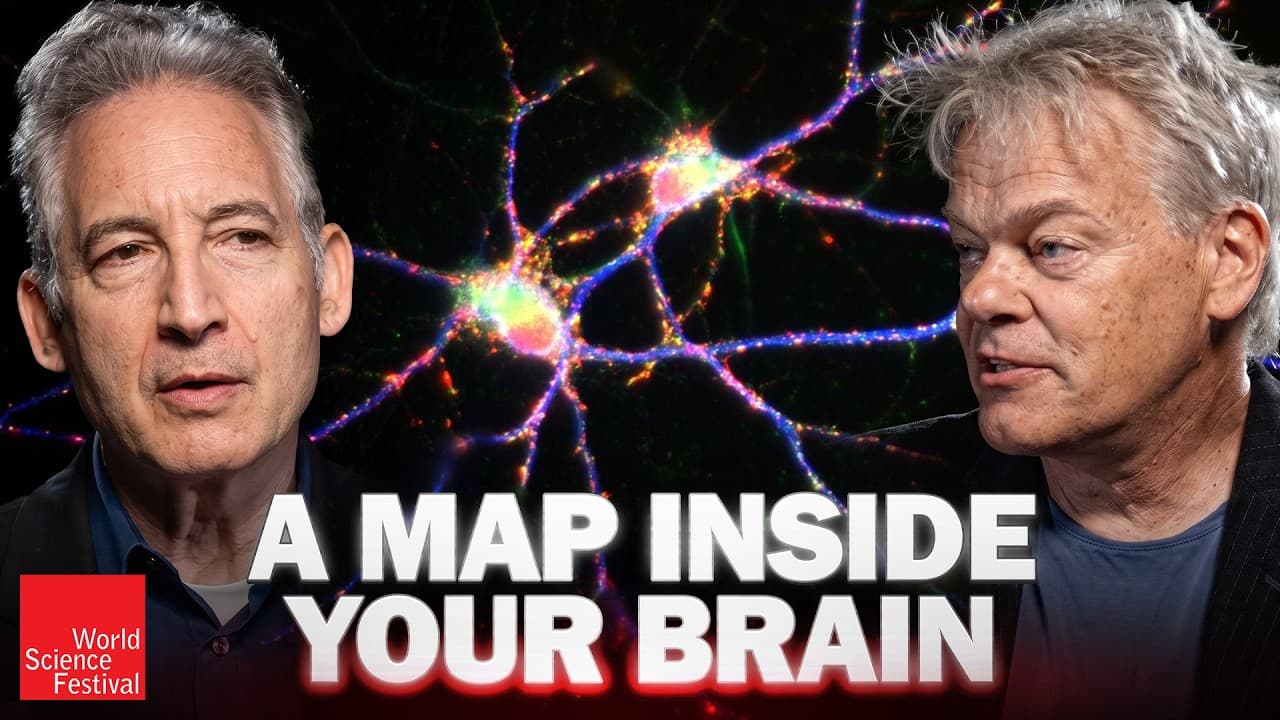
Grid cells form a stable internal map in the brain that operates as an intrinsic coordinate system for space. The map stays coherent in darkness and calibrates to the outside world, enabling navigation and linking to memory processes. This framework has implications for understanding memory and diseases like Alzheimer's.
Transcript
- That idea seems almost outlandish that individual cells would somehow be tied to specific locations 'cause you're not telling me that there's a light signal
- No. - that's coming from that location. - Exactly. And we also though it was outlandish because how can these cells know anything about locations? It's not derived from anything that comes ... Read More
Key Insights
- Grid cells form a stable internal map that serves as the brain's coordinate system for space.
- The map is active even in darkness, indicating internal space representation not solely dependent on senses.
- Place cells in the hippocampus helped establish the concept of spatial mapping.
- Grid cells provide a hexagonal firing pattern that contributes to an organized spatial grid.
- The entorhinal cortex contains the grid cell system, which is essential for navigation.
- Calibration to the outside world is necessary for the internal map to be useful.
- Space perception may be an intrinsic brain construct rather than a direct sensory input.
- The evolution of spatial mapping suggests early, shared neural solutions across species.
- More videos from this channel:
- More from this channel: World Science Festival
Install to Summarize YouTube Videos and Get Transcripts
Explore YouTube Video Summarizer or Get YouTube Transcript Extractor
Questions & Answers
Q: How do grid cells differ from place cells in the brain's navigation system?
Grid cells, located in the entorhinal cortex, fire in a hexagonal grid pattern to form an internal coordinate system for space, which remains active and internally driven even when no external cues are present. Place cells, found in the hippocampus, activate in specific environmental locations, contributing to a map that helps identify where the animal or person is in a given space. Together they create a robust spatial representation and support navigation and memory.
Q: What evidence supports that grid cell maps are internal rather than solely sensory driven?
The discussion notes that the grid cell map remains active when sensory inputs are reduced or absent, such as in darkness. This suggests an internal representation of space that does not rely exclusively on visual or other external signals. Calibration with the outside world then aligns this internal map with actual locations, enabling accurate navigation even without direct sensory cues.
Q: Why is the brain’s spatial map considered essential for survival?
Spatial navigation is fundamental for locating resources, avoiding danger, and moving through environments effectively. The brain’s internal map supports these functions by maintaining stable relationships between neural firing patterns, enabling an animal to remember routes and adapt to new spaces. This system likely evolved early and is shared across species, illustrating its critical role in behavior and survival.
Q: How does the map stay stable across time and experiences?
The internal map preserves the relative relationships of grid cell firing, keeping a consistent spatial representation. It remains active across sleep and different states, and it is calibrated when the animal encounters new environments. Once calibrated, the map can be recalled, so particular cells fire in corresponding locations on subsequent visits, providing a reliable framework for navigation.
Q: What is the role of the entorhinal cortex in spatial navigation?
The entorhinal cortex contains grid cells that generate the hexagonal firing pattern forming the brain’s internal spatial map. This region is a key component of the neural network that supports navigation, and its grid cell activity provides a coordinate framework that the brain uses to determine location within an environment.
Q: How early in evolution might spatial mapping systems have appeared?
The discussion suggests that orientation cells exist in many species and even in flies, indicating that orientation-based spatial processing emerged very early in evolution. The spatial mapping system for precise position likely evolved later, with similar mechanisms retained and refined across species to support navigation and memory.
Q: What are grid cells that form a torus pattern and why is this significant?
Grid cells fire in a hexagonal pattern that mathematically can be described as forming a torus, an internal structure that supports continuous, seamless navigation through space. This pattern provides a stable framework for encoding position and movement, contributing to a robust internal map that the brain uses to track location and integrate with memory systems.
Q: What broader implications does this research have for memory and artificial intelligence?
Understanding the brain’s internal map offers insights into how memory is structured and retrieved in spatial tasks. The concepts may inform approaches to studying and treating memory-related conditions like Alzheimer’s disease. In AI, modeling an intrinsic spatial coordinate system could inspire algorithms that emulate human-like navigation and memory integration, leveraging grid cell-like representations to improve spatial reasoning.
Summary & Key Takeaways
-
The video explains that grid cells in the entorhinal cortex create an internal map that remains active even without sensory input, showing the brain’s intrinsic spatial coding. The discussion traces the history from place cells to grid cells and emphasizes an internal coordinate system.
-
The conversation covers how this internal map is calibrated to environmental cues, how it preserves relationships between cell firing, and how it supports navigation and memory functions.
-
The dialogue concludes with broader implications for memory, Alzheimer’s disease, and potential connections to artificial intelligence, highlighting that space may be a construct the brain imposes on the world.
Read in Other Languages (beta)
Share This Summary 📚
Summarize YouTube Videos and Get Video Transcripts with 1-Click
Try YouTube Summary with ChatGPT & Claude or YouTube Transcript Generator
Explore More Summaries from World Science Festival 📚

Summarize YouTube Videos and Get Video Transcripts with 1-Click
Try YouTube Summary with ChatGPT & Claude or YouTube Transcript Generator