How does quantum nonlocality challenge reality?
TL;DR
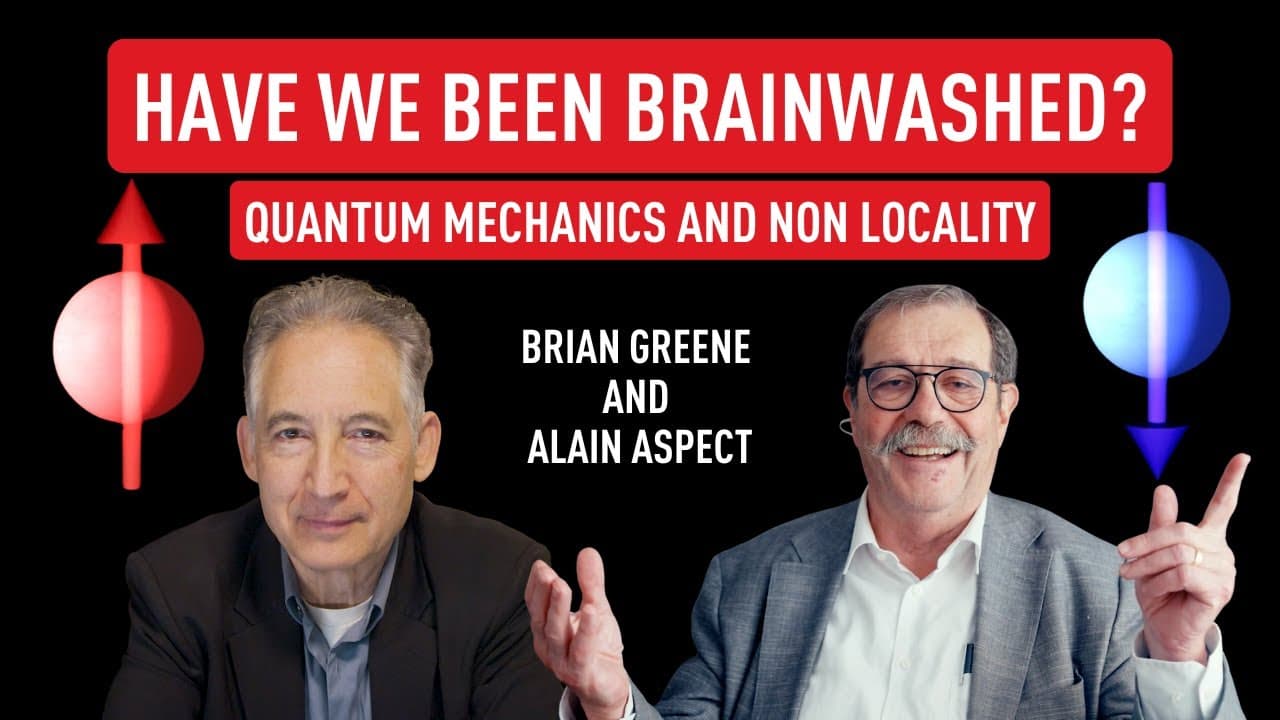
Quantum nonlocality shows entangled particles influence each other instantly across distance, challenging the idea that objects have independent, local properties. The talk traces how Einstein, Bell, and Born shaped the interpretation, and how Aspect’s experiments reveal nonlocal correlations while quantum mechanics accurately predicts outcomes. It emphasizes that the calculation success remains consistent even when the underlying picture of reality is debated.
Transcript
I think all history of physics shows that at each stage it's difficult to swallow. Think for instance, Newton, gravitation. It's instantaneous through space. It was extremely difficult for people to accept that. We have been brainwashed since we were kids, and so we accept it. Hey everyone, thanks for joining us. Today's conversation is in the ... Read More
Key Insights
- Nonlocality is accepted as a working feature of quantum mechanics despite conceptual discomfort. It challenges the idea that physical reality is confined to local, independent properties.
- Bell’s inequality provides a testable boundary between local realism and quantum predictions, and Aspect’s experiments confirm violations that favor nonlocal correlations.
- The wave function collapses or updates as a mathematical tool, while real objects may still be described with reasonable physical intuition, albeit with limits on locality.
- Quantum history shows a pattern: new theory often requires a shift in how we imagine reality, even as calculations remain predictive.
- Contextuality versus realism frames the debate: properties may depend on measurement settings or exist independently, a core tension in interpreting quantum data.
- Nonlocality implies instantaneous connections that do not require signals traveling through space, challenging classical ideas about separability and information transfer.
- Despite interpretive debates, quantum mechanics remains extraordinarily successful at predicting outcomes across experiments.
- The dialogue illustrates how scientists navigate between mathematical success and conceptual clarity, acknowledging ongoing unresolved questions about reality.
- More videos from this channel:
- More from this channel: World Science Festival
Install to Summarize YouTube Videos and Get Transcripts
Explore YouTube Video Summarizer or Get YouTube Transcript Extractor
Questions & Answers
Q: A real search query question about the video (e.g. 'How to...', 'What is...', 'Why does...', 'When should...'). Question 1
What is nonlocality in quantum mechanics and how does it differ from classical locality? Nonlocality refers to correlations between distant objects that appear to influence each other instantaneously, beyond what local signals could explain. This contrasts with classical locality, where interactions propagate at finite speeds. The concept emerges from entanglement experiments and Bell tests, guiding interpretations about reality and measurement.
Q: Question 2
Why did Einstein doubt a purely local realistic interpretation of quantum mechanics? Einstein hoped for a deeper, deterministic theory that would reproduce quantum results without weird nonlocal effects. He advocated for an objective reality that exists independently of observation, arguing that instantaneous distance influences would violate locality and require a hidden mechanism to preserve realism.
Q: Question 3
What role did Bell's theorem play in quantum foundations, and how did Aspect contribute to its experimental verification? Bell's theorem provides inequalities that distinguish local realism from quantum predictions. Aspect conducted experiments with entangled photons showing violations of Bell inequalities, supporting quantum nonlocal correlations and challenging the notion that locality plus realism can fully explain quantum phenomena.
Q: Question 4
How did early quantum ideas about wave particles evolve into modern interpretations? Planck introduced energy quanta, Einstein linked light to photons, and de Broglie proposed matter waves. Born then introduced probabilistic interpretations of the wave function, shifting the view from real waves to probability amplitudes, which influenced how we describe quantum systems.
Q: Question 5
What is the significance of the wave function in quantum theory according to the discussion, and why is its reality contested? The wave function encodes probabilities of outcomes and guides predictions. Some view it as a real physical field, while others see it as a computational tool. The debate hinges on whether a complete description requires an ontic, physical wave or an epistemic, information-based representation.
Q: Question 6
How does the history of physics influence acceptance of nonlocal concepts, as described in the talk? Historical shifts show that new theories often meet resistance, such as gravitation and electromagnetism challenges. Yet predictive success drives acceptance, suggesting that reality may resist intuitive pictures while calculations remain reliable and useful for forecasting experiments.
Q: Question 7
What is the practical takeaway about quantum theory from Aspect and Greene’s discussion? The practical takeaway is that quantum mechanics reliably predicts measurement outcomes even if the underlying reality remains unsettled. The core ideas of entanglement and nonlocality are experimentally validated, while interpretation continues to evolve with ongoing debate.
Q: Question 8
Why might researchers still debate the true nature of reality despite strong experimental support for quantum predictions? Because experimental success does not uniquely identify a single ontological picture, leaving room for multiple interpretations such as contextuality or nonlocal realism. This ongoing dialogue reflects the fundamental limits of our understanding of what constitutes physical reality.
Summary & Key Takeaways
-
Aspect discusses the historical struggle to accept nonlocality and how experiments test Bell’s inequality, reshaping our view of reality and locality.
-
The interview contrasts Bohrian contextualism with Einsteinian realism, arguing that the theory’s mathematics works, even if the full picture of reality is unsettled.
-
Readers learn how early 20th century insights from Planck, Einstein, and Born evolved into modern views on wave functions, entanglement, and nonlocality, while computation remains reliable.
Read in Other Languages (beta)
Share This Summary 📚
Summarize YouTube Videos and Get Video Transcripts with 1-Click
Try YouTube Summary with ChatGPT & Claude or YouTube Transcript Generator
Explore More Summaries from World Science Festival 📚

Summarize YouTube Videos and Get Video Transcripts with 1-Click
Try YouTube Summary with ChatGPT & Claude or YouTube Transcript Generator