How does science fit with faith and meaning?
TL;DR
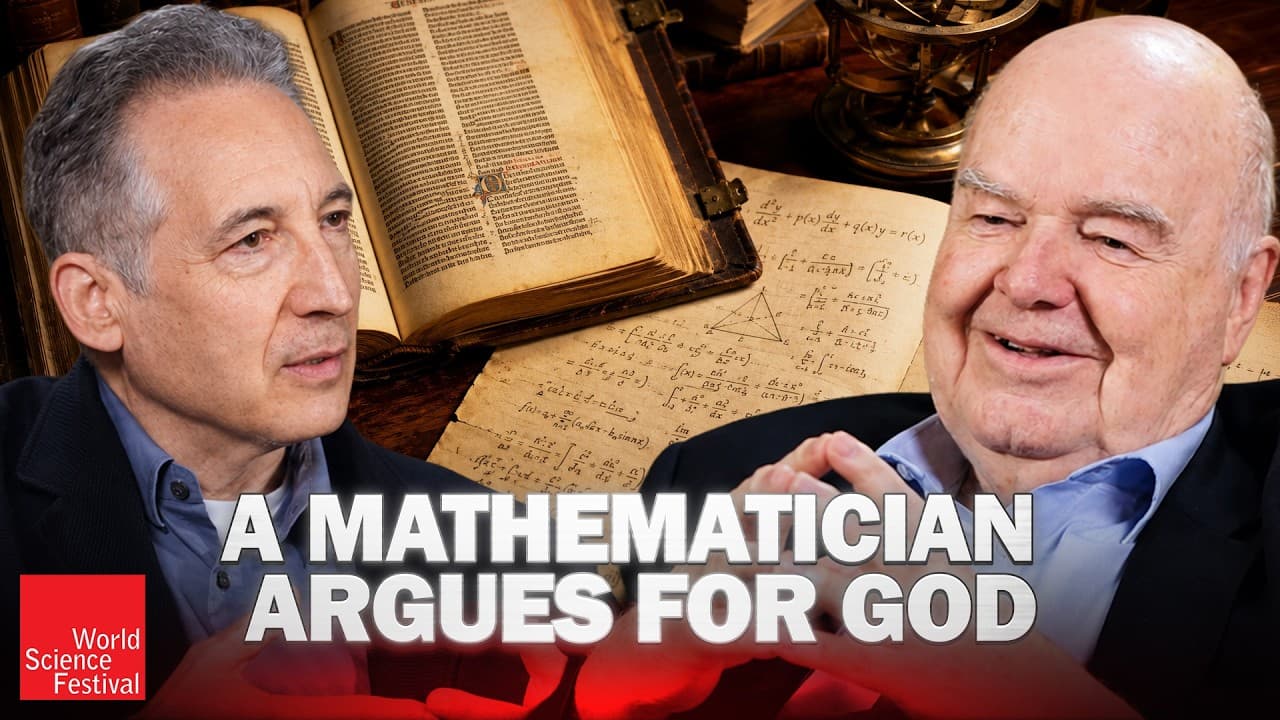
Science and faith can point to a shared, word based universe. The conversation argues that science searches the universe with a rational method, while revelation provides questions science cannot answer, suggesting both processes contribute to meaning. Mathematics is described as a language revealing structures rooted in divine intelligence, not a conflict with belief.
Transcript
- You have this belief in something that I yearn for, which is something transcendent and something that gives some kind of ultimate meaning. Now, I don't share your worldview, but I find it kind of thrilling that there are people who really hold to this. So I'd like to understand where you get that confidence from. - Well, it's fascinating, becaus... Read More
Key Insights
- Science sits between two worldviews, theism and atheism, offering a way to understand the universe rather than a war between beliefs.
- Mathematics is described as both discovered and created, hinting at a mind behind the universe and the human ability to study it.
- The Bible is cited as a source of a rational, God given framework that motivates early modern science and its pursuit of taxonomy and understanding.
- Revelation is presented as a means by which God communicates answers that science cannot provide alone.
- The 'word based' nature of reality is highlighted, with references to Genesis and the Logos to describe how language and math structure the cosmos.
- There is a discussion about alien intelligence and whether mathematics would be universal, suggesting potential common ground across civilizations.
- Epistemology is raised, questioning what science can know and what lies beyond empirical study in terms of meaning and purpose.
- The program emphasizes that a purely physicalist view may not fully capture the human experience of meaning and wonder.
- More videos from this channel:
- More from this channel: World Science Festival
Install to Summarize YouTube Videos and Get Transcripts
Explore YouTube Video Summarizer or Get YouTube Transcript Extractor
Questions & Answers
Q: What is the relationship between science and religion according to the speakers?
The speakers describe science as a method that investigates the universe and seeks to understand it, while religion provides a framework for meaning and purpose. They argue there is no inherent war between science and faith, but rather a tension between two worldviews, with science occupying a central, mediating position. This view supports dialogue between disciplines rather than conflict.
Q: Why do the participants mention mathematics in this discussion?
Mathematics is used to illustrate that the universe is understood through precise language. It is described as a word based system that reveals the underlying order of reality. The speakers link mathematical structure to a divine intelligence, suggesting that humans can discover truths about the cosmos because the world is inherently intelligible.
Q: What is meant by revelation in this context?
Revelation is presented as God reaching down to humans, providing answers that science alone cannot supply. It complements scientific inquiry by addressing questions of meaning, purpose, and the nature of reality that lie beyond empirical investigation, creating a twofold approach to knowledge: discovery through science and revelation through faith.
Q: Do the participants think science can explain everything?
No, they contend that science cannot answer all questions, especially those about ultimate meaning and purpose. While science explains mechanisms and laws, questions about purpose and why the universe exists at all require philosophical or theological considerations that accompany empirical exploration.
Q: What is the significance of the phrase word based universe in their view?
The phrase underscores the idea that reality is governed by language like structures that can be described precisely through words and symbols. The Logos and biblical language are invoked to connect scripture with the mathematical and informational descriptions of the cosmos, suggesting a coherent, communicative universe.
Q: How do the speakers view the possibility of extraterrestrial intelligence sharing mathematics?
They speculate that advanced intelligences elsewhere might share mathematics because it could be embedded in the fabric of reality. This line of thought connects to the broader idea that mathematics is a universal language, potentially understood by any intelligent life capable of formal reasoning.
Q: What role does epistemology play in their discussion?
Epistemology, the study of knowledge, is central as the speakers examine what science can know versus what remains beyond empirical methods. They argue that certain kinds of knowledge, such as meaning or divine revelation, require non empirical approaches and cannot be reduced to physical explanations alone.
Q: How do they connect ancient texts to modern science?
They draw a parallel between Genesis statements like God said and the modern idea that the universe is intelligible and law governed. The discussion suggests that ancient scriptures anticipated a rational, studied universe where humans are invited to explore the created order using mathematics and science.
Summary & Key Takeaways
-
A dialogue between Brian Greene and John Lennox explores how science and religion relate, arguing they are two processes that can illuminate the same cosmos.
-
The talk presents the view that mathematics and the structure of reality reflect a divine source, while science probes the hows of the universe.
-
The discussion emphasizes that science cannot answer every question, especially about meaning and purpose, which faith attempts to address through revelation.
Read in Other Languages (beta)
Share This Summary 📚
Summarize YouTube Videos and Get Video Transcripts with 1-Click
Try YouTube Summary with ChatGPT & Claude or YouTube Transcript Generator
Explore More Summaries from World Science Festival 📚
Summarize YouTube Videos and Get Video Transcripts with 1-Click
Try YouTube Summary with ChatGPT & Claude or YouTube Transcript Generator