Why AI Scaling Alone Cannot Produce Real Reasoning
TL;DR
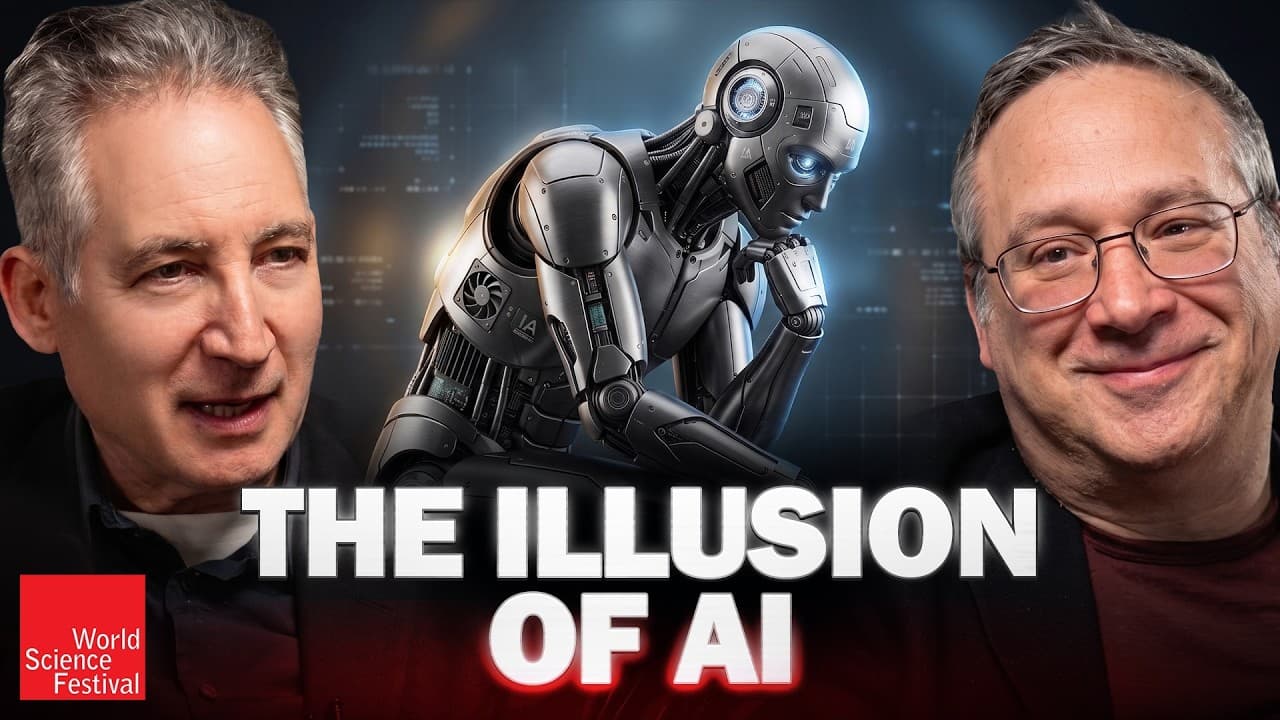
Scaling language models with more data and computing power is not sufficient to produce artificial general intelligence, according to Gary Marcus. Current systems approximate patterns in how people use words, while developers increasingly supplement them with classical AI components such as loops, conditionals, and Python interpreters. Human tendencies to attribute agency also make these systems appear more intelligent or conscious than Marcus believes they are.
Transcript
- Others in the field have said to me, I was blown away by what Chat was able to do. - I certainly wasn't blown away. It was always obvious that if you had a richer database, you'd do better, as you increase the data, these models were gonna get better at what they do, and what they do is they build an approximation of how people use words. It was ... Read More
Key Insights
- Scaling alone is not producing artificial general intelligence, according to Gary Marcus. He argues that increasing data and computing power improves models at approximating how people use words, but does not supply the deeper capabilities required for reliable, human-like reasoning.
- Recent AI progress is increasingly driven by components outside large language models. Marcus points to loops, conditionals, Python interpreters, and other tools as evidence that developers are supplementing unreliable language models with techniques that resemble classical symbolic AI.
- Large language models build approximations of human word usage. Marcus says richer databases predictably improve this pattern-based ability, but he rejects the conclusion that better linguistic approximation must eventually become general intelligence or genuine understanding.
- Humans naturally over-attribute agency and intelligence to the external world. Marcus agrees that this tendency helps explain why people may perceive a human essence, awareness, or deeper intelligence in language models that generate convincing responses.
- Claims that current large language models possess self-awareness or consciousness are ludicrous in Marcus's assessment. His position distinguishes fluent language production from evidence of subjective awareness, emphasizing that persuasive conversational behavior does not by itself establish consciousness.
- IBM Watson's Jeopardy performance depended on strong engineering and the structure of the task. Marcus says 99% of Jeopardy answers were titles of Wikipedia pages, allowing the system to search for the nearest relevant page rather than fully understand language and inference.
- Children's grammatical behavior differs from similarity-driven neural networks. Marcus found that children were correct on English past-tense forms 96% of the time, while both children and adults could apply the regular rule to unfamiliar names and forms without relying on similar known verbs.
- AI debates involve social questions as well as technical ones. The conversation considers whether machines genuinely create or convincingly imitate creativity, how people might find purpose if work becomes less central, and whether AI's benefits would be distributed widely or concentrated among a few.
- More videos from this channel:
- More from this channel: World Science Festival
Install to Summarize YouTube Videos and Get Transcripts
Explore YouTube Video Summarizer or Get YouTube Transcript Extractor
Questions & Answers
Q: Why is scaling alone insufficient for artificial general intelligence?
Scaling gives language models more data and computing power, which improves their approximation of how people use words. Gary Marcus argues that this improvement is not enough for artificial general intelligence because linguistic pattern matching does not automatically produce reliable reasoning or understanding. He sees the growing use of external tools and classical AI techniques as evidence that scaling by itself is reaching its limits.
Q: How are developers compensating for unreliable language models?
Developers are adding components outside the large language model, including loops, conditionals, Python interpreters, and other tools. These additions are sometimes grouped under the term harness, but Gary Marcus characterizes them as forms of classical symbolic AI. Their increasing importance suggests that recent progress is not coming solely from larger datasets and greater computing power, despite continued public emphasis on scaling.
Q: What do large language models actually learn, according to Gary Marcus?
Large language models learn an approximation of how people use words, according to Gary Marcus. More data makes that approximation richer and can improve model performance, but Marcus says this mechanism remains different from genuine understanding or general reasoning. His central distinction is between producing convincing language patterns and possessing the dependable cognitive abilities that would be required for artificial general intelligence.
Q: Why do people attribute intelligence and agency to AI systems?
People have a natural tendency to over-attribute agency and intelligence to things in the external world. Gary Marcus agrees that this human tendency affects reactions to large language models, whose fluent language can encourage users and researchers to infer a human-like essence. The conversation suggests that convincing verbal behavior can therefore create stronger impressions of intelligence, awareness, or intention than the underlying technology warrants.
Q: Are current large language models conscious or self-aware?
Gary Marcus considers claims that current large language models may possess consciousness or self-awareness to be ludicrous. His judgment rests on the distinction between generating persuasive language and demonstrating subjective awareness. The conversation emphasizes that people are predisposed to perceive agency in external systems, so fluent responses alone should not be treated as adequate evidence that a model has a mind or conscious experience.
Q: How did IBM Watson succeed at playing Jeopardy?
IBM Watson succeeded through an impressive engineering approach that exploited the structure of Jeopardy questions. Gary Marcus says 99% of the answers were titles of Wikipedia pages, so the system could often identify the nearest relevant page instead of achieving the broad language understanding and inference he had assumed the game required. That feature explains why Watson's victory initially surprised him.
Q: How did children's language learning differ from early neural networks?
Gary Marcus's research found that children produced correct English past-tense forms 96% of the time, despite theories that focused heavily on noticeable errors such as invented forms. Children and adults could also apply the regular past-tense rule to unfamiliar words regardless of similarity. Earlier neural networks were much more strongly driven by resemblance to known examples, making their behavior substantially different in detail.
Q: What broader human questions does advanced AI raise?
Advanced AI raises questions about creativity, purpose, work, and the distribution of social gains. The conversation asks whether systems can genuinely claim creativity or merely imitate it convincingly, and how people might find meaning if work no longer occupies the same central role. It also considers whether the benefits promised by advanced AI would be widely shared or concentrated in the hands of a few.
Summary & Key Takeaways
-
Gary Marcus argues that the hypothesis connecting ever-larger models directly to artificial general intelligence is failing. He says recent progress increasingly comes from external components, including loops, conditionals, and Python interpreters. Although these additions are sometimes called a harness, Marcus views them as a return to techniques associated with classical symbolic AI.
-
Marcus traces his skepticism to early work comparing neural networks with human language learning. His research found that children produced correct English past-tense forms 96% of the time and could apply abstract grammatical rules beyond familiar examples. Earlier neural networks, by contrast, depended strongly on similarity and only broadly approximated children's behavior.
-
The conversation connects technical limitations with human judgment and social consequences. Marcus says people naturally over-attribute agency and intelligence, making claims of machine self-awareness or consciousness especially misleading. The discussion also considers creativity, meaning when work is less central, and whether gains from advanced AI would be broadly distributed or concentrated among a few people.
Read in Other Languages (beta)
Share This Summary 📚
Summarize YouTube Videos and Get Video Transcripts with 1-Click
Try YouTube Summary with ChatGPT & Claude or YouTube Transcript Generator
Explore More Summaries from World Science Festival 📚

Summarize YouTube Videos and Get Video Transcripts with 1-Click
Try YouTube Summary with ChatGPT & Claude or YouTube Transcript Generator