What Bell's theorem reveals about quantum foundations
TL;DR
Bell's theorem reshaped how we understand quantum foundations by challenging classical explanations of quantum numbers. The discussion highlights the Copenhagen view versus alternatives, the role of realism, and why historical figures differently understood the theory. It emphasizes that quantum explanations may not rely on visualization but on precise, testable dynamics and predictions.
Transcript
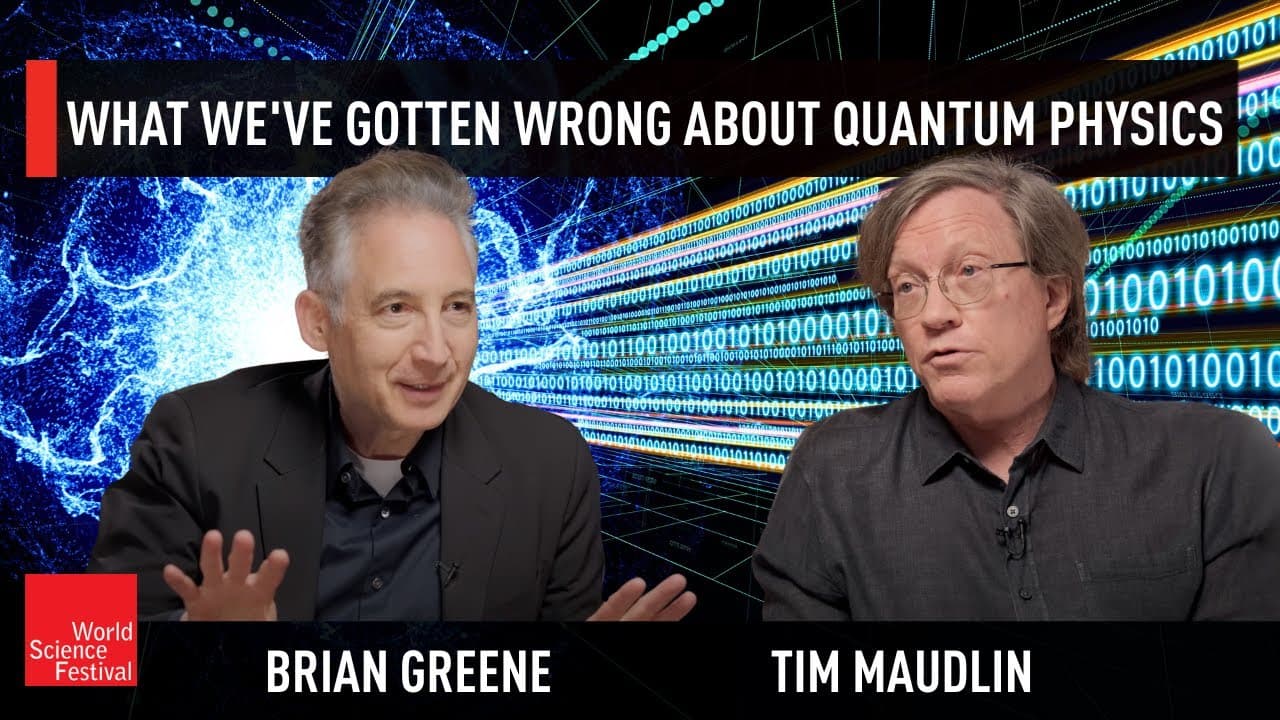
Welcome everyone. Today's conversation is going to be on the foundations of physics, issues of quantum mechanics, the measurement problem, entanglement, non-locality, you know, things of that sort. And I'm so pleased that we have Tim Mlin who is a professor of philosophy at NYU. Also the founder and director of the John Bell Institute. John Bell, a... Read More
Key Insights
- Bell's theorem challenges the notion that quantum numbers can be fully explained by classical visualization
- The Copenhagen approach is described as a non the theory rather than a single predictive framework
- Realism and interpretation are distinct ideas that influence how we frame quantum questions
- Bohr's legacy highlighted the limit of visualization in subatomic physics but allowed for comprehensible explanations
- The discussion distinguishes between empirical predictions and underlying explanations
- Different formulations of physics can produce the same predictions but are not simply interchangeable interpretations
- History shows that unified front among theorists strengthens the acceptance of new ideas
- A theory in physics should provide a precise account of what exists and how it behaves, not just predictions
- More videos from this channel:
- More from this channel: World Science Festival
Install to Summarize YouTube Videos and Get Transcripts
Explore YouTube Video Summarizer or Get YouTube Transcript Extractor
Questions & Answers
Q: What is Bell's contribution to quantum foundations as discussed in the video
Bell's contribution, as described in the dialogue, is foundational to how we think about quantum correlations and non local effects. He catalyzed a shift from purely predictive accounts to questions about what explanations of those numbers can exist beyond classical intuition. His work prompted reevaluation of how realism and locality fit in quantum theory and inspired ongoing debates about how to interpret quantum data.
Q: Why do the speakers argue against equating interpretations with competing theories
The speakers argue that interpretations are not interchangeable with competing theories because two theories can give identical empirical predictions yet rely on fundamentally different assumptions about reality. They emphasize that a theory should specify a precise ontology and dynamics, whereas an interpretation may merely reframe the same equations without altering predictive content, creating a false equivalence between distinct conceptual commitments.
Q: What is Bohr’s position on visualization in quantum mechanics
Bohr’s position, as explained in the conversation, is that visualization of the subatomic world is not reliable as a complete guide to understanding. He suggested that classical visualization fails to capture the underlying reality of quantum phenomena, though the goal remains to explain the experimental numbers rather than to depict a visual picture of reality.
Q: How does the dialogue describe the difference between predictions and explanations
The dialogue differentiates predictions from explanations by noting that a theory should do more than forecast numbers; it should offer a coherent account of what exists and how it behaves. Predictions are empirical outputs, while explanations attempt to reveal the mechanism or logic that gives rise to those outputs, even if visualization is limited.
Q: What role does realism play in the discussion of quantum interpretations
Realism is discussed as a contested concept that got tied to quantum interpretations by later discussions. The speakers note that some adherents use realism to argue for or against certain interpretations, influencing debates about whether there is a coherent picture of reality beyond observable numbers and how that picture should be structured.
Q: What historical dynamic affected the acceptance of new quantum ideas
Historical dynamics include how Bohr, Heisenberg, and their colleagues formed a Copenhagen group, while Einstein and others debated separately. The lack of a united front among early critics and supporters slowed consensus, showing that social dynamics in science can influence which ideas gain traction and how quickly new theories are adopted.
Q: What does the term 'theory' mean in the context of quantum mechanics according to the speakers
In the conversation, a theory is defined as a presentation with fairly high precision about what exists in the world and how it behaves, expressed through a mathematical formalism and dynamical equations. This goes beyond a mere collection of numbers; it requires a coherent framework that can be tested and refined.
Q: Why do the speakers think some quantum questions do not have a single intuitive picture
The speakers argue that the subatomic world may resist complete visualization because the underlying explanations cannot be captured by intuitive pictures. They propose that comprehensible theories can exist without a classical image, provided they offer precise dynamics and explanations that align with experimental results, even if visualization remains limited.
Summary & Key Takeaways
-
The conversation traces the legacy of Bell and Copenhagen and how it affected our understanding of quantum theory, focusing on the shift away from classical visualization toward a more robust explanation of observed data.
-
The speakers discuss whether quantum mechanics requires a single coherent story or if multiple compatible explanations exist, stressing that theories should provide high precision accounts of what exists and how it behaves.
-
The dialogue contrasts prediction, explanation, and visualization, arguing that there can be comprehensible theories that do not rely on intuitive pictures, and that historical debate impacted how physicists approach quantum puzzles.
Read in Other Languages (beta)
Share This Summary 📚
Summarize YouTube Videos and Get Video Transcripts with 1-Click
Try YouTube Summary with ChatGPT & Claude or YouTube Transcript Generator
Explore More Summaries from World Science Festival 📚

Summarize YouTube Videos and Get Video Transcripts with 1-Click
Try YouTube Summary with ChatGPT & Claude or YouTube Transcript Generator