What Are Quantum Computers and How Do They Work?
TL;DR
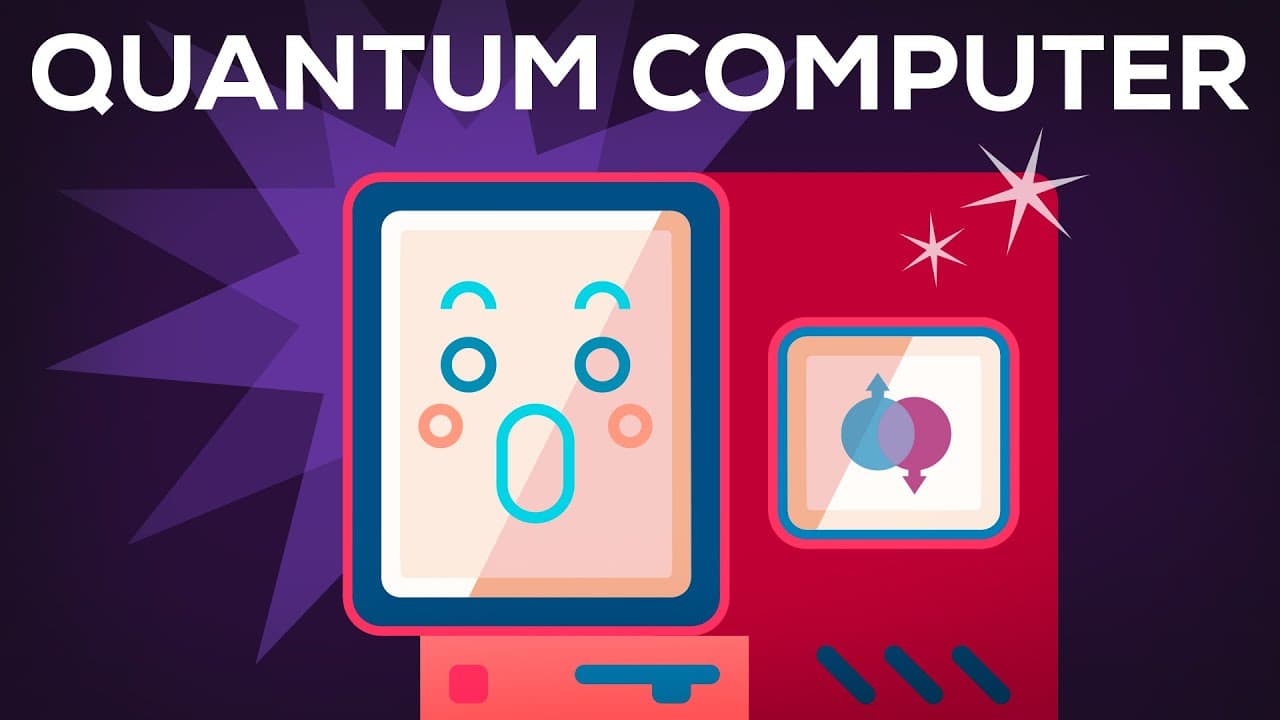
Quantum computers use qubits that can exist in superpositions of states, enabling parallel calculations and exponential efficiency compared to traditional computers. They pose significant improvements in areas like database searching, IT security, and quantum simulations, potentially revolutionizing technology and science.
Transcript
Quantum Computers Explained – Limits of Human Technology For most of our history, human technology consisted of our brains, fire, and sharp sticks. While fire and sharp sticks became power plants and nuclear weapons, the biggest upgrade has happened to our brains. Since the 1960's, the power of our brain machines has kept growing exponentially, all... Read More
Key Insights
- 💻 The power of computer technology has been exponentially growing since the 1960s, but it is approaching its physical limits as computer parts shrink to the size of atoms.
- ⚛️ Quantum physics poses challenges for traditional computers as transistors reach a tiny scale. Quantum tunneling may cause electrons to transfer through blocked passages, making conventional computers obsolete.
- 🧠 Quantum computers use qubits, which can be in a superposition of states and exhibit entanglement. This allows for parallel computations and potentially exponential improvements in efficiency and speed.
- 🔐 Quantum computers pose a threat to IT security as they could easily crack encryption systems that rely on public and private keys, jeopardizing sensitive data.
- 🔬 Quantum simulations can help solve complex problems in fields such as molecular science, revolutionizing industries like medicine by providing new insights into protein structures and interactions.
- 🌍 The full extent of quantum computers' impact on humanity is still uncertain. It remains to be seen whether they will be a specialized tool or bring about a revolution.
- 📚 This content is supported by the Australian Academy of Science, which promotes excellence in scientific research and knowledge dissemination.
- 💰 The production of videos like this one is made possible by supporters on platforms like Patreon. If you want to support Kurzgesagt's work, you can join their Patreon page and become part of the "Kurzgesagt bird army."
Install to Summarize YouTube Videos and Get Transcripts
Explore YouTube Video Summarizer or Get YouTube Transcript Extractor
Questions & Answers
Q: What are the limitations of traditional computers as they continue to shrink in size?
As computer parts get smaller, they approach the size of atoms, which introduces quantum physics phenomena like quantum tunneling that disrupt the predictable behavior of traditional transistors.
Q: How do qubits in a quantum computer differ from traditional bits in a classical computer?
Qubits can exist in a superposition of states, meaning they can represent both 0 and 1 simultaneously, allowing for parallel computations and exponential efficiency.
Q: What are the potential applications of quantum computers?
Quantum computers have the potential to revolutionize areas like database searching, where they can find information faster than traditional computers by using algorithms that only require the square root of the search time. They also pose a threat to IT security due to their ability to quickly crack encryption systems. Additionally, quantum simulations can provide more accurate insights into the quantum world, leading to advancements in fields like medicine.
Q: Will quantum computers replace traditional computers entirely?
While quantum computers excel in certain areas, they are not expected to replace traditional computers in all aspects. Traditional computers will still be useful for many everyday tasks, while quantum computers will be more specialized for complex calculations and simulations that require exponential computing power.
Summary & Key Takeaways
-
Traditional computers consist of simple components like logic gates and transistors, but as computer parts approach the size of atoms, quantum physics becomes a challenge.
-
Quantum computers use qubits, which can exist in a superposition of states, allowing for parallel calculations and exponential efficiency.
-
Quantum computers have the potential to revolutionize areas like database searching, IT security, and simulations of the quantum world.
Read in Other Languages (beta)
Share This Summary 📚
Summarize YouTube Videos and Get Video Transcripts with 1-Click
Try YouTube Summary with ChatGPT & Claude or YouTube Transcript Generator
Explore More Summaries from Kurzgesagt – In a Nutshell 📚





Summarize YouTube Videos and Get Video Transcripts with 1-Click
Try YouTube Summary with ChatGPT & Claude or YouTube Transcript Generator