Quantum Computing Expert Explains One Concept in 5 Levels of Difficulty | WIRED
TL;DR
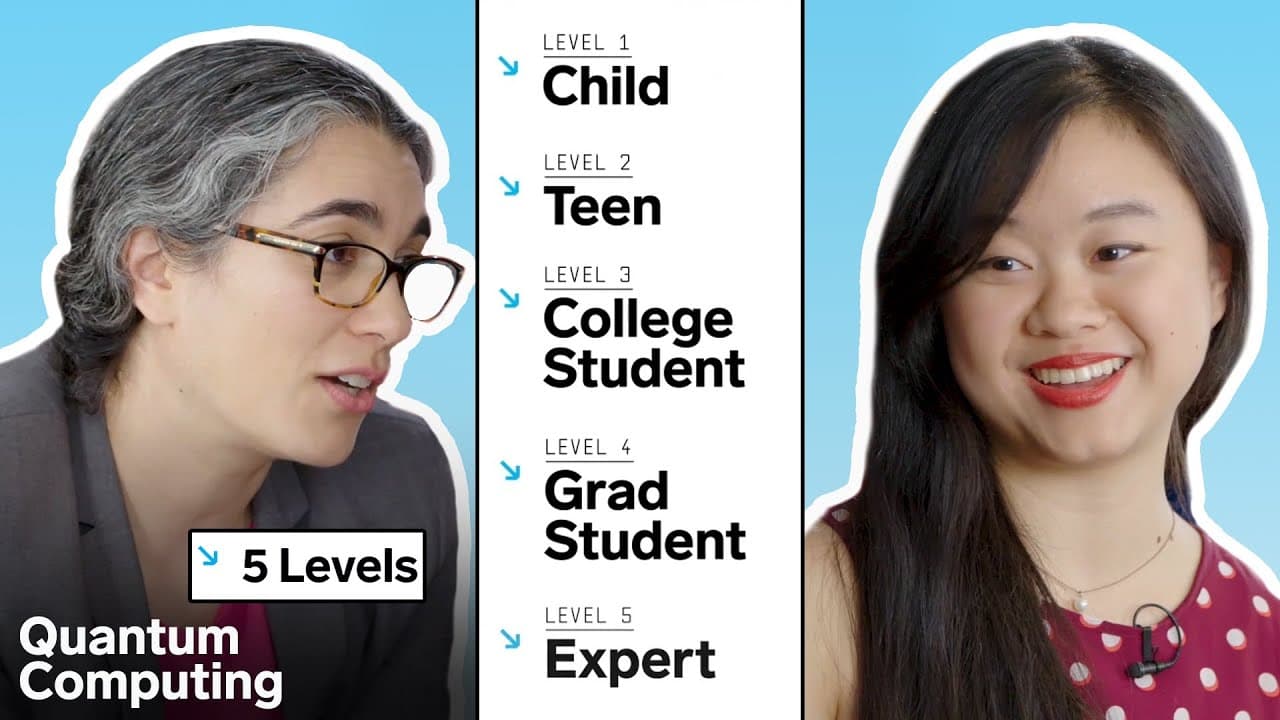
Quantum computing is a fundamentally new way of solving problems, and IBM Research scientist Talia Gershon explains it in five levels of increasing complexity, from a child to an expert. She uses a spinning penny to demonstrate superposition, a state that combines heads and tails at once, and two pennies to show entanglement, where measuring one instantly determines the other. See how these quantum rules could help discover new things and solve problems that even the world's biggest supercomputer cannot.
Transcript
hi my name is talia gershon and i'm a scientist at ibm research today i've been challenged to explain a topic with five levels of increasing complexity it's a completely different kind of computing called quantum computing quantum computers approach solving problems in a fundamentally new way and we hope that by taking this new approach to computat... Read More
Key Insights
- 🚡 Quantum computing operates by utilizing quantum properties such as superposition, entanglement, and interference to perform computations in a new and more efficient way.
- 💻 Current quantum computers are in the early stages of development, with limitations related to decoherence and the need for fault tolerance.
- 📠 Quantum computing has the potential to significantly impact scientific research, simulation, machine learning, and cryptography.
- 🛄 The field of quantum computing is constantly evolving, with ongoing research aiming to improve hardware, software, and the overall understanding of quantum phenomena.
Install to Summarize YouTube Videos and Get Transcripts
Explore YouTube Video Summarizer or Get YouTube Transcript Extractor
Questions & Answers
Q: How does a quantum computer differ from a classical computer?
A classical computer represents everything, from YouTube videos to internet searches, using a specific combination of zeros and ones. A quantum computer calculates in a totally different way, using new rules based on the laws of quantum mechanics. Talia Gershon compares it to being able to spin a coin so it does not have to choose just heads or tails.
Q: What is superposition in quantum computing?
Superposition is the idea that a quantum object is not simply in one state or another. Gershon demonstrates it with a spinning penny: while it spins, it is not just heads or tails but a combination of both. This quantum property can exist in real, physical objects in the world.
Q: What is entanglement and how is it demonstrated?
Entanglement means two things are deeply connected, and in the quantum world they are much harder to separate again than ordinary tangled objects. Gershon uses two pennies: if they were entangled and spun together, measuring one to be heads would mean the other is also heads, and the same for tails. Their outcomes are linked rather than independent.
Q: Who explains quantum computing in this WIRED video?
The explainer is Talia Gershon, a scientist at IBM Research. She was challenged to explain quantum computing at five levels of increasing complexity so that everyone, from beginners to experts, can understand it at some level.
Q: What is quantum mechanics?
Gershon describes quantum mechanics as a branch of physics, just like any other branch of science. It is the study of things that are either really small, really well isolated, or really cold. Scientists use these laws to completely reimagine how computing works and to build new kinds of computers.
Q: Why are scientists building quantum computers?
Certain problems cause even the world's biggest supercomputer to effectively run out of space, similar to running out of storage on a phone. Gershon says quantum computers take a new approach so we can start exploring problems we could never solve any other way. The hope is they will one day help us understand nature better and create new medicines.
Q: What is the gold "chandelier" shown in the video?
The structure that looks like a fancy chandelier, made with real gold, is actually the quantum computer itself. Gershon calls it a really special kind of computer that calculates things in a totally different way than an ordinary computer.
Summary & Key Takeaways
-
Quantum computing is a new approach to computation that solves problems in a fundamentally different way than classical computers, leveraging quantum properties such as superposition and entanglement.
-
Quantum computers use quantum bits or qubits that can exist in multiple states simultaneously, allowing for parallel computations and increased memory capacity.
-
Quantum computers have the potential to revolutionize fields such as chemistry, machine learning, and cryptography, offering faster and more efficient solutions to complex problems.
Read in Other Languages (beta)
Share This Summary 📚
Summarize YouTube Videos and Get Video Transcripts with 1-Click
Try YouTube Summary with ChatGPT & Claude or YouTube Transcript Generator
Explore More Summaries from WIRED 📚





Summarize YouTube Videos and Get Video Transcripts with 1-Click
Try YouTube Summary with ChatGPT & Claude or YouTube Transcript Generator