How Do Quaternions Rotate Objects in 3D?
TL;DR
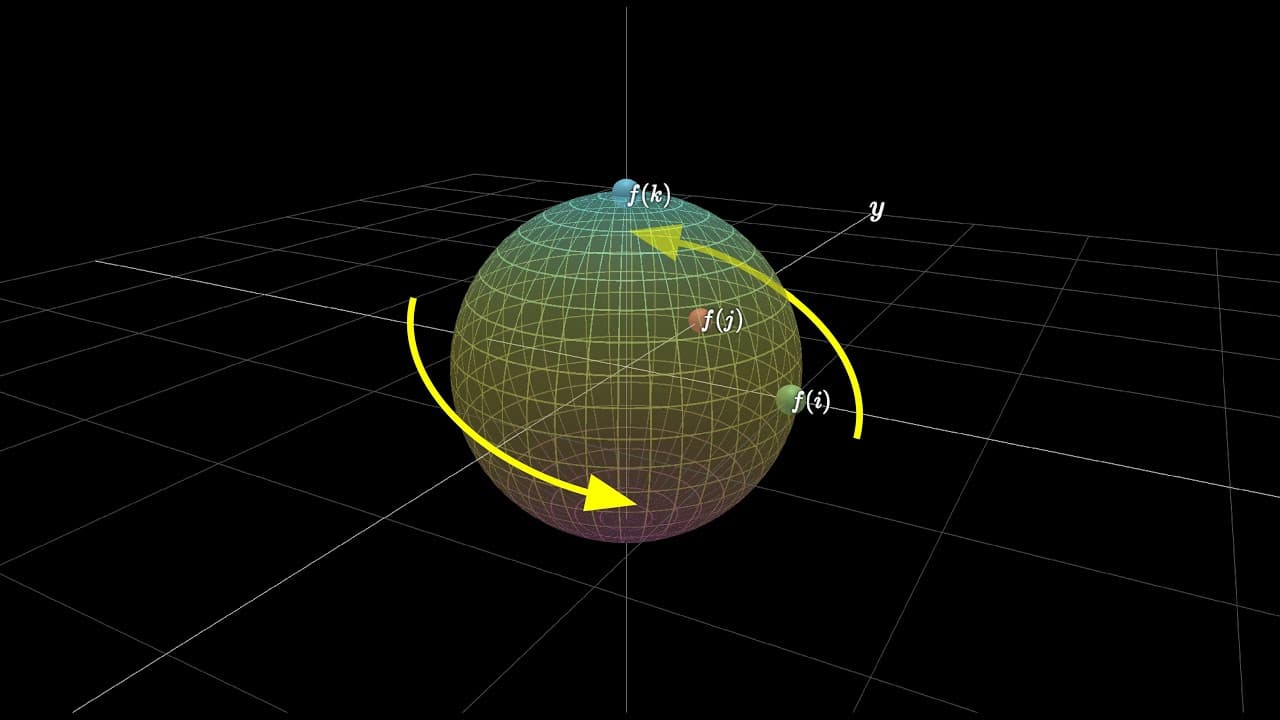
Quaternions represent a 3D rotation using a unit axis and half the desired angle, then rotate a point through the product q times the point times q inverse. This method avoids gimbal lock, supports seamless interpolation between orientations, and avoids certain numerical precision and normalization problems associated with interpolating rotation matrices.
Transcript
In a moment, I'll point you to a separate website hosting a short sequence of what we're calling explorable videos. It was done in collaboration with Ben Eater, who some of you may know as that guy who runs the excellent computer engineering channel. And if you don't know who he is, viewers of this channel would certainly enjoy the content of hi... Read More
Key Insights
- Quaternions are a four-dimensional number system whose largest practical use case is describing three-dimensional orientation. They are especially relevant to computer graphics, robotics, virtual reality, and other systems that need reliable calculations involving orientation in space.
- Phone orientation software can rely on quaternions to maintain an internal model of how a device is positioned in space. The transcript gives the example of quaternion-based code shipped to hundreds of millions of devices, illustrating that the mathematics has widespread practical applications.
- Euler angles are rotation angles around three axes that programmers can use to construct a desired orientation with 3 by 3 matrices. This approach is comparatively easy to imagine, but it remains vulnerable to important edge cases and interpolation problems.
- Gimbal lock is a failure mode in which two rotation axes become aligned, causing the representation to lose a degree of freedom. This vulnerability is one major reason quaternions are preferred for many systems that calculate changing three-dimensional orientations.
- Quaternion interpolation is a seamless way to move between two three-dimensional orientations. It lacks the ambiguities associated with Euler angles and avoids the numerical precision and normalization issues that can arise when directly interpolating between two rotation matrices.
- Complex multiplication is a useful two-dimensional analogy for quaternion rotation. A unit complex number formed from the cosine and sine of an angle can multiply a point represented as a complex number and return the coordinates of that point after rotation.
- A rotation quaternion is constructed from a normalized axis and half the desired rotation angle. Its real part is the cosine of that half-angle, while its three imaginary components are the axis coordinates scaled by the sine of the half-angle.
- Quaternion rotation works through a sandwich product rather than a single multiplication. The point is multiplied by q from the left and by the inverse of q from the right, and the resulting computation returns the coordinates of the rotated point.
Install to Summarize YouTube Videos and Get Transcripts
Explore YouTube Video Summarizer or Get YouTube Transcript Extractor
Questions & Answers
Q: What are quaternions used for in 3D rotation?
Quaternions provide a way to describe three-dimensional orientation that avoids bugs and edge cases found in some alternative methods. They are used in computer graphics, robotics, virtual reality, phone orientation tracking, and other applications involving spatial orientation. Their main practical advantages include avoiding gimbal lock and enabling seamless interpolation between two orientations.
Q: Why are quaternions preferred over Euler angles?
Quaternions are often preferred because Euler angles can suffer from gimbal lock when two axes of rotation become aligned, causing the system to lose a degree of freedom. Euler angles can also create difficulties and ambiguities during orientation interpolation. Quaternions avoid gimbal lock and provide a more seamless way to interpolate between separate three-dimensional orientations.
Q: What is gimbal lock in a 3D rotation system?
Gimbal lock occurs when two of the axes used to describe a rotation become aligned. Once that happens, the representation loses a degree of freedom, limiting its ability to express independent rotations. The transcript identifies this as a major weakness of constructing orientations from Euler angles and a problem that quaternion-based rotation avoids.
Q: How is a quaternion constructed for a 3D rotation?
First, define the rotation axis as a unit vector with i, j, and k components whose squared values sum to 1. Then use half of the desired rotation angle to construct the quaternion. The cosine of the half-angle becomes its real part, while the sine scales the three axis components in its imaginary part.
Q: How does a quaternion rotate a point in 3D?
Represent the three-dimensional point using i, j, and k components, then place it inside a quaternion sandwich. Multiply the point by the rotation quaternion q from the left and by the inverse of q from the right. Expanding these products according to the multiplication rules for i, j, and k returns the rotated point coordinates.
Q: Why is complex multiplication compared with quaternion rotation?
Complex multiplication offers a simpler two-dimensional example of using a number system to compute rotations. A unit complex number containing the cosine and sine of an angle multiplies a point represented as a complex number. Using the rule that i squared equals negative 1, the product returns the coordinates of the point after rotation around the origin.
Q: Why is half the rotation angle used in a quaternion?
The quaternion rotation method constructs q from the cosine and sine of half the desired angle, rather than the full angle. The point is then transformed through two products, with q on the left and q inverse on the right. The transcript introduces this structure as the reason the half-angle must be understood through the complete multiplication process.
Q: What advantages do quaternions have over rotation matrices?
A 3 by 3 matrix can describe three-dimensional transformations and rotations effectively, but directly interpolating between two rotation matrices can introduce numerical precision and normalization issues. Quaternions avoid those stated interpolation problems while providing a seamless path between orientations. They also offer protection from gimbal lock, which can affect rotations constructed from Euler angles.
Summary & Key Takeaways
-
Quaternions are a four-dimensional number system with an important practical role in representing three-dimensional orientation. Their use extends to computer graphics, robotics, virtual reality, and phone orientation tracking. They are valuable because they avoid bugs and edge cases that can affect other approaches to computing rotations.
-
Euler angles construct an orientation through rotations around three understandable axes, often represented with 3 by 3 matrices. Although this mostly works, aligned rotation axes can produce gimbal lock and remove a degree of freedom. Euler angles can also introduce difficulties and ambiguities when interpolating between two orientations.
-
A quaternion rotation starts with a normalized axis and a quaternion built from the cosine and sine of half the desired angle. The point is then placed inside a quaternion sandwich, with q multiplied from the left and its inverse from the right, producing the rotated point after expansion.
Read in Other Languages (beta)
Share This Summary 📚
Summarize YouTube Videos and Get Video Transcripts with 1-Click
Try YouTube Summary with ChatGPT & Claude or YouTube Transcript Generator
Explore More Summaries from 3Blue1Brown 📚
Summarize YouTube Videos and Get Video Transcripts with 1-Click
Try YouTube Summary with ChatGPT & Claude or YouTube Transcript Generator