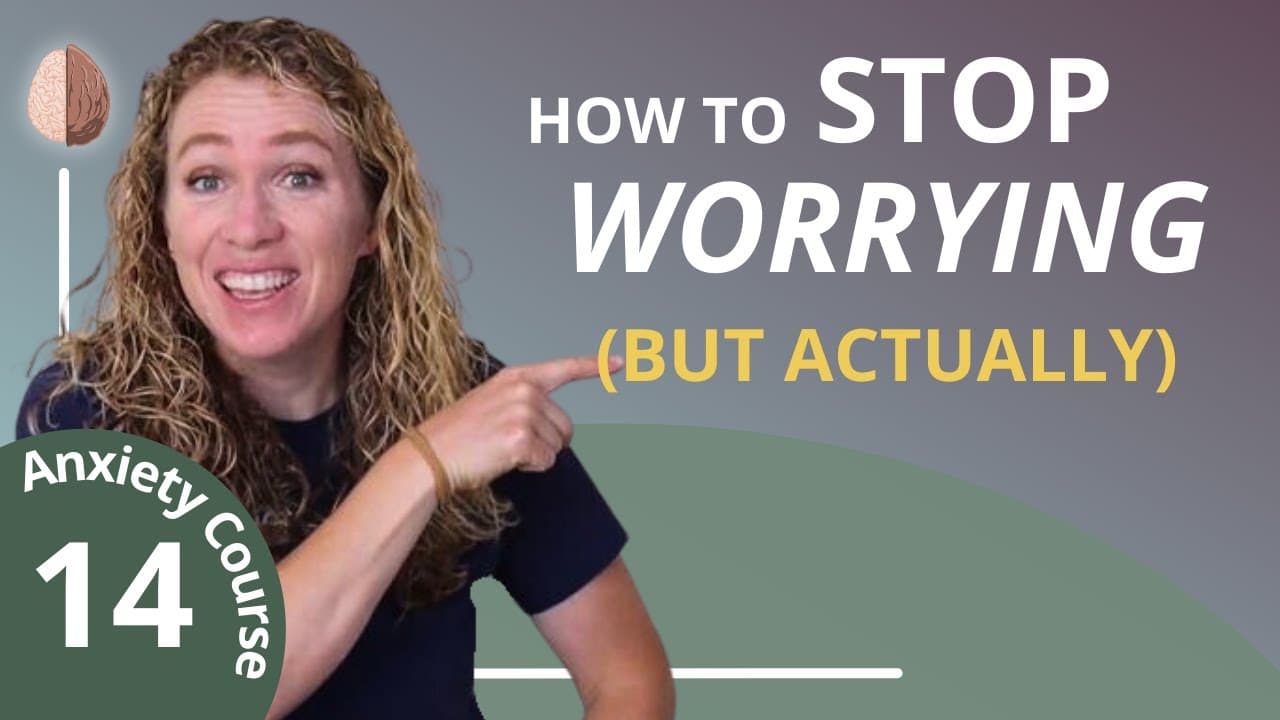
How to stop worrying and master GAD with scheduled worry
TL;DR
Worrying is a controllable behavior, not a fixed trait. The video teaches scheduled worry, a boundaried time to worry daily, while using cognitive defusion for random thoughts. It explains that worry is maladaptive problem solving and shows how to redirect attention to values and present moment actions.
Transcript
Worry is the fuel of anxiety. It's what feeds generalized anxiety disorder. If you want to learn how to control generalized anxiety disorder, you have to learn how to control your worry. But if you tell someone to stop worrying, they'll just like shake their head because it's not that easy. Worry is hard to control. It's an old habit that's wor... Read More
Key Insights
- Worry thoughts are automatic and should be observed, not fought, through cognitive defusion.
- Worrying is an active behavior where the mind dwells on troubles, unlike random thoughts which can be noticed and released.
- Scheduled worry limits worry by designating a fixed time and place, turning worry into a controllable exercise.
- Writing worries down during the scheduled period concretizes concerns and signals willingness to address them.
- Worry time should be 15 to 30 minutes and occur at a consistent time each day.
- Distraction is not a long term solution because it reinforces the importance of worries and reduces value-driven living.
- Redirecting attention to present values and daily activities helps reclaim control over anxiety.
- Boundaries on worry are trained, not cured instantly, requiring practice for weeks to form new neural grooves.
- More videos from this channel:
- More from this channel: Therapy in a Nutshell
Install to Summarize YouTube Videos and Get Transcripts
Explore YouTube Video Summarizer or Get YouTube Transcript Extractor
Questions & Answers
Q: What is scheduled worry and how does it help control anxiety
Scheduled worry is a deliberate practice where you allocate a specific daily time and place to worry, typically 15 to 30 minutes. This confines worry to a controlled window, reducing the constant rumination that fuels generalized anxiety. Over a few weeks of consistent practice, you build neural boundaries that lessen overall anxiety and improve focus on valued activities.
Q: How should you handle random worry thoughts
Random worry thoughts should be noticed and acknowledged with a light, nonjudgmental response, such as thanking the brain for the thought and moving on. This is cognitive defusion, which helps prevent engagement with intrusive worries. The aim is to observe thoughts without letting them dictate actions or trigger prolonged distress.
Q: What is the difference between worry and automatic thoughts
Automatic thoughts pop in and out and do not require engagement, while worrying involves active engagement with concerns and repeating them. Distinguishing the two allows you to apply cognitive defusion to the former and boundary-based strategies to the latter, enabling more control over anxiety.
Q: Why is distraction not a good long-term strategy for worry
Dis distraction can provide short term relief but it signals the brain that the worry is important, reinforcing rumination in the long term. The approach encourages living by values and engaging in meaningful activities rather than avoiding thoughts, which strengthens resilience and reduces chronic anxiety over time.
Q: What role do values play in managing worry
Values guide attention away from future fears toward present moment actions and meaningful life activities. By focusing on what you care about now, you redirect energy from worry toward engaging with people, work, and experiences, which reduces the impact of anxiety and increases a sense of purpose.
Q: How long should you practice this worry boundary exercise
You should practice the worry boundary exercise for a few weeks to a month, ideally daily for at least three weeks, to rewire the brain and establish reliable routines. Consistency builds a stronger habit, making worry less intrusive and increasing the time you can enjoy a worry-free day.
Q: What is the purpose of writing worries down during worry time
Writing worries down during worry time makes concerns concrete and signals commitment to addressing them. It also helps identify actionable steps or budget constraints, though the exercise primarily trains the brain to limit worry by scheduling it, rather than solving every worry immediately.
Q: What feedback comes from adopting scheduled worry about control over anxiety
Adopting scheduled worry changes the perception of control by turning worry into a managed activity rather than a free-floating threat. Over time, this creates new neural grooves and reduces the frequency and intensity of anxious responses, enabling more moments of calm and focused living.
Summary & Key Takeaways
-
Scheduled worry confines worry to a daily, fixed time, helping the brain form new boundaries and reduce overall anxiety. The approach distinguishes random, involuntary thoughts from deliberate worry and reframes worry as a problem solving activity to be bounded. The method emphasizes alignment with values and present moment engagement.
-
Distraction is discouraged as a long term strategy because it reinforces worry, but limited distraction can support boundary training when used with scheduled worry. The technique asks for writing worries down during a set period and then shifting focus to meaningful activities and relationships.
-
The training relies on identifying worry as maladaptive, separating it from useful problem solving, and building a daily routine that reduces steady anxiety. It includes practical steps like choosing a consistent time and place for worry and breaking the habit of ruminating on future fears.
Read in Other Languages (beta)
Share This Summary 📚
Summarize YouTube Videos and Get Video Transcripts with 1-Click
Try YouTube Summary with ChatGPT & Claude or YouTube Transcript Generator
Explore More Summaries from Therapy in a Nutshell 📚






Summarize YouTube Videos and Get Video Transcripts with 1-Click
Try YouTube Summary with ChatGPT & Claude or YouTube Transcript Generator