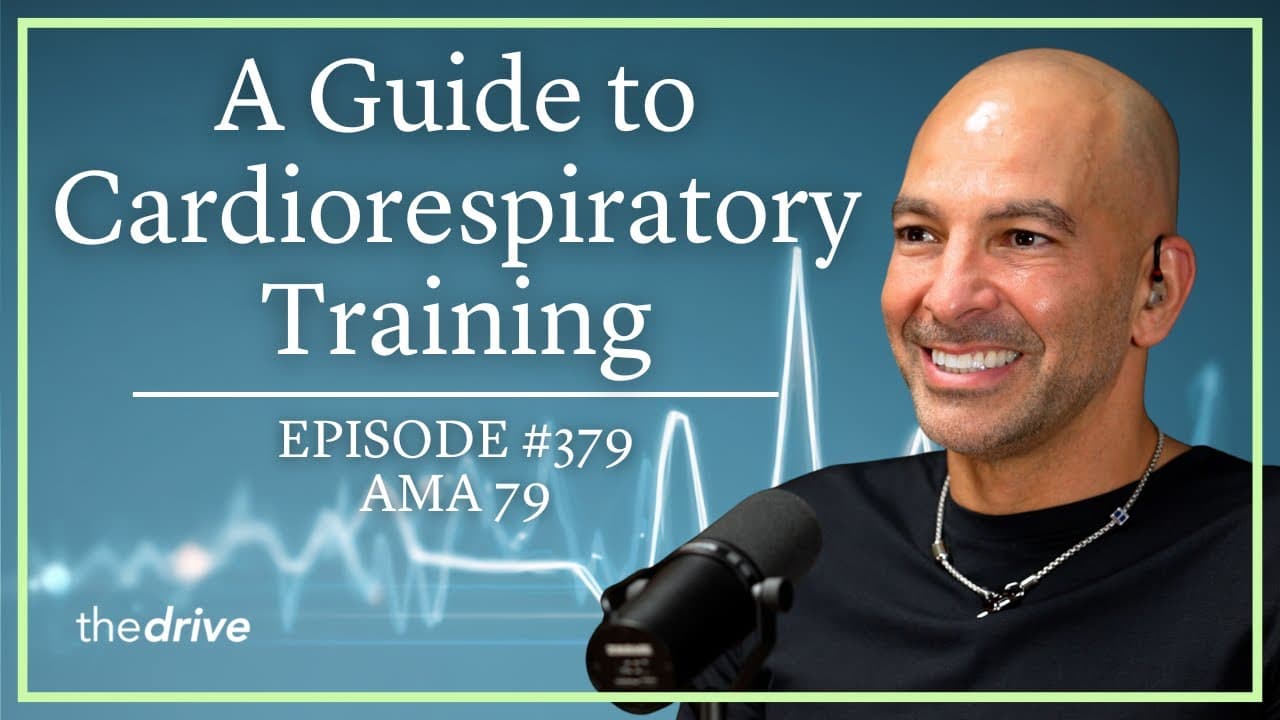
How to boost zone 2 VO2 max for longevity and health
TL;DR
CRF is the strongest modifiable predictor of lifespan and healthspan, and zone 2 training targets this system without maximal effort. By improving VO2 max through practical training, you increase physiologic reserve to better tolerate stress and disease while supporting longer, healthier living.
Transcript
Hey everyone, welcome to the Drive podcast. I'm your host, Peter Aia. Peter, welcome to another AMA. How you doing? I'm doing very well. Thank you for having me back. Always welcome to have you. I see every time we do these, you bring something more and more to each recording. What what have what have I brought this time? I don't I'm not even aware... Read More
Key Insights
- CRF is a powerful, modifiable predictor of all-cause mortality and healthspan that outperforms many other metrics.
- VO2 max is a standardized measure of the body's ability to utilize oxygen during maximal effort testing.
- Zone 2 is a non maximal effort zone that requires careful navigation and tracking for consistent improvements.
- Improving VO2 max requires hundreds of hours of work across cardiovascular, pulmonary, hematologic and muscular systems.
- Small increases in VO2 max can yield large reductions in mortality risk over time.
- VO2 max can be estimated using METs and is discussed as a practical training target alongside Zone 2.
- The discussion covers how to measure and track progress across different training volumes and life stages.
- Training balance between Zone 2 and higher intensity is tailored for beginners, experienced trainees and older adults.
- More videos from this channel:
- More from this channel: Peter Attia MD
Install to Summarize YouTube Videos and Get Transcripts
Explore YouTube Video Summarizer or Get YouTube Transcript Extractor
Questions & Answers
Q: What is VO2 max and why is it important for longevity
VO2 max is the maximum rate at which the body can utilize oxygen during exercise. It reflects how efficiently the heart, lungs and muscles work together to deliver and use oxygen. Higher VO2 max generally indicates greater physiologic reserve and correlates with lower all-cause mortality risk. Training to improve VO2 max involves structured cardiovascular work that challenges the body and fosters systemic adaptations over time.
Q: How does Zone 2 training differ from high intensity workouts
Zone 2 training targets a moderate intensity that supports aerobic adaptations without maximal effort. It builds endurance, efficiency and metabolic conditioning while minimizing the risk of burnout and injury. High intensity workouts push the system toward maximal effort and speed adaptations but require longer recovery and may not be suitable for all beginners or those with limited time. A balanced approach combines both zones smartly.
Q: Why is cardiorespiratory fitness a central longevity pillar
Cardiorespiratory fitness represents how well the heart, lungs, blood vessels and muscles can work together to deliver and use oxygen. It provides a large physiologic reserve to tolerate stress such as infections or surgery. Because CRF integrates multiple bodily systems, improvements in this area tend to produce broad health benefits and extend both lifespan and healthspan.
Q: What does the data say about CRF and mortality risk
Evidence shows that being in the bottom quartile of VO2 max is associated with a four to fivefold higher risk of all-cause mortality within a year compared with those in the top quintile. Even moving from one quartile to the next can produce substantial, meaningful reductions in risk, highlighting the large impact of CRF improvements.
Q: How should beginners approach cardiorespiratory training for longevity
Beginners should start with gradual, sustainable cardio that fits their schedule and tolerances while focusing on building a robust Zone 2 base. The key is consistency over time, ensuring workouts are challenging but not overwhelming, and progressively increasing volume and occasional higher intensity sessions as fitness improves. This approach supports long-term adherence and meaningful VO2 max gains.
Q: Can Zone 2 training be adapted for older adults
Yes, Zone 2 training can be tailored to older adults by considering individual fitness levels, medical history, and recovery capacity. Emphasis is placed on safe intensities, gradual progression, and integration with other forms of activity. The goal remains to improve oxygen delivery and utilization while maintaining independence and reducing age-related decline.
Q: What are common mistakes in cardio training for longevity
Common mistakes include overdoing high intensity without adequate base, neglecting recovery, and not tracking progress. Others are using incorrect zones or intensities, relying on a single metric for progress, and failing to balance volume with intensity. A well-rounded plan uses Zone 2 as foundation and adds calibrated higher intensity work over time.
Q: How can progress in VO2 max be measured and tracked
Progress can be tracked by periodic VO2 max testing or estimating METs from submaximal tests. Consistent testing under similar conditions helps monitor changes over months and years. Additionally, tracking perceived exertion, heart rate response, and training volume provides practical insight into adaptations and helps refine the plan for sustained improvements.
Summary & Key Takeaways
-
CRF is a leading, modifiable predictor of how long and how well you live, integrating heart, lungs and muscle function.
-
Zone 2 training targets the non maximal effort realm that improves VO2 max and overall endurance without pushing to exhaustion.
-
Implementing a structured plan for different life stages and time budgets can sustainably raise VO2 max and healthspan over years.
Read in Other Languages (beta)
Share This Summary 📚
Summarize YouTube Videos and Get Video Transcripts with 1-Click
Try YouTube Summary with ChatGPT & Claude or YouTube Transcript Generator
Explore More Summaries from Peter Attia MD 📚
Summarize YouTube Videos and Get Video Transcripts with 1-Click
Try YouTube Summary with ChatGPT & Claude or YouTube Transcript Generator