Why Does cos(x) Squared Look Like a Cosine Wave?
TL;DR
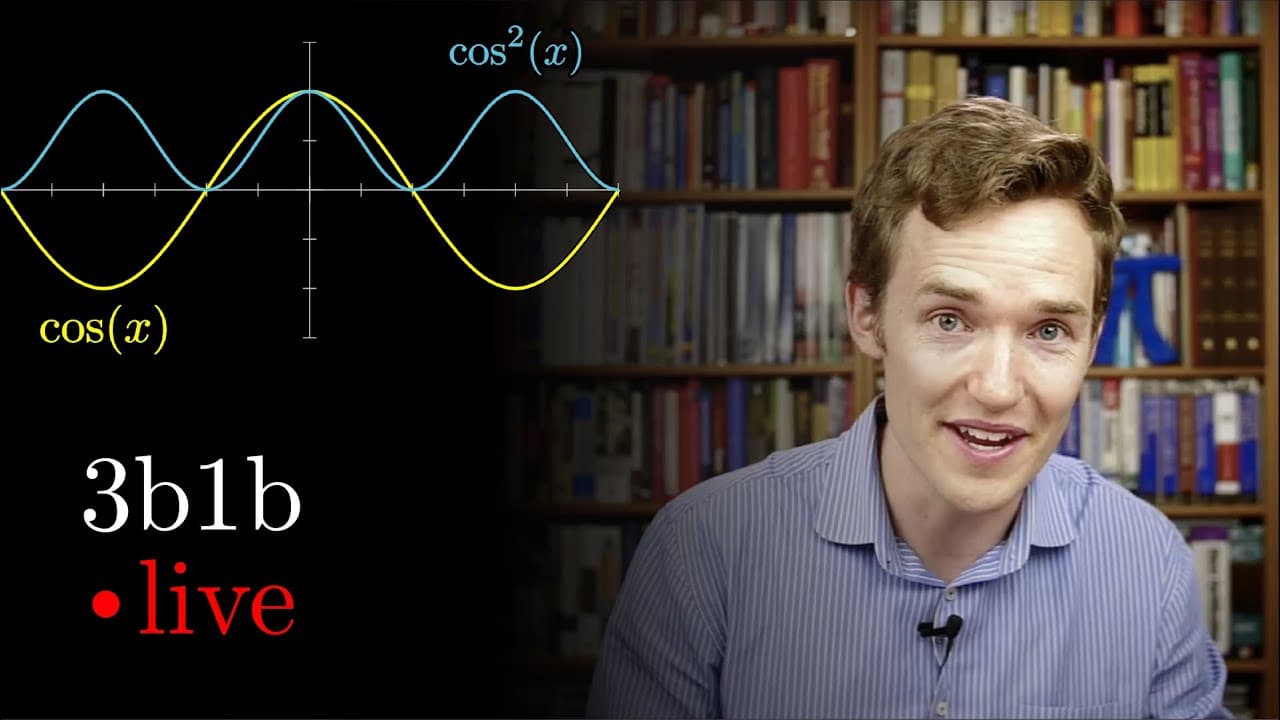
Squaring cosine gives another cosine wave: cos(x)^2 equals (1 + cos(2x)) / 2. You can find this identity with a graphing calculator, before knowing any trig definitions. Shift cosine up by 1, halve it, then double the input frequency, and the two graphs match exactly. This fact leads toward a deeper link between trigonometry and complex numbers.
Transcript
My end goal for this lecture and the following lecture is to draw for you a connection between trigonometry and complex numbers. And I really do think when you understand that connection between the two, it strengthens your understanding of both of them. So for this lecture, we're just going to go back to the basics on some of the trigonometric ... Read More
Key Insights
- The graph of cos(x)^2 is a scaled-down cosine wave. It stays positive, runs from 1 down to 0 and back to 1, and completes a full cycle every pi instead of every 2 pi.
- The identity cos(x)^2 = (1 + cos(2x)) / 2 is a non-trivial fact about trigonometry. You can find it just by playing with graphs in a tool like Desmos, before learning what cosine means.
- Multiplying the input of a function by a constant squishes its graph horizontally and raises its frequency. Many people find this counterintuitive, because a bigger input constant makes the wave shorter, not longer.
- Multiplying the input by 2 makes cosine finish its cycle as x goes from 0 to pi. The value fed into cosine then runs from 0 to 2 pi over that shorter interval.
- Squaring cosine changes only the output, in the y-direction. That squaring produces another, faster cosine wave is surprising, which is why the identity deserves attention.
- Squaring cosine keeps the peaks at 1 and turns the trough of negative 1 into 1. So any guess for the graph of cos(x)^2 must dip to 0 and return to 1 twice between 0 and 2 pi.
- The squared-cosine identity links squaring a function to scaling its input. Another function shares this behavior, satisfying f(2x) = f(x)^2, and that points toward the link between trigonometry and complex numbers.
- The lecture is the second episode of the Lockdown live math series. It uses live audience quiz questions powered by Itempool, a Desmos graphing calculator, and music by Vincent Rubinetti.
Install to Summarize YouTube Videos and Get Transcripts
Explore YouTube Video Summarizer or Get YouTube Transcript Extractor
Questions & Answers
Q: What does the graph of cos(x) squared look like?
The graph of cos(x)^2 looks like a smaller cosine wave that stays entirely positive. Between 0 and 2 pi it starts at 1, dips to 0, rises back to 1 at pi, dips to 0 again and returns to 1 at 2 pi. So it oscillates twice as fast as cosine, between 0 and 1 instead of between negative 1 and 1.
Q: What is the identity for cos(x) squared?
The identity is cos(x)^2 = (1 + cos(2x)) / 2. Doubling the input doubles the frequency of the cosine wave. Adding 1 lifts the wave above the x-axis, and dividing by 2 brings its height down to between 0 and 1. The result matches the graph of cosine squared exactly. It is a non-trivial fact that many people find hard to memorize.
Q: How can you derive the cos squared identity using a graphing calculator?
Start with cos(x) and change it until it matches cos(x)^2. First add 1 so the graph is entirely positive. It is now twice as tall as the target, so divide by 2. It still cycles every 2 pi, but the target cycles every pi, so replace x with 2x to squish it horizontally. The two graphs then lie exactly on top of each other.
Q: Why does multiplying the input by 2 squish a graph horizontally?
Multiplying the input by 2 makes the function reach each input value twice as fast. For cosine, a full cycle needs its argument to go from 0 to 2 pi. With 2x as the input, the argument covers 0 to 2 pi while x only goes from 0 to pi. So the cycle finishes in half the horizontal distance. That is why a larger input constant compresses the graph and raises its frequency.
Q: Why is it surprising that cos(x) squared is another cosine wave?
Squaring a function changes its outputs, so it acts in the y-direction. Nothing about that operation suggests the result should be another cosine wave, just oscillating faster and shifted. It is easy to see that the peaks and troughs of cosine all become 1 when squared, but the exact shape between them is not obvious. The more you learn about what cosine means, the less obvious the identity becomes.
Q: How can you predict key points of the cos squared graph without knowing its shape?
Look at the key values of cosine. At input 0 cosine is 1, and 1 squared stays 1. At pi cosine is negative 1, and squaring gives 1. At 2 pi it is 1 again. Wherever cosine crosses zero, the square is also 0. So the graph must go from 1 down to 0, up to 1, down to 0 and up to 1 over the interval, even before you know its exact shape.
Q: What function satisfies f(2x) = f(x) squared?
The available part of the lecture poses this question but does not reveal the answer. It asks which function gives the same result whether you plug in 2x or square f(x). The question comes from the cosine-squared identity, where squaring cosine is related to scaling its input. The lecturer says it will take until the next lecture to see how closely this connects to trigonometry and complex numbers.
Q: What topics does the second Lockdown live math lecture on trigonometry cover?
The lecture starts with the graph of cos(x)^2 and the identity it leads to, then asks which function satisfies f(2x) = f(x)^2. According to the video description, it then introduces trigonometry, sin(3) and cos(3), SohCahToa, a Leaning Tower problem, and how to compute trig functions. It also covers sin(pi/6), cos(pi/6), trig of negative theta, cos(pi/12), and the graph of tan(theta).
Summary & Key Takeaways
-
The lecture covers the basics of trigonometric functions, with the goal of linking trigonometry to complex numbers over this lecture and the next. It starts by imagining a learner who knows no trig and finds real facts just by experimenting with the cosine graph on a graphing calculator such as Desmos.
-
In a live poll, most viewers correctly predicted that cos(x)^2 looks like a smaller, all-positive cosine wave that cycles every pi. A second question asked for the matching identity, and 3,165 viewers chose the correct answer: cos(x)^2 equals one half of (cos(2x) + 1).
-
The identity can be built step by step: shift cosine up by 1, halve it, then double the input to squish it horizontally. The fact that squaring relates to scaling the input leads to a new question: which function satisfies f(2x) = f(x)^2? Later sections cover SohCahToa, special angles and the tangent graph.
Read in Other Languages (beta)
Share This Summary 📚
Summarize YouTube Videos and Get Video Transcripts with 1-Click
Try YouTube Summary with ChatGPT & Claude or YouTube Transcript Generator
Explore More Summaries from 3Blue1Brown 📚
Summarize YouTube Videos and Get Video Transcripts with 1-Click
Try YouTube Summary with ChatGPT & Claude or YouTube Transcript Generator